



Hello hello!
Your next best-performing ad may just already be in a creator’s camera roll.
These days, Meta CAC keeps climbing... while shipping and product costs chip away at every order, and your ad team still needs fresh creative every single week. 🙃
The brands getting ahead are pulling more out of just one relationship: the creator who posts about your product because they genuinely like it.
SARAL is built to run that whole program, from finding the right creators and seeding product to tracking which posts actually sell. The ones that perform become Meta partnership ads straight from the creator’s handle, and with newly launched Shoppable Feeds, those same videos land on your homepage, tagged and ready to buy.
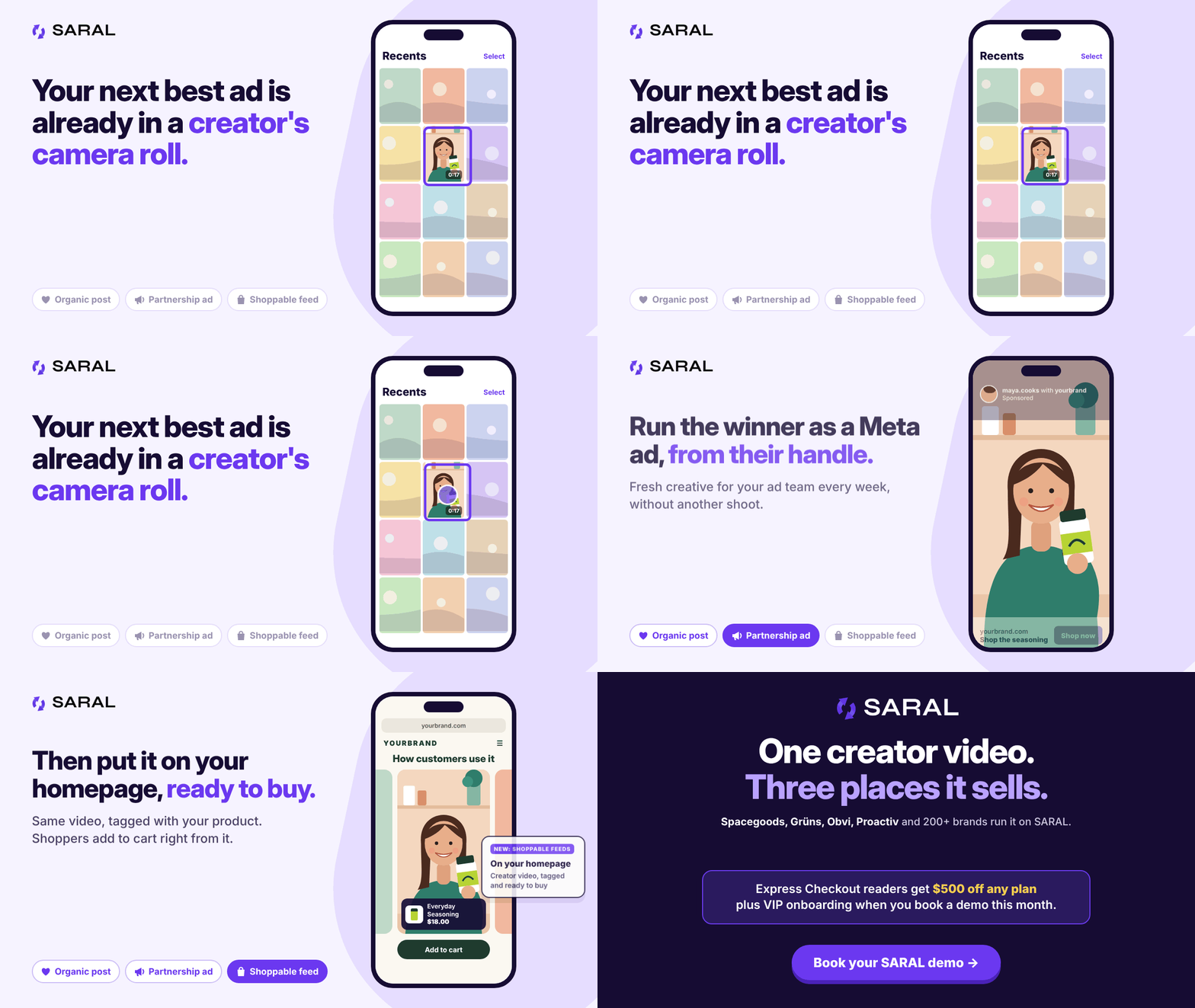
Spacegoods, Grüns, Obvi, Proactiv and 200+ other brands are using SARAL to build a sustainable + profitable growth channel with influencers.
EC readers who book a demo this month get $500 off any plan, plus VIP onboarding, migration support and ongoing strategy sessions!!
Book your personalized SARAL and get $500 OFF!
What we’ve been thinking about…
Supplements are getting weird.
Last week, we covered how jelly sticks are coming for the gummy supplement format. And this week, we saw two new supplement launches that defy standard formats:
First, Everyday Dose (a coffee brand) and Le Lick (a new electrolyte lollipop brand) launched Le Latte, a coffee-flavored electrolyte lollipop with 50mg of caffeine.
Then First Day, a gummy vitamin brand, launched its first product that isn’t a gummy: Ready to Pour Protein + Fiber + Collagen Liquid Packets (three different SKUs for Adults, Teens, and Kids—a product strategy First Day employs across all of its formats). The language around this new format is that it comes already dissolved (as opposed to a powder format), so you pour a packet into water with “no scoop and no clumps.”
In the same week, we saw a coffee-electrolyte lollipop launch and a gummy brand straying from gummies. Supplement brands everywhere are looking past the gummy, and the formats get weirder by the week.
It’s looking like gummies peaked in 2026. As we talked about this February, this was the year of the gummy supplement. We saw launches + incredible growth from brands like Lemme, Create (creatine), Plant People, Bloom, and even AG1. Then Unilever agreed to buy Grüns in April for ~$1.2B, less than three years after Grüns launched.
Since then, Grüns has made a gummy for basically every function:
It already had Grüns Kids, Nütrops (cognitive) and Immün. Then it put a whole family of gummies under its Ü Snacks banner, including Müves, a fiber gummy with 10g per serving, an Olipop flavor collab, a kids’ bundle with Once Upon a Farm.
A whooooole lot of gummy shelf space now belongs to a Unilever brand, with multiple big players following suit. When the gummy aisle is that crowded, a smaller brand can’t win just by being a gummy anymore. So brands are getting weirder:
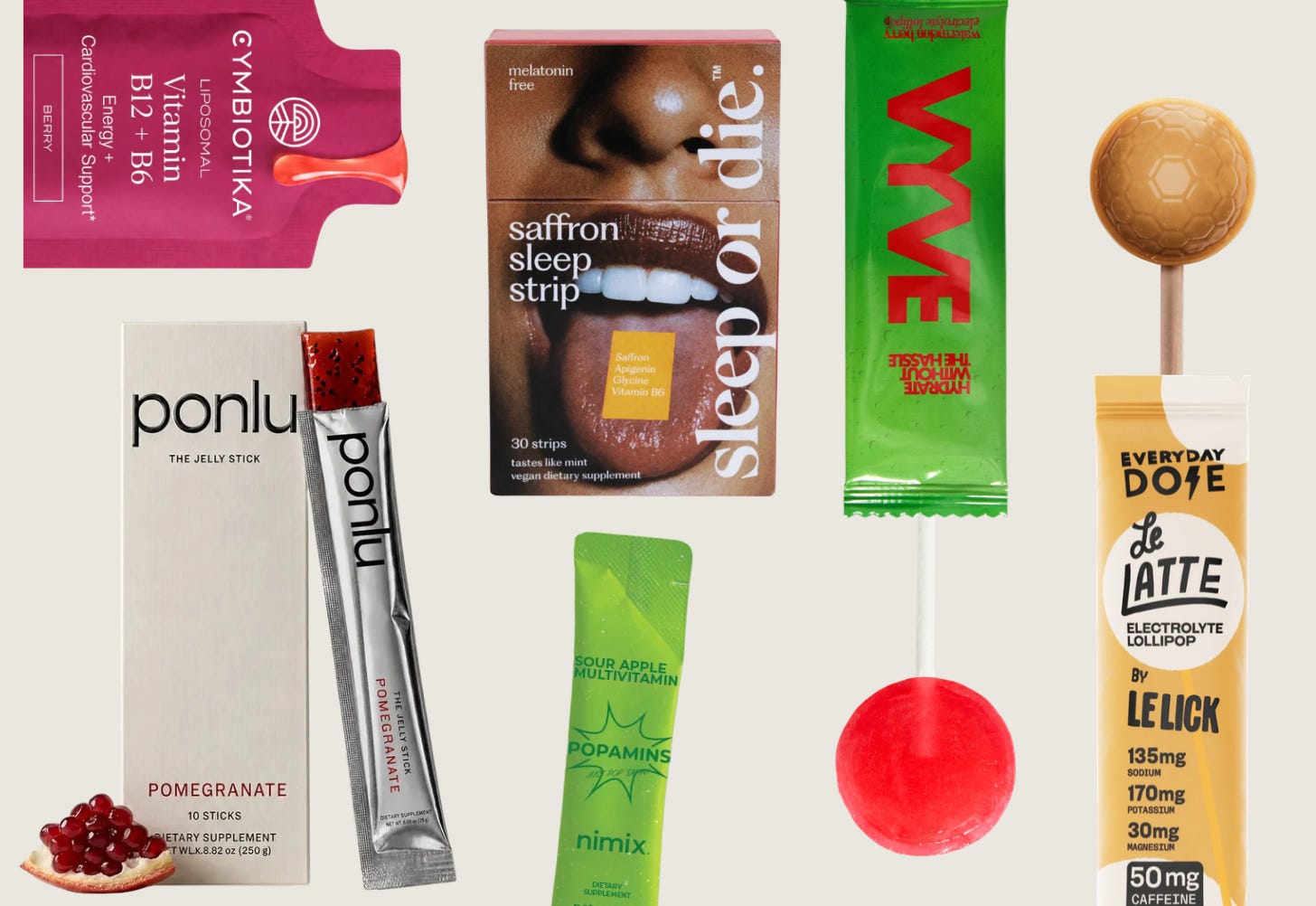
Lollipops. Le Lick (see above), plus VYVE, which similarly sells sugar-free electrolyte pops with 300mg of potassium and 190mg of sodium.
Strips. Sleep or Die went viral with dissolvable sleep strips—think Listerine strips in format, but with supplements packed in (in Sleep or Die’s case, melatonin, GABA, and L-theanine). The WSJ just covered the whole strip boom—I (Jenna) was quoted in this piece!
Jelly sticks. Goli, Physician’s Choice, Ponlu, and Mimitime in the jelly pouch format (positioned as a “beauty snack”). More on this format in last week’s send.
Liquid packs. Cymbiotika basically built this category. It has sold 200M+ “rip and sip” liquid packets and grown to $150M in revenue, according to the company, and it’s now in all 1,900+ Target stores. First Day (see above) is the newest to join with a slightly different angle: ready-to-pour into water (meaning it needs to be diluted) rather than “rip and sip.”
…Pop Rocks. Yes, really. Nimix’s Popamins are “popping multivitamins” in multiple flavors, plus a pre/probiotic and a women’s formula. Not long ago, getting adults to take a daily vitamin meant giving them a tablet… now it’s crackling candy on your tongue. We tried these, and they were SO FUN.
So, will one of these formats dethrone the gummy? Maybe not, but they may not need to. A gummy, however fun, still lives in the vitamin aisle, fighting 40 other gummies for the same shelf. A jelly stick can sit in beauty (like Mimitime, which is sold in Target’s Beauty Studio). A coffee lollipop can sit next to the coffee. A sleep strip can sit at checkout next to the breath mints.
The brands getting weird have figured out that a new format comes with a new shelf, and a new shelf means a new shopper who never walks down the supplement aisle at all.
What’s next, functional cotton candy?! 👀
CPG & Consumer Goods

Before you raise, read this. In Stock, Shopify's Substack newsletter, talked with creator-turned-investor-turned-founder Rachel Mansfield (investor in 25+ brands including Gruns, and now founder of Cadootz). Rachel shares her unique POV from both sides of the table… including why she turned down a multimillion-dollar offer this spring. If you like Express Checkout, In Stock is the natural next read. Subscribe here for real stories from the front lines of entrepreneurship.*
AG1 adds caffeine. AG1 just launched AG1 Energy+, its original greens formula plus 100mg of plant-based caffeine and 100mg of L-theanine, sold in travel packs in a Mango Sunrise flavor and championed by F1 champ Lewis Hamilton, who is now AG1’s Global Ambassador.
AG1 seems to be having an identity crisis. The brand spent most of its life saying no to everything and sticking to just one SKU on one channel (DTC for 15 years), taking it to $600M in revenue.
In the last 18 months, though, AG1 has been launching new products across new channels seemingly every quarter. It added AGZ (sleep), AG1 Pro (creatine), Essentials Gummies (for the plebs), and now Energy+. The brand has also gone from zero physical stores to Target, Ulta, Costco, The Vitamin Shoppe, and now, Walmart, Kroger, Harris Teeter, and Wegmans.
Energy+ makes AG1 look more like Bloom, which already sells a greens powder, energy drinks, and caffeinated stick packs with L-theanine.
From broth to bag. Fond Regenerative, the San Antonio bone broth brand sold in 4,000+ stores, is rolling out grass-fed beef tallow potato chips to 200 H-E-B stores this month. The idea reportedly came from a chip manufacturer that wanted access to Fond’s regenerative tallow supply.
Fond started as a bone broth brand and has since added demi glazes and cooking fats, all sourced from American regenerative farms with no additives or seed oils. It’s now in 4,000+ stores, including Whole Foods, Sprouts, and Wegmans, and says it’s growing 48% year over year.
The tallow chip aisle is getting crowded, fast. Just look at Ancient Crunch, the company behind tallow chips Masa and Vandy: the company now sells its tallow chips at Target and Whole Foods (totaling 3,000+ stores nationwide) and last year, Masa was the fastest-selling chips brand at Sprouts. Other emerging brands like Vaca Chips and Beefy’s Own have gotten in on the category. Even the big guys are launching tallow chips: this May, Utz Brands launched Boulder Canyon chips cooked in beef tallow.
The real advantage is having the tallow… because making the chip is the easy part. Masa spent over $3 million on beef tallow in 2025, and this year, the company expects to purchase nearly $4 million worth of tallow. Modern Retail reports that while tallow demand is boosting sales for brands like Masa, it’s also placing pressure on their margins. Fond already sources the fat for its own products, so it’s entering the category with the hardest piece in place. That’s why the manufacturer called them.
According to SPINS, US sales of products containing beef tallow reached around $1.1bn in the year to March 2026, up roughly 275% over three years (and that’s on the power of MAHA messaging). More brands plus a limited supply means tallow will keep getting more expensive… just look at the whey situation. The brands that control their own supply have a serious upside!!
Southern Living is spilling the tea. The 60-year-old magazine is getting into CPG with the most on-brand bev imaginable: canned sweet tea, called Sweet Talk. This brand was developed in the Southern Living Test Kitchens, and will hit shelves in Alabama and Florida in the spring.
This is parent company People Inc.’s first CPG brand that it owns and produces itself—a new rev source as AI changes how much traffic these traditional pubs are getting from web. They also hired a bev industry vet to run the brand, which shows that they’re taking this seriously (not treating it as a licensing deal).
Not to get too meta about it, but media brands make sense in CPG—they’ve built the trust and audience already. We’ll be curious to see if other media brands (like Good Housekeeping, another People Inc brand) will get in on the CPG game.
Keeping up with the stick packs. UPDATE, the caffeine-free energy brand Kim Kardashian co-founded, just launched its first Stick Packs. Each has 300mg of paraxanthine plus Alpha-GPC, L-theanine and B12, with zero sugar and five calories.
Quick refresher: paraxanthine is a caffeine metabolite, AKA the main compound your body turns caffeine into. UPDATE’s pitch is that skipping straight to it gets you the energy without the jitters—something that we’ve experienced firsthand. We had CEO Daniel Solomons on the pod in April to talk through the science, plus how Kim found the brand on her own before becoming a co-founder.
We’re seeing a lot of RTD brands launch a stick pack sidekick: Bloom, Celsius, even Jetty. The consumer-facing pitch is that it’s more portable and allows for customized potency, but this format is helpful from a brand POV too; it significantly cuts shipping weight and packaging (and therefore costs).
More tiny cocktails! Misunderstood Brands, the New Jersey company behind Misunderstood Whiskey and oat milk cream liqueur OATRAGEOUS, launched four 100mL canned cocktails, including two Old Fashioneds, a dairy-free Espresso Martini, and a dairy-free Piña Colada. They’re rolling out alongside expanded Wegmans distribution on the East Coast.
The move comes as RTD cocktails continue to grow, even as the broader category is starting to cool down. RTD cocktail volumes in the US rose 17% in 2025, and the broader cocktail and long drinks segment is projected to grow 9% annually through 2030.
Co-founder JD Recobs told Express Checkout that cocktails are already a popular way to enjoy the company’s spirits, so the cans felt like a natural next step for them. At $4.99, they’re also a lower-commitment way to try out the brands. “The biggest thing for us is finding more ways to get our products into people’s hands, whether that’s a full bottle, a mini, or a ready-to-drink cocktail,” he said. Walmart recently approved the 50mL OATRAGEOUS Espresso for checkout counters in Florida, alongside the 750mL bottle.
Finally, a drink that does nothing. Pulped, a new sparkling juice brand from Swedish chef Robert Sandberg, launched nationwide on Amazon in three flavors. The brand is calling itself “a flavor-first rebellion against functional drinks,” and that’s really it. Each can is 50% squeezed fruit juice with botanicals and a pinch of sea salt, and there’s no added sugar, stevia, or artificial sweeteners.
The brand has a pretty stacked team right out the gate. Sandberg’s co-founders are Jennifer Sunnfors, the former CMO of Mela Water (acquired by KJ Holding Corp. in 2025) and was an early team member at Barebells and NOCCO. The real question here is whether or not this positioning of a “functionless” drink is something that they stick with moving forward for the broader marketing angles that they take. From a launch strategy and from marketing to the industry perspective, it’s not a bad angle to take. It will stand out and make people comment on the brand. However, we’re not sure if the consumer will really take to that kind of claim or not.
Good news for sensitive stomachs. The FDA confirmed it won’t take any enforcement action against “low-FODMAP” labels, after the broth and seasoning brand Gourmend Foods sued the agency on First Amendment Grounds.
FODMAP is an acronym that stands for Fermentable Oligosaccharides, Disaccharides, Monosaccharides, and And Polyols. Translation: FODMAPs are fermentable carbs found in foods such as onions, garlic, and dairy, and they can set off symptoms for people with IBS (up to 45 million Americans, according to the IFGD). Until now, brands making foods for those shoppers risked getting in trouble by the FDA for making said claims.
I (Jenna) have been “prescribed” a low-FODMAP diet before, and it was challenging to navigate the grocery store with this assignment. Now, a brand like Fody Foods, which is a platform brand built on low-FODMAP pantry staples, can accurately communicate its use case without relying on hard-to-decipher claims like “Sensitive Recipe” or “Sensitive Pasta Sauce” (admittedly, I will miss the meme-ability of relating emotionally to a pasta sauce).
A new sunscreen on the market. La Roche-Posay just rolled out a new sunscreen, the first-of-its-kind in the US, featuring bemotrizinol (BEMT), the first new sunscreen filter approved by the FDA in 25 years!!
It isn’t the first to get into the BEMT space. Australian suncare brand Ultra Violette was first to bring this ingredient to the US, and Netrogena recently launched its own version.
BEMT is a super exciting ingredient because it lets US brands make the light, no-white-cast SPF that consumers have been seeking from other countries (namely France and Korea). In general, suncare popularity is up (thank goodness) and is mostly led by brands that treat the category like skincare, not sunscreen (per Spate’s suncare report).
Grandma’s porridge is fibermaxxing. Just like every other strategic brand launhing a fiber-packed version of its OG brands, B&G Foods is launching a fiber-packed Cream of Wheat in 2027, part of the company’s plan to put its resources behind “higher impact” brands. The 133-year-old porridge brand already sells gluten-free, protein and lower-sugar cocoa versions.
The fiber launch is really part of a bigger story about B&G cleaning house. The company used to buy brands constantly, and now, it’s selling them off: Green Giant U.S. Frozen, Le Sueur and Don Pepino are gone, the dividend got cut in half, and there’s nearly $2B in long-term debt to pay down. Cream of Wheat made the cut, so now it has to start growing… and they’re betting on fiber to do the heavy lifting.
Retail
Target is cooking! Target reported its best sales growth in more than five years, and the grocery aisles did a lot of the work! Net sales grew 7.1% to $27.1B in Q3. Food and bever1`age grew nearly 7% to $6.4B, which makes it Target’s biggest category by a mile, and beauty grew more than 9% to $3.5B. Target also raised its full-year sales outlook to around 6% growth.
Grocery is doing exactly what Target hoped it would. When I (Nate) spent the day at Target HQ in Minneapolis for its F&B Discovery Day back in July, John Conlin, Target’s SVP of Food & Beverage Merchandising, told me he wanted food to be “the trip driver” that gets people coming in more often. He also said the plan was to cut “post-peak” brands and tired line extensions to make room for emerging and founder-led ones. Four months later, about half of center store grocery has been reset, the snack, candy, and beverage aisles that changed the most are up nearly 10% since the reset, and food has shown up in 40 million more transactions this year.
This is exactly the Target is the new Whole Foods story we and so many others have been telling. And it’s why so many of the brands in this week’s issue are sitting on Target shelves.
We can’t forget about the big bets in beauty Target is making that clearly has already started to pay off. A little over a year ago, Ulta’s shop-in-shops left Target stores, and we assumed that Target would answer with affordable products, exclusives, and discovery. Instead, Target has added 90 new beauty brands this year, and launched Target Beauty Studio which is now in more than 600 stores. Management called the Beauty Studio “very early” on the earning call, yet beauty still grew more than 9% and took more market share. It’s the same playbook that’s working for them in grocery, so it’s starting to look like Target is becoming the next Ulta, too.
For the brands reading this news, it’s important to remember what investors told us in September: Getting into Target is just the beginning. Yes, Target is bringing on more newness than ever, and early numbers can be flattering, but it doesn’t mean the brands will succeed. The numbers we’re talking about here are for Target—not for the brands inside of the store. What matters, and will always matter here, is velocity and repeat purchases.
Funding, Mergers, and Acquisitions
Olives are getting their moment. Freestyle Snacks, a brand selling olives (and pickles) in grab-and-go snack packs, raised a $5M seed round led by Cutting Horse ventures. Paige DeSorbo (Giggly Squad co-host and founder of Daphne) also joined the round as her first investment into a CPG brand. The brand is also launching into 1,000 Walmart doors this month.
Freestyle has a great story. Founder Nikki Seaman started it during the pandemic when her favorite part of the grocery store, the olive bars, were shut down. Nikki told us sales have roughly doubled every year, and that “we knew what was working and wanted to pour gas on the fire, especially with major retail expansion underway.” Freestyle has a lot of headway here: apparently 82% of consumers can’t name a single olive brand, so there’s room for them to win this category.
Investing (rather than starting a brand or joining C-suite) is really the best of both worlds for influencers or creators: let the founder who knows the category keep running the business, and let the creator bring what they’re great at, which is attention, trust, and sometimes even a reason for a buyer to take a meeting. It also helps a lot when they were a fan first, and Paige was posting about Freestyle’s olives before she’d ever met the team. We’ve seen a ton of this lately, from Jake Shane at Dolce Glow to Alix Earle at Cymbiotika to Jay Shetty at Sleep or Die, and I’d bet there will be a lot more soon.
A $350M stick-up. Sixth Street, the global investment firm, took a $350M minority steak in the the grass-fed meat stick brand Chomps. It joins Stride Consumer Partners, which first invested in 2021. Co-founder Rashid Ali will stay on as CEO, and Chomps says it will keep running as an independent company.
This is a beast of a brand. Chomps did $4M in revenue in 2016, $20M in 2018, and has reportedly passed $1B this year. It’s now in more than 65,000 retail locations, including Starbucks, Marriott, and Home Depot, and it sells around 2 million sticks a day. Plus, it isn’t only beef anymore. Chomps launched chicken sticks earlier this year, which became the No. 1 brand in their segment within 12 weeks, and a third of the people buying them had never bought Chomps before—clearly the brand has even more room to scale!
Chomps is riding a category that’s been booming. Dried meat sticks are now a nearly $6B business growing 9.5% a year, and protein-forward snacks as a whole now do more than $20B in annual sales. Those categories have driven almost 30% of all snack dollar growth over the past three years, and the big guys have noticed. PepsiCo launched its own meat stick brand, Good Warrior, earlier this year, and General Mills, Archer, and Conagra have all expanded their meat snack lines.
Shoot for the MOON, land in the denture aisle. DOC Brands, the company behind 40+-year-old dental repair brand Dentemp (temporary fillings, denture repair, mouth guards), acquired MOON Oral Beauty for an undisclosed amount. Beach House Group, an LA brand incubator, built MOON with founder Shaun Neff and launched it in 2019 alongside Kendall Jenner. MOON sells whitening products, toothpaste, brushes, floss and mouth rinse, and it’s carried at Ulta.
MOON was one of the first brands to sell toothpaste like beauty, with pastel packaging, a celebrity launch partner, and collabs like a Sprinkles Cupcakes toothbrush. Since then, oral care’s momentum has moved from beauty to wellness. As we covered in June, Boka, another “clean” toothpaste brand, hit a reported $100M+ run rate and got into all 4,500 Walmart stores with $10–12 tubes. Evenmouth and DAYLY are selling probiotics and vitamins.
Yang Gang gets spicy. Former presidential candidate (and now Noble Mobile CEO) Andrew Yang invested in SMÁLÀ, a squeezable, no-drip chili oil from YouTubers Andrew and David Fung, AKA the Fung Bros (2.2M subscribers). It’s a mix of Chinese, Italian and Hispanic flavors, made in the USA, and about $8.99 in the hot sauce aisle. Three months into retail, it’s in 272 H-E-B stores across Texas, and the brand says 95.7% of those stores have reordered.
SMÁLÀ was built with Create With Cura, a Florida company pitching itself as the “Modern General Mills.” Cura partners with creators to launch and run food brands (hungryboy hot sauce, VeryLuckee, Mustard Mike’s). It’s a lot like the incubator model behind MOON, applied to the condiment aisle—the creator brings the audience, and the operator handles everything else.
Menopause gets some moolah. Stripes Beauty, the menopause-focused beauty and wellness brand founded by Naomi Watts, raised $5M from Jibe Ventures, which joins owner L Catterton who took a majority stake in 2024. The money reportedly will go toward building out its supplement business, expanding more Ulta doors, and growing its DTC presence.
High-protein pizza gets a shot. Yough!, the frozen pizza brand that makes its dough with Greek yogurt, closed a $4M seed round with Selva Ventures and Carter Comstock, a co-founder of Freshly and an Olipop investor. Each pizza has between 40 and 50 grams of protein, and the brand is in more than 2,500 stores, including Target, Sprouts, and Fresh Thyme.
Yough! says it’s on track for $16M in sales this year—not too shabby for a brand that only went nationwide at Target in March. It’s also, of course, already getting copied. Back in August we wrote about Caulipower, the OG better-for-you frozen pizza brand, launching its own Greek yogurt pie to keep up.
Buying up the whole dish. LT Foods Americas, which owns Royal (the No. 1 basmati rice brand in the U.S.), just acquired Maya Kaimal Foods, maker of the No. 1 Indian simmer sauces in the US, for a reported $5.8M. LT bought 100% of the company from PE firm North Castle Partners (in since 2019), co-founders Maya Kaimal and Guy Lawson, and early investors. Kaimal, a Saveur alum and cookbook author who started the brand in 2003, stays on as executive creative director. Royal rice plus Maya Kaimal sauce and dal adds up to a full Indian dinner from one company.
Indian food at home is clearly growing. Deep Indian Kitchen just passed $100M in annual sales and is in 26,000+ stores. Gymkhana Fine Foods, a sauce brand spun out of a two-Michelin-star London restaurant, launched nationally at Whole Foods this year.
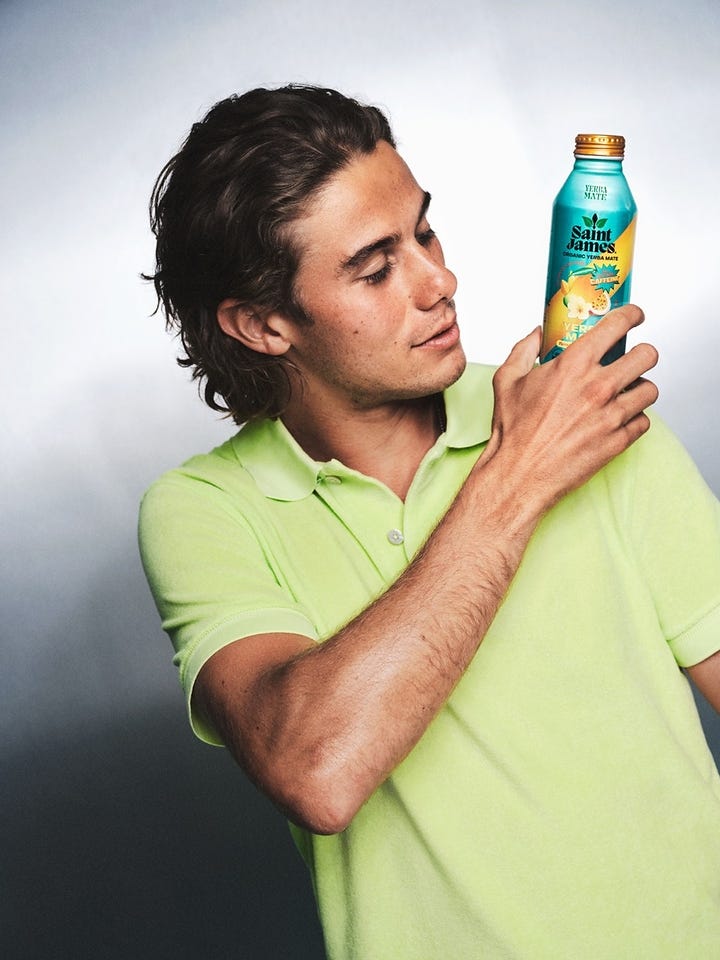
Saint James scores. NHL star Jack Hughes is now the first outside investor in Saint James Iced Tea, after starring in the brand’s yerba mate launch campaign this summer (its first line outside iced tea).
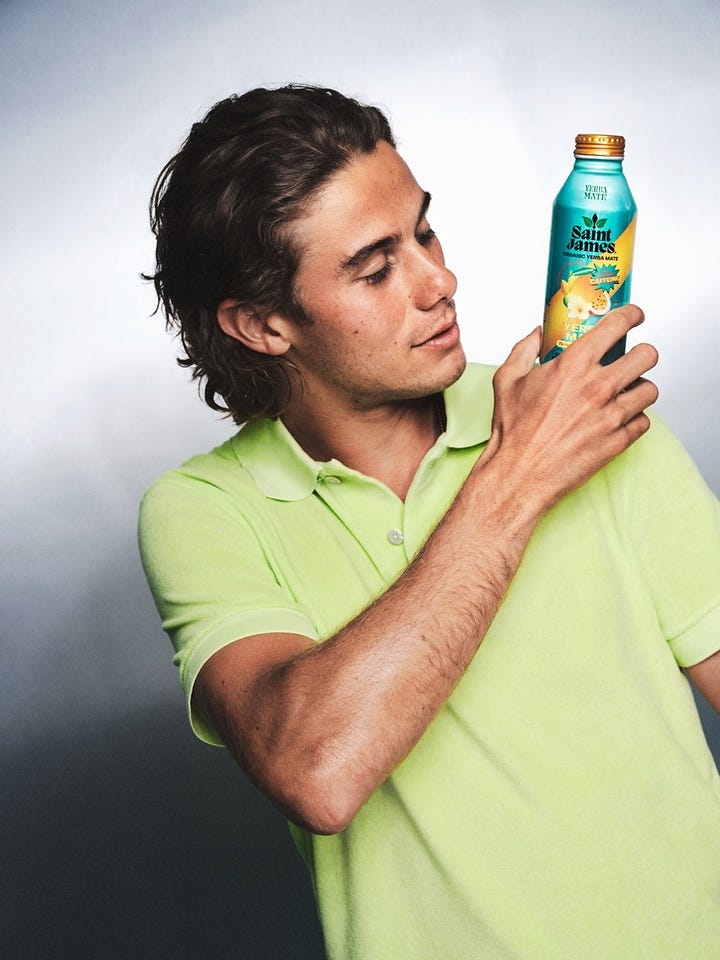
Saint James was co-founded in 2022 by John Ferolito, who co-founded AriZona Iced Tea with Don Vultaggio in 1992. The two famously fell out over whether to sell: Ferolito wanted to cash out, and he said Tata, Coca-Cola and Nestlé had all made offers. Vultaggio wanted to keep AriZona private (and keep the 99-cent can). After years in court, Vultaggio won the right to buy Ferolito out. So it’s pretty funny that the guy who spent a decade trying to sell AriZona now has a brand that has grown without any outside investors—until now, anyway. And even then, the first check comes from a hockey player who’s a real fan, not a PE firm.
Per the brand, Saint James grew 164% YoY in September and is now in 25,000+ doors across the U.S. and Canada, including its first nationwide Costco program and all 120 Just Salad locations.
If you haven’t yet, please subscribe, like, leave a comment, and share! It helps us continue to bring you the most interesting news + nuance in consumer and retail every week.
Wow, its getting weird