



Hello hello!
We’re coping with some serious residual FOMO, because Wayflyer’s inaugural Visionaries Summit in London was a huge success (listen to the panels featuring the UK’s best brand founders here).
It spanned across 3 days, 9 panels, 30+ founders of brands including Trip, Suri, and Candy Kittens, 500+ guests—exploring topics like how to build credibility in a crowded wellness space, the art of creating a brand universe, and how to take market share from legacy brands.
Lucky for us, they’re now bringing it stateside (cue Stateside by Zara Larsson) the last week of August, and—trust us—you will NOT want to miss this one!!
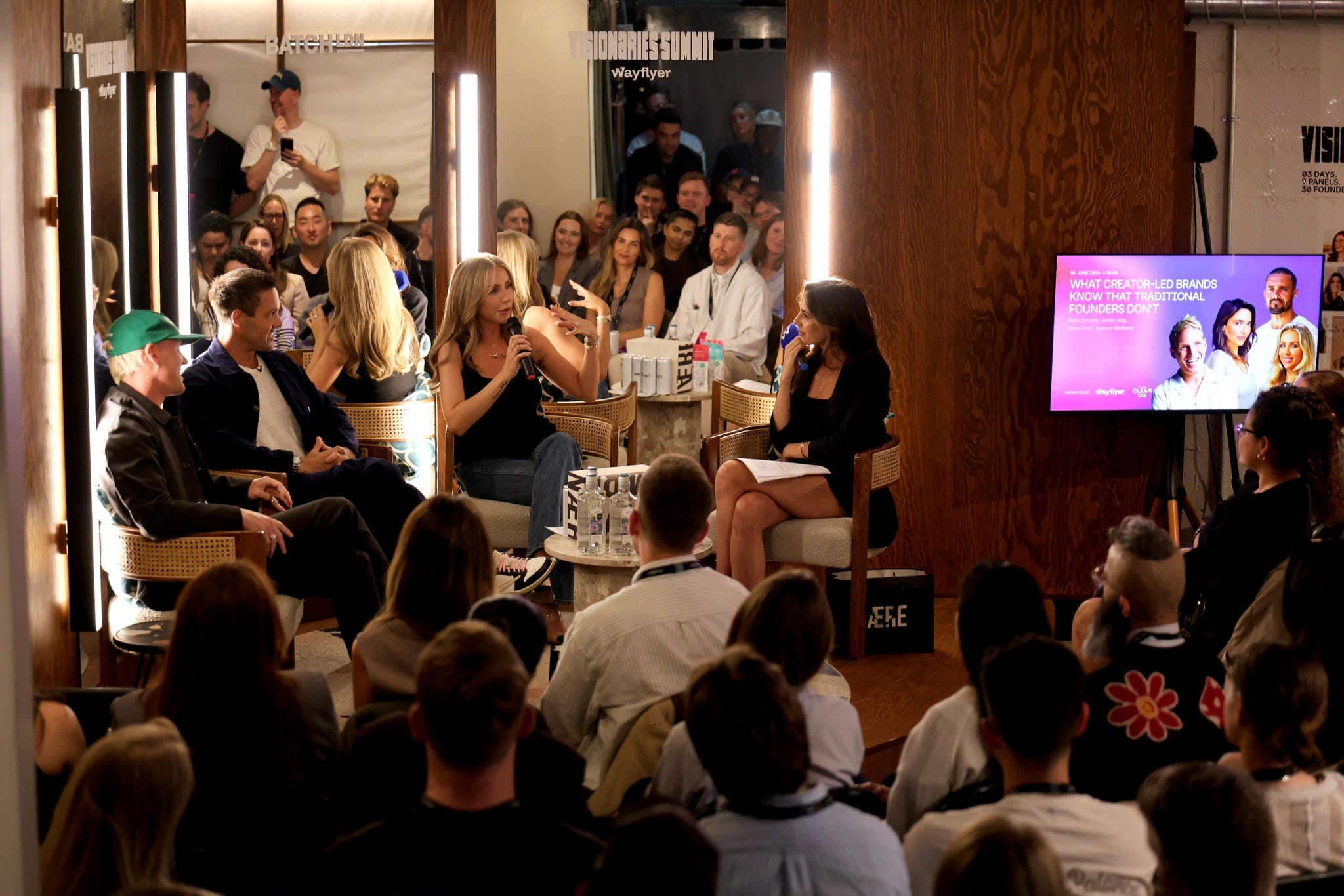
Want to participate? They’re collecting requests for panel speakers in LI post comments and IG post comments!
News of the Week
Elementary schoolers are about to have entirely new goods to barter at recess… because the new lunchbox is officially here!


In the past week alone, we saw two launches specifically targeting the school-age childhood demographic:
Beech-Nut Nutrition Company, owned by Swiss company Hero Group, just launched its Goodies line in the US—clean-label snacks (bars, poppable bites, potato sticks, etc)—for kids four-and-up, now at Walmart and Kroger. Hero already sells Goodies across nine other markets; this is the brand finally betting on the American lunchbox.
And the founding duo behind Yasso launched a new functional snack brand: Snack Buddies—mini muffins with 5g protein and 4–5g fiber, essentially a better-for-you Little Bites.
We’re watching a complete overhaul of what’s actually going into kids’ lunchboxes. Dyes, high-fructose corn syrup, gluten? We don’t know them. Today’s lunchbox is the cleanest it has ever been—and it’s only going to get cleaner (and more functional, protein-ified, fiber-rich, and whatever-the-next-thing-is) from here.
For years, while better-for-you products in the baby and toddler aisle saw steady growth and innovation (organic purées! single-origin everything! entire fridges dedicated to HPP baby food!), “kids’ food” meant one of two things: an afterthought (a smaller, sadder version of an adult product) or effectively candy in a trench coat (fruit snacks that are functionally gummy bears, “juice” that’s 10% juice… you get it).
How’d we get here? The defining lunchbox food of the last 40 years was invented in the late ‘80s by an Oscar Mayer exec whose literal assignment was to find a way to move more bologna (imagine earnestly being tasked with selling more baloney…). When he needed $30M to build the assembly lines, he had to pitch the board of the company that had just bought Kraft… which was Philip Morris. Yes, the Marlboro people. The lunchbox staple a whole generation grew up on (including us) was, functionally, a scheme built and marketed by Big Tobacco.
Kids’ food was an afterthought by design.
So why is everyone suddenly racing to fix it? A couple of things clicked into place at once.
The adult better-for-you shelf is basically full. Every category has its clean-label darling, the white space is mostly gone, and the millennial parent who reorganized their own pantry around “no junk” has now turned that exact lens on their kids. Kids are the last open frontier, and the parents buying for them already shop this way for themselves.
And the place that lens lands hardest is exactly this age. The CDC’s latest numbers shows that American kids aged 1-18 get 61.9% of their daily calories from ultra-processed food (UPF)—more than adults (53%), and peaking at a rough 64.8% for ages 6–11, which is exactly the lunchbox demographic.
There’s a regulatory tailwind, too. The clean-label, no-synthetic-dye positioning that every one of these brands leads with maps onto the current policy mood around kids and UPF—which is exactly why “no dyes, no seed oils, no high-fructose corn syrup” has become the front-of-pack table stakes rather than the differentiator.
But the reality is, processed food isn’t going anywhere—convenience is non-negotiable for most busy parents. So the play was never “no package,” it’s “better package”: if the kid is going to get the majority of their calories from something wrapped, make the wrapped thing as good as it feasibly can be.
Will parents actually pay for all this? The toddler aisle already answered that. In February, Jennifer Garner’s Once Upon a Farm IPO’d on the NYSE, raising ~$200M and popping 17% on day one to an ~$847M valuation. Little Spoon crossed $150M in net revenue and ran the biggest food launch in Target’s history.
The parent who happily spent $7 a pouch on organic purées does not suddenly stop caring on the kid’s fourth birthday—if anything, it’s a values decision that compounds, right up until the kid starts packing their own lunch.
So what’s actually in the new lunchbox?
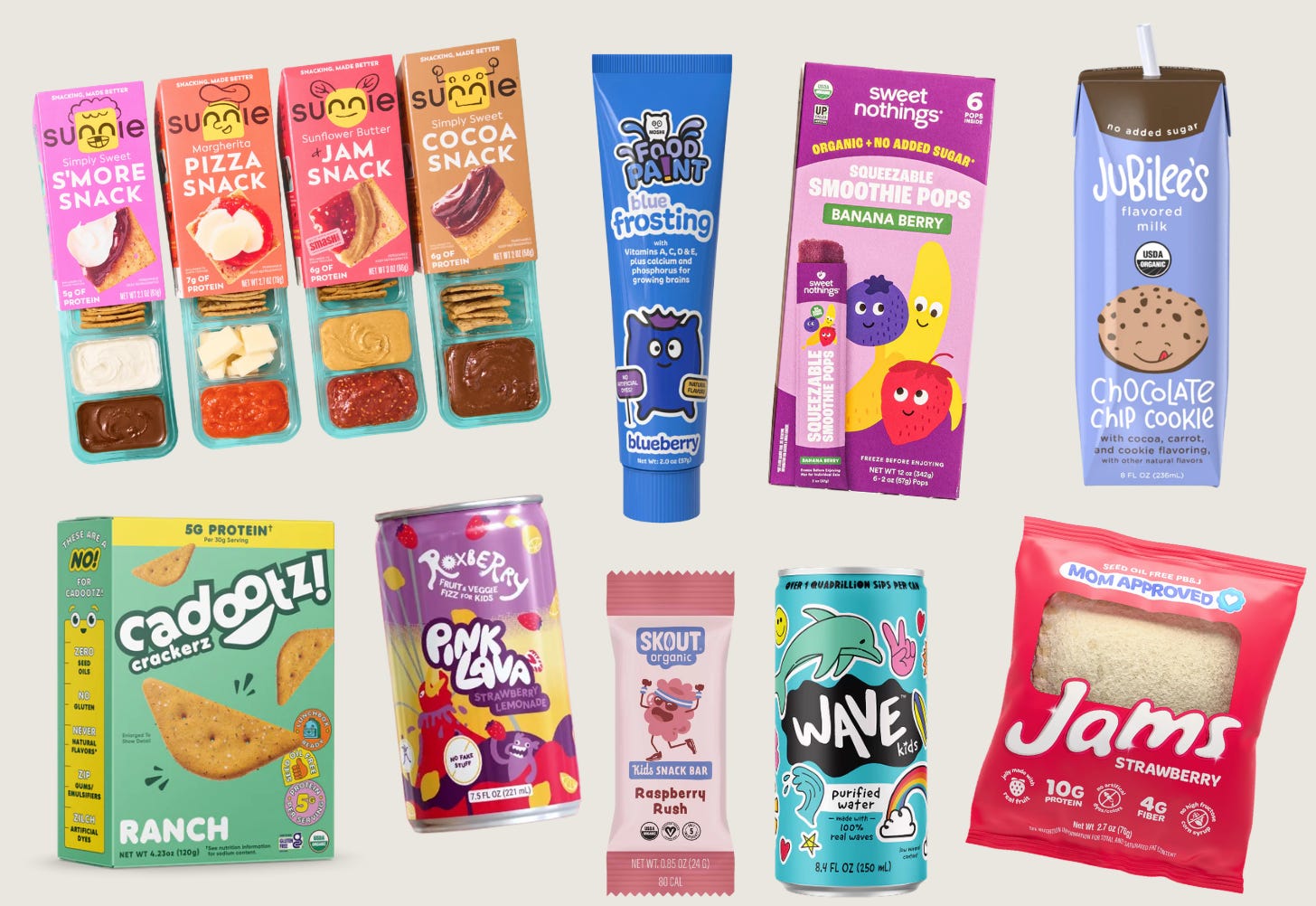
The main event (the Lunchables slot): Sunnie, refrigerated snack-pack “dippers” made to be a balanced mini-meal, free of seed oils, refined sugar, and gluten, now in ~500 Target stores. A serious upgrade from baloney’s dark past.
OR the PB&J: JAMS, DropOut Companies’ cleaner Uncrustables—10g protein, no seed oils (side note: DropOut just brought on Andrew Strife, the co-founder and CFO of LesserEvil, as CEO).
The snack stack (a crowded slot, which tells you something): Happy Wolf‘s nut-free, fridge-fresh bars made from ingredients you’d recognize in your own kitchen; Skout Organic‘s shelf-stable, school-safe bars with seven-or-fewer organic ingredients; Cadootz‘s 5g-protein whole-food crackers; and Yumi, the toddler-snack brand parents admit to eating themselves.
The drink (heating up fastest): Jubilee’s shelf-stable whole-milk boxes with hidden veggies and no added sugar, plus NoBiggie, Wave Kids, and Roxberry racing to own the sparkling/functional kids drink—a slot that barely existed before Poppi made “better soda” aspirational for the under-12 set.
The treat: Sweet Nothings‘ spoonable, no-added-sugar smoothie; the Yasso founders’ Snack Buddies; and Gruns‘ kids gummy vitamins replace the traditional fruit snacks (functional or bust).
The fun: Noshi—”food paint,” naturally colored fortified frosting, showing how the category has moved past pure nutrition and into experience.
Where does this go next? Every nostalgic kid SKU gets its clean remake—Lunchables → Sunnie, Uncrustables → JAMS, soda → NoBiggie… you get the gist.
The functional arms race follows the adult playbook down on a lag (protein and fiber now, gut health next). And next, the incumbents will stop building and start buying—Once Upon a Farm’s IPO and Beech-Nut’s Goodies move both signal that the next wave likely exits to a strategic rather than scaling alone.
For 40 years, kids’ food was the afterthought. Now, the same parents who fixed their own pantries are looking to reflect their values in their kids’ meals. The lunchbox was always ripe for disruption—now, it’s finally happening.
CPG & Consumer Goods
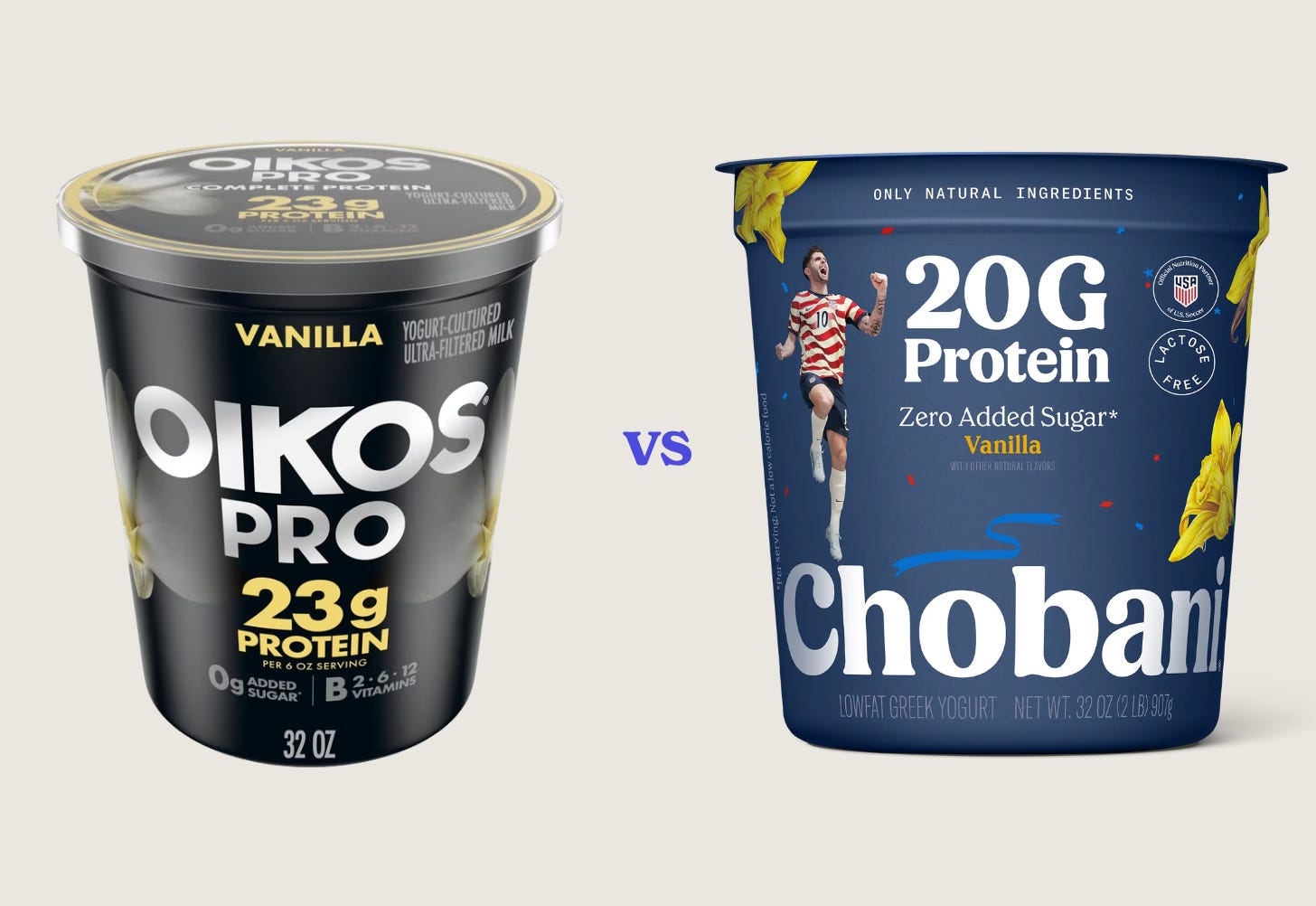
The yogurt wars rage on. Danone has sued Chobani, alleging it uses a 6.7-ounce serving size—vs. the 5.3-ounce industry standard—to claim 20g of protein per serving on its 32-ounce tubs, when FDA rules would put that figure at 18g.
This is not the first time that Danone has sued Chobani… there have been lawsuits between the two brands for over a decade now. Back in 2016, Danone convinced a court to get Chobani to take down ads that implied Danone’s Light and Fit contained chlorine. In 2019, Danone failed to sue Chobani over claims its yogurt had 33% less sugar than Dannon’s Danimals line. Then in 2025, Danone filed a trademark infringement lawsuit in New York against Chobani over its La Colombe cold brew coffee line. Someone give these poor yogurt lawyers a BREAK!
Regardless of the outcome, Danone is clearly feeling the pressure from Chobani’s massive success. Chobani is well positioned to be the next century spanning brand. Over the past 20 years, it has evolved from scrappy startup operating out of a shuttered Kraft Foods yogurt plant to controlling 26% of the overall U.S. yogurt market and is valued at nearly $20 Billion. They single-handily drove interest in greek yogurt from less than 1% of the US yogurt market to over 50% of the entire market in 10 years.
Highly recommend reading our deep dive on why we think Chobani is the next 100 year brand!
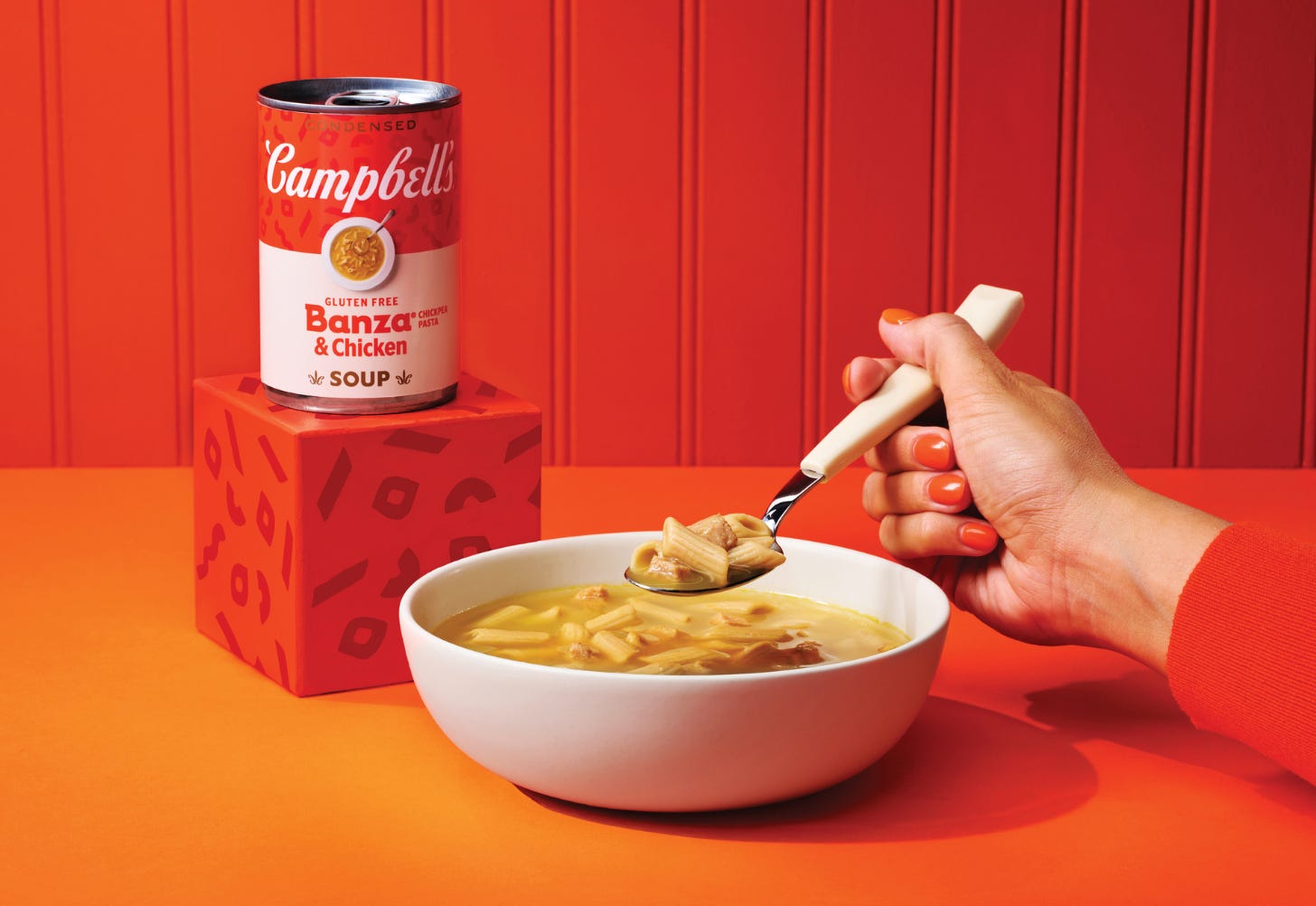
We just love this collab!! For the first time in 150 years Campbell’s is launching a gluten-free canned chicken noodle soup using Banza chickpea pasta. This is their 3rd gluten-free soup they’ve made since launching the line in 2023.
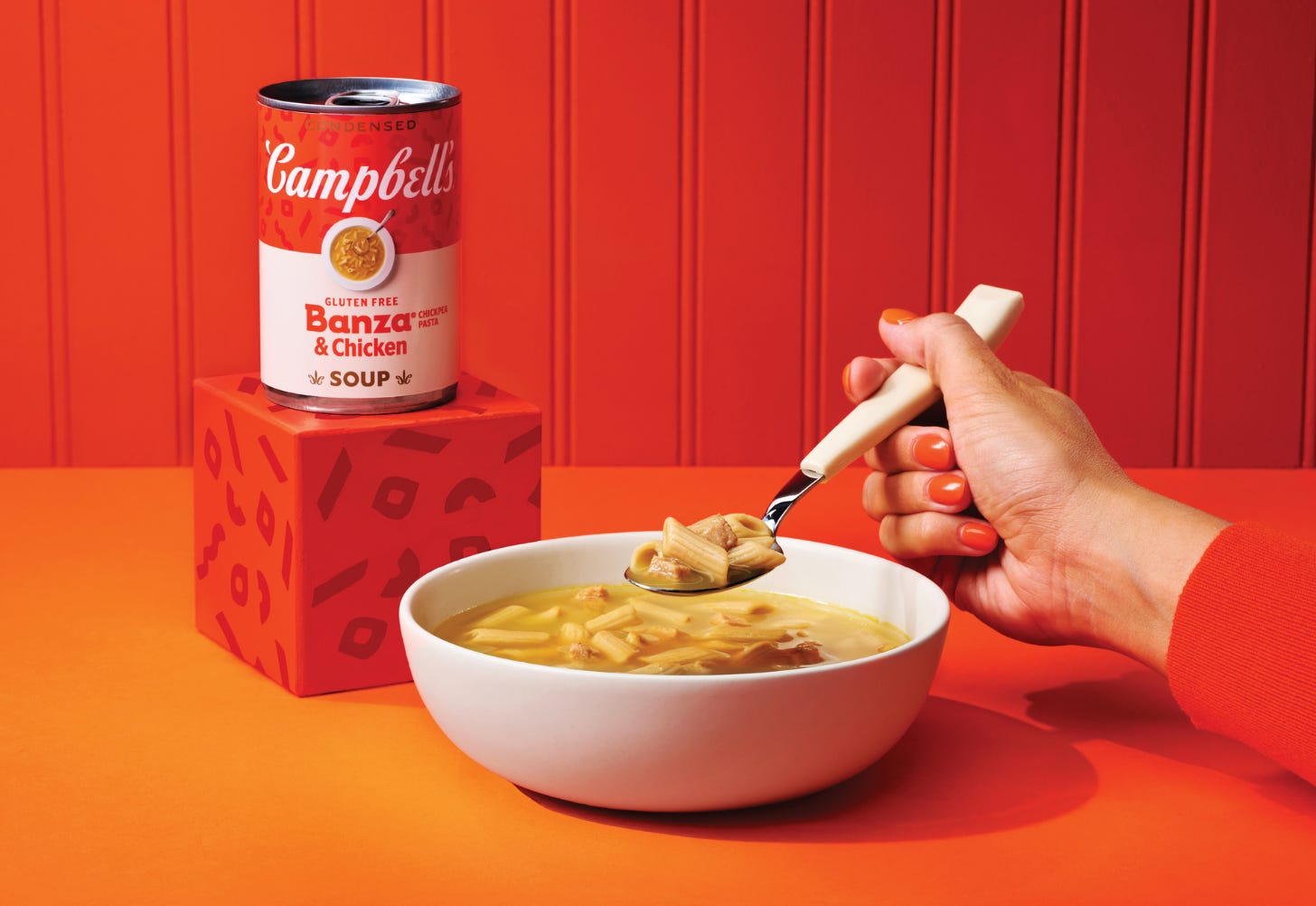
According to data cites by Campbell’s, about 30% of the US population is actively seeking out gluten free options and the market is projected to grow nearly 10% annually over the next decade. That’s a good amount of people wanting good GF options to add to their cart.
Sure, it makes sense for a growing number of gluten-free consumers. But this collab represents something much larger: When a legacy brand—with significant visibility, accessibility and distribution—collaborates with an emerging brand—with built-in consumer trust and a better-for-you halo—both benefit immensely. A consumer who may have moved away from the Campbell’s brand in an effort to clean up their cart could be swayed to return, while a consumer who couldn’t justify Banza’s premium prices can now trial the brand in an accessible format.
As Banza’s co-founder, Brian Rudolph, told us:
“Campbell’s came to us with the idea, and recognizing how iconic the product is, we jumped at it. Our goal is to make chickpea pasta as common as traditional pasta, and there’s no better way to signal it’s here for the long term than teaming up with a brand that’s thrived for over 150 years.”
And (though this is entirely speculation), this could be Campbell’s testing the waters for an acquisition 👀
Gen-Z won’t be bought—they’ll be recruited.1 poppi just opened applications for its Fall 2026 College Ambassador program. In other words: a brand now big enough to buy any shelf in the country is still hand-recruiting 19-year-olds to hawk soda at their sorority formals, because campus is where consumer habits get set for the next 40 years.
But... what does it actually take to reach college students at scale? One of our favorite finds lately has been Muses, the agency running some of the most recognized campus programs out there, for brands like Lucky Energy, Blank Street, and Hop Wtr. Making Gen-Z deem something “culture-worthy” is notoriously hard. These are the people who actually know how.
Check them out if you want in with college students!! Fall recruiting season is heating up right now—the smart brands are locking in their campus play before move-in. Book a FREE consultation with Muses and walk away with a campus blueprint for your specific brand.
A great week for the Soy Boys:
Whey is expensive; soy is not. Mondelēz International announced Alpine Bio in its 2026 CoLab Tech accelerator to co-develop high-protein snacks using the startup’s fractionated soy protein isolate—a whey substitute as whey protein concentrate prices have surged over two years.
Alpine Bio’s OG moonshot product is molecular farming (genetically engineered soybeans to grow casein, which I mentioned here). But Mondelēz is not working with the genetically engineered casein. Instead, they’re working with FSPI (fractionated soy protein isolate), a separate product made from non-GMO soybean flour—a neutral-tasting, highly soluble complete protein designed to “do whey’s job.”
The rest of the 2026 cohort (precision-fermented fat maker Nourish Ingredients, GLP-1 prebiotic fiber startup Arkasa, clean-label emulsifier firm Ruby Bio) shows Mondelēz casting a wide net across ingredient resilience, not committing to soy.
And the most well known soy milk brand, Silk, is launching a plant-based protein yogurt and its first shelf-stable RTD protein shake across US retail this summer. The yogurt delivers 13g of complete soy protein per serving (a new target for Danone’s legal endeavors? 🙃), 2x twice the category average, while each shake bottle packs 30g.
Good Culture fans, rejoice! Fewer out-of-stocks might be coming for the famous cottage cheese brand. Michigan Milk Producers Association announced a partnership with Good Culture to produce cottage cheese at MMPA’s newly opened Remus, Michigan facility (acquired last year), expanding the co-op’s processing capabilities and helping Good Culture scale supply and reach more shelves nationwide.
The sunscreen aisle might look different soon. For the first time in more than 20 years, the FDA cleared an ingredient for use in U.S. sunscreens. Bemotrizinol—a UVA/UVB filter commonly used in Europe—can now be used at up to 6% after DSM Nutritional Products petitioned the agency.
We asked Emily Doyle, DUNE Suncare’s Co-Founder and CEO, for her insights on this suncare milestone:
“It’s a genuinely exciting moment for the industry. Bemotrizinol has been a trusted UV filter in Europe, Japan, South Korea, and Australia for years—formulators in those markets have had access to more advanced sunscreen technology than what’s been available in the U.S. for a long time. The approval of bemotrizinol matters not just as an ingredient, but as a signal. It suggests the U.S. regulatory environment is beginning to evolve in a way that can support real innovation in sun protection.”
“The opportunity gives indie brands access to a UV filter that global formulators have trusted for years, and it opens the door to new textures, protection profiles, and formats that simply weren’t always available or easy to achieve with the existing (and relatively limited) U.S. filters. For brands like DUNE, it’s a chance to build on an already strong foundation rather than solve a performance gap. The challenge is that novelty isn’t a strategy. Incorporating a new sunscreen active requires significant investment in formulation, testing, and validation. The harder question is whether bemotrizinol genuinely elevates a product or whether a brand is reformulating just to capitalize on the moment. For smaller indie brands especially, those resources are finite—so the bar for ‘why this, why now’ needs to be high.”
At the same time, sun care is getting a tech upgrade. The90 just launched the Gem, a $299 wearable that tracks UVA and UVB exposure in real time via a photodiode sensor, marketed to women as a skin-care device. The startup raised ~$3 million led by influencer Lauryn Bosstick, with Ulta Beauty and Sephora as eventual retail targets.
Nestlé USA officially goes fully dye-free. Nestlé USA announced the removal of all certified artificial colors from its U.S. portfolio, fulfilling a mid-2026 pledge made under pressure from the White House and RFK Jr. General Mills, Kraft Heinz, and Campbell’s have made similar commitments.
In June 2025, Nestle announced that >90% of its US portfolio was already dye-free, but decided to fully commit to the bit by mid-2026—following similar moves from Kraft Heinz and The Campbell’s Company, as well as retailers like Target.
K-food’s seaweed supply chain gets future-proofed. CJ Foods announced plans to build a land-based gim (a roasted seaweed) cultivation facility in South Korea, opening in 2027, as rising ocean temperatures threaten supply. Bibigo posted 1,100% retail sales growth from 2020 to 2024.
Korean beauty walked so Korean food could run. K-beauty exports grew from $7.57B in 2020 to $10.23B in 2024, carried by the same Hallyu engine—K-pop, K-dramas, the TikTok algorithm—that’s now moving Korean pantry staples into mainstream carts. K-food exports hit a record $13.62B in 2025, with instant ramyeon becoming the first single category to clear $1.5B (up nearly 22% year-over-year). Food is running beauty’s playbook a few years behind.
Clearly, CJ Foods is betting that this is more than a fad. Climate-proofing a supply chain is a serious business, and happens only when a category has become mainstay.
Michelob Ultra is carrying the whole bar tab. Anheuser-Busch announced a $20M investment in its St. Louis brewery and a Missouri can plant to scale up Michelob Ultra production, now the top-selling U.S. beer by volume, as part of a broader $600M manufacturing commitment.
Bud Light long held the crown as America’s top-selling beer, but following conservative boycotts in 2023, sales slipped. Modelo Especial stepped into the vacancy, overtaking Bud Light in off-premise dollar sales that June. Modelo’s dominance has since cooled, partly because of the Trump administration’s immigration policies dampening enthusiasm for Mexican imports. Beer is political, and there’s no denying it.
Michelob Ultra’s ascent can’t be separated from its relentless sports sponsorship strategy—the NBA’s first-ever global beer sponsor, official beer of the FIFA World Cup 2026, and a 30-plus-year partnership with the PGA Tour.
Interestingly, some of this may be fueled by the NA boom: Just one year after launching in January 2025, Michelob Ultra Zero became the #1 top-selling and fastest-growing non-alcoholic beer in America, overtaking Heineken 0.0. Circana named it the #1 innovation across the entire U.S. beer industry for the year. Michelob Ultra Zero accounted for 54% of all NA beer category growth year-to-date.
Eat mor chikin. Archer Meat Snacks is launching its first-ever chicken product—Oven-Roasted Chicken Mini Sticks—at Target this month, as the brand bets a new protein will fuel growth in the booming meat snacks category.
In March, Chomps made the same move—debuting its chicken sticks after 10 years of development. We had Stacey Hartnett, SVP of Marketing at Chomps, on The Curious Consumer podcast to tell us more about the decision to go all-in on chicken—listen here!
We’ve covered the massive meat stick boom before. It only makes sense that as these on-the-go protein snacks boom in popularity, consumers will look for an alternative (and leaner) protein source. When all meat stick companies seem to be copy-pasting formats, flavors, and protein sources from each other, it’ll be interesting to see who comes out on top.
Retail
Everything is a retailer now. Faire is opening its wholesale marketplace to hotels, offices, and non-retail businesses, a pivot from pure resale that follows a pilot with ~5,000 buyers. Brands like Simply Gum are already using it for hotel mini bars and client gifting.
As Jen Burke, Faire’s CRO, shared with us on The Curious Consumer, everything is becoming a retailer now. Faire built its business on independent retailers, but that pool is finite, and you can only grow GMV so far by signing more of the same buyer. Hotels, offices, gyms, and salons already purchase product in volume—they were just never counted as “retail.” Running a ~5,000-buyer pilot before opening the gates signals this is a deliberate land grab for an entirely new buyer base, not a one-off experiment.
The deeper shift is that commerce infrastructure has been commoditized. Shopify made anyone a store, retail media turned every retailer into a media company, and Faire is now making every business a buyer. “Retailer” was never a fixed identity—it was whoever owned the customer relationship and the rails to transact, and now everyone has the rails. For brands, that translates to demand without the usual cost of chasing it: a major tech office stocking protein bars in its kitchen is a recurring, higher-margin reorder and a discovery moment in a setting the brand could never buy its way into.
K-Beauty boom continues. Olive Young, the world’s largest K-beauty retailer, just opened its second U.S. store location at Westfield Century City, following its first Los Angeles opening in May 2026.
Funding
Hot dogs…for golfers? Gleezy Dog, the self-proclaimed premium hot dog company by golfers for golfers (there really is a niche for everything…), raised a $2 million seed round led by The Club by Old Tom Capital. The North Carolina–based brand has sold over 1.5M hot dogs to date (cannot validate how much or how little was consumed by Joey Chestnut).
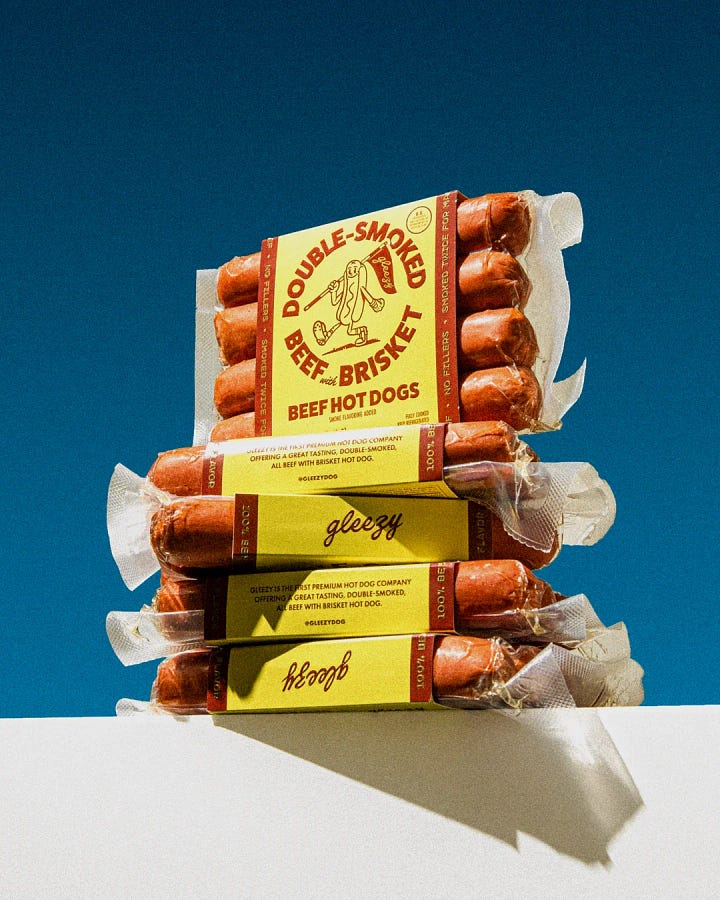
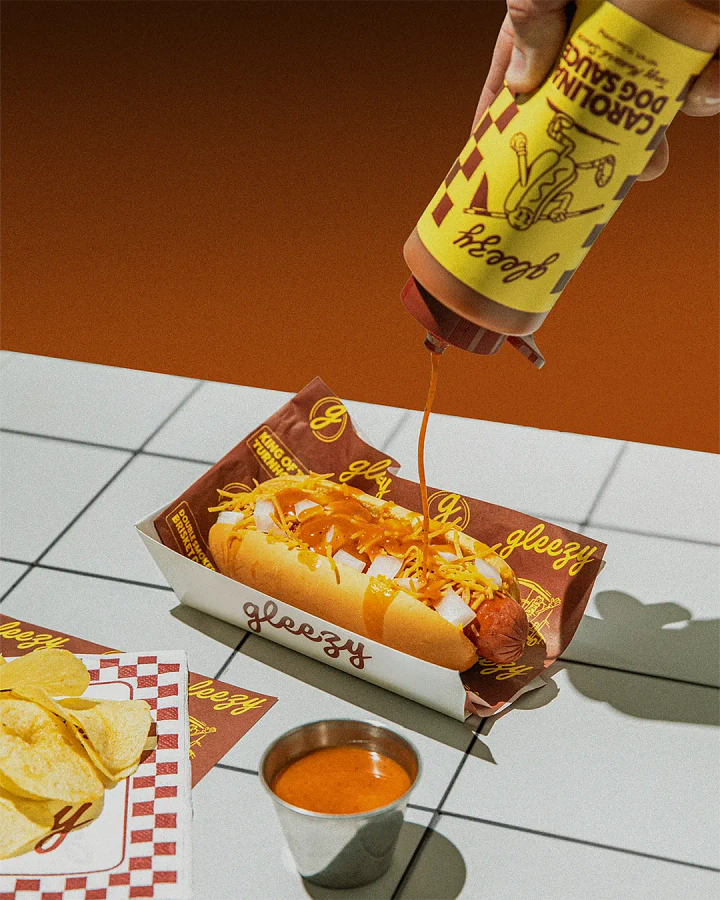
Source: Gleezy Dog The branded meat space is ripe for disruption, and bets are starting to be placed. Earlier this month, The Sausage Project hit Walmart as part of an expansion to roughly 3,266 stores nationwide. The DFG Ventures–backed chicken sausage brand (from the team behind goop kitchen and Cravings by Chrissy Teigen) went from about 280 doors to more than 3,000 in just over a year—a sign there’s real appetite for fresh takes on the refrigerated meat aisle.
In January, ButcherBox made its first big retail move, rolling fresh, 100% grass-fed beef into more than 1,400 Target stores—stepping off its DTC subscription roots and onto the retail shelf.
And in April, Lottie’s Meats brought its sister-founded pork sausage line to Target across Northern California, Washington, and Oregon—its biggest retail expansion yet, on top of 300-plus existing doors.
So, why now? It’s the same force reshaping every other aisle: consumers want upgrades to the products they already love—real food, sourced better, and with bigger flavor. ButcherBox’s Target launch was explicitly tied to the retailer’s health-and-wellness push, and all three brands adopted the same playbook as the rest of packaged food—free from additives, preservatives, and anything artificial, plus cleaner sourcing and better branding.
Smoking hot fundraise. Algae Cooking Club raised $11.6M to scale its fermentation-derived algae-based cooking oil, which boasts a 535°F smoke point and an omega-9 fatty acid profile—positioning squarely at the intersection of the anti-seed-oil movement and premium kitchen staples. The new capital will be used to scale its retail footprint, having recently launched nationwide in Target.
Even if the anti-seed oil debate fades after 2027, premium cooking oils are likely here to stay. Consumer perception of cooking oil has been fundamentally reprogrammed over the last decade—from an undifferentiated pantry stable to a considered purchase, or even luxury gift (shoutout Brightland for building that frame, and Graza for democratizing it).
Zero Acre, Brightland, Graza, and Algae Cooking Club are all building thoughtfully in the non-seed-oil-oil category, but building differently. Brightland and Graza are the brand-equity plays; Zero Acre (cooking oil made by fermenting sugarcane into oil) and Algae Cooking Club are the IP/technology plays. Those are two different acquirer profiles—one is a Unilever or Kraft Heinz wanting a premium brand on shelf, the other is a Cargill or ADM wanting the fermentation tech.
Protein from thin air. Solar Foods raised €77.8 million ($89.2M) in grants and loans for Factory 02, its first commercial-scale plant for Solein—a protein grown by feeding microbes hydrogen, CO2, and nitrogen instead of sugar, so the raw inputs are essentially air, water, and electricity rather than farmland or livestock.
The CEO is openly pitching Solein as a whey hedge (sensing a theme, here?): stable supply, no price volatility, cost-competitive. That’s the same pressure pushing Mondelēz toward soy isolate—the whey squeeze is quietly underwriting the entire alt-protein-ingredient pitch.


If you haven’t yet, please subscribe, like, leave a comment, and share it! It helps us continue to bring you the most interesting news + nuance in consumer and retail every week.
This is sponsored advertising content. If you’re interested in sponsoring a future Express Checkout newsletter, please email us at hello@expresscheckout.co
The rise of better for you kids products is so interesting. It is basically the last stop on the better for you train haha
Wondering if there are any longitudinal studies in the works on the kids themselves with better-for-you lunchbox eats - will they simply become the next wave of wellness shoppers? Or rebel and go the fast food route instead? My guess is that brands and costumers evolve side by side 👀