



Hello hello!
In today’s CPG world, winning a Walmart order is the dream—and also… one of the fastest ways to run a perfectly healthy brand out of cash.
That’s the story we rarely tell: that giant Walmart purchase order comes with a giant bill, and it lands months before Walmart pays you. You’re fronting supplier deposits, a full production run, and freight on Net 60-90 terms, which leaves a 120 to 150 day gap between “we won Walmart!” and a single dollar actually hitting your account. Worse, the gap scales with the win—the bigger the order, the deeper the hole it digs before it makes you a cent (cool, cool, cool).
We got curious about how brands actually cover that gap, so we went deep on the real options—equity, PO financing, factoring—and what each one quietly costs you. The move almost everyone reaches for first tends to be the most expensive money on the table.
We wrote the whole breakdown for our friends at Bridge, the direct lender behind Walmart’s PO financing program. If a Walmart or Sam’s Club order is anywhere in your future, read it before you accidentally hand over equity you never needed to give up.
Read now before you sign that PO →
And speaking of brands winning at Walmart—today's deep dive is about one buzzy newcomer pulling it off right now. More on them below!
News of the Week
Don’t tell your single friends, but turns out… it pays to be boring and cheap.
Or at least, that’s the learning we’ve gathered from Smash Kitchen, the organic, better-for-you pantry line co-founded by actor Glen Powell, Sean Kane (ex-The Honest Company) and Sameer Mehta (ex-Jinx, -Casper) and backed by Collaborative Fund. The brand is officially on track to hit $100M in revenue by end-of-year and enter 15,000 more stores… just one year after launching.
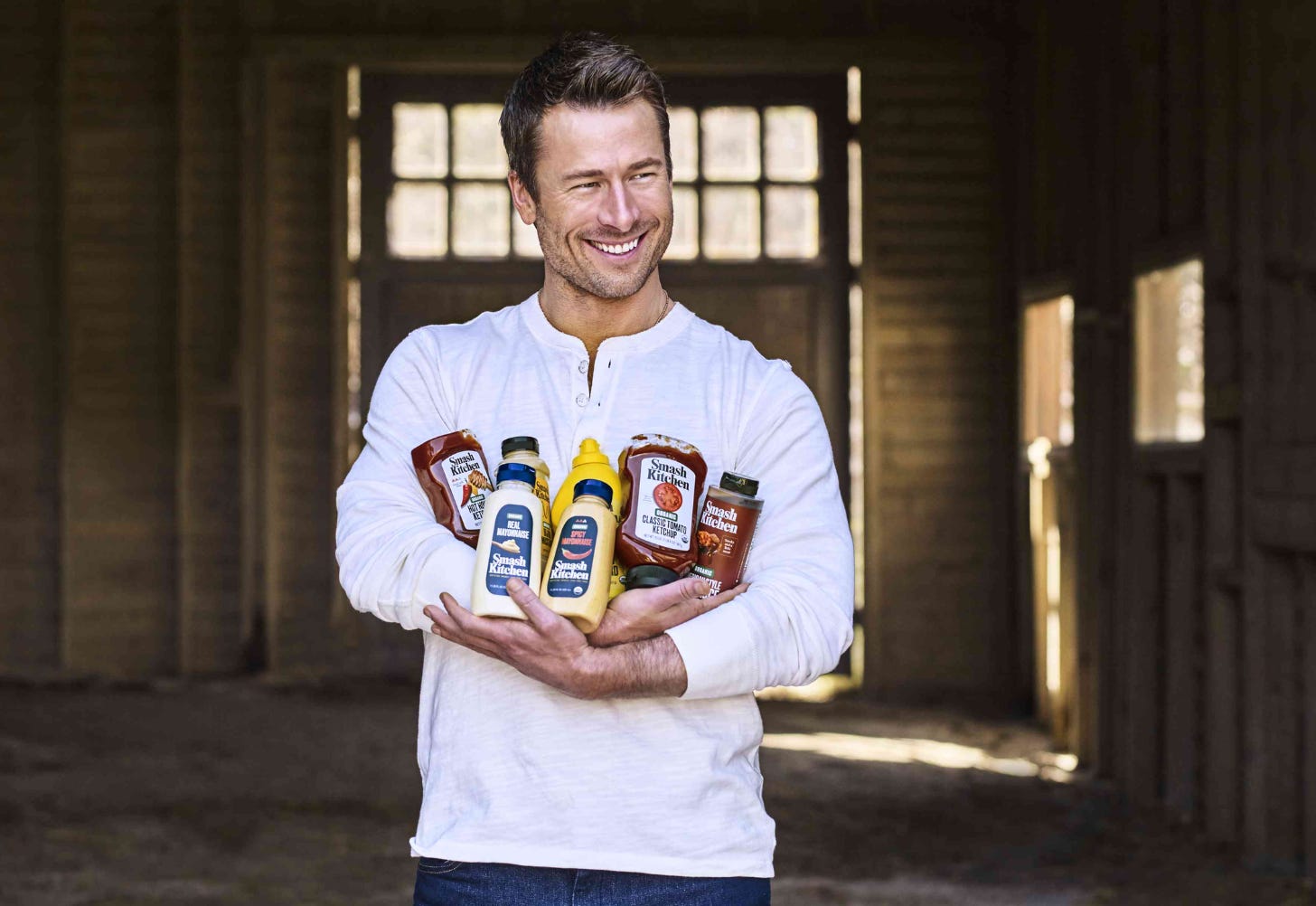
The brand originally launched into Walmart nationwide with a handful of organic BBQ related condiments in the most generic-possible packaging with utterly nondescript branding at shockingly low prices, comparable to generic brands. At launch, we earnestly thought this was a sneaky move by Walmart: launch a private-label condiment line with a celebrity attached to it, giving it the clout of a celebrity CPG brand and the accessibility + scale of private-label.
But now, the joke’s on us: this is a very real, standalone brand now boasting distribution at Target, Sprouts, Albertsons, and soon in Kroger, on-board American Airlines flights—and it’s launched nearly 60 different organic SKUs across aisles, from dessert sauces to salad dressing, cooking oil, and chips. No fancy flavors or novel formats, but a consistent throughline of accessible pricing and organic, “simple” ingredients.
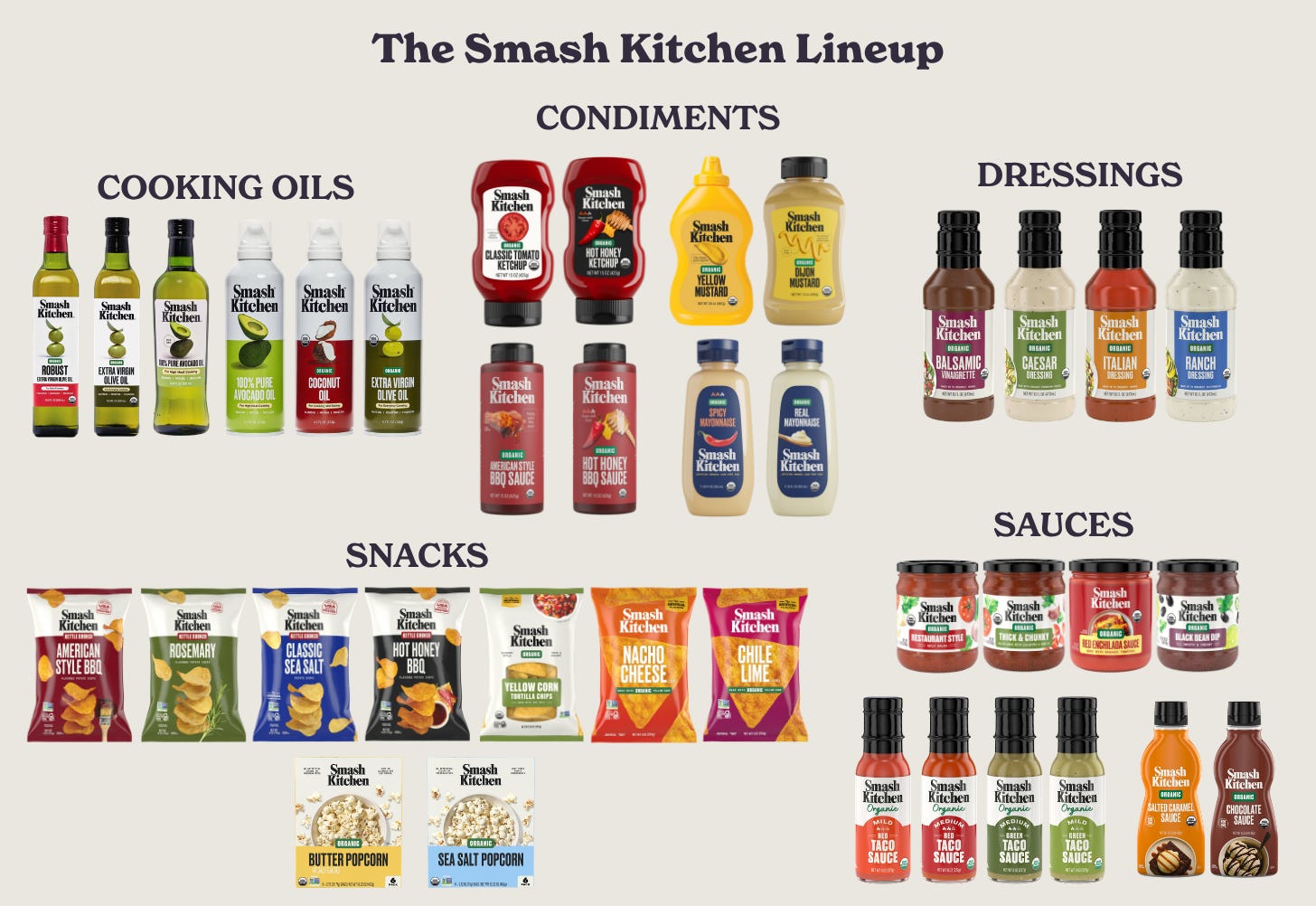
It feels like Smash Kitchen is breaking every rule of modern, buzzy CPG brands: its packaging is anything but standout, it lacks focus (rapidly expanding across categories and aisles), and it’s wholly rejecting the classic better-for-you playbook (grow through natural channel at premium prices then achieve mass-market appeal).
Smash Kitchen went boring, unfocused, cheap, and mass-market out the gate… and it looks like it’s working.
In its first three months on the market, Smash’s revenue hit $3M… and then it crossed $10M by six months.
The brand is targeting profitability this year—its first year on the market.
So… how is this even working? We spoke to Andrew Montgomery, Partner at Collaborative Fund, and Smash Kitchen’s Co-Founder and CEO Sameer Mehta to get the scoop.
On being boring: The last decade of better-for-you ran on one rule: earn your spot in the cart by looking like nothing else on the shelf (Poppi’s loud cans, Sauz’s nearly-neon pasta sauce jars). Smash looks like everything else on the shelf—and that’s the entire point.
“Many better-for-you brands look disruptive for the sake of being disruptive,” Sameer told us. “We wanted shoppers to instantly know what the product is while still delivering taste and quality.”
“The simple, familiar packaging is intentional. The team wanted products that feel approachable and mainstream, not niche or ‘health food,’” said Andrew. “The goal is mass adoption, not just appealing to natural channel shoppers.”
Even Glen himself fits the thesis (we love you, Glen, but let’s be real). The instinct with a celebrity brand is to pick someone whose persona is the product, but a strong POV cuts both ways, narrowing the brand to the fans who buy the worldview. Glen is the opposite play: an affable, all-American face broad enough to sell ketchup to literally anyone, with no politics or polarizing personal brand to alienate the shopper who just wants ketchup.
He brings the reach and the built-in trust of a celebrity without asking you to opt into anything—which, for a brand whose whole bet is “you already know what this is,” is exactly the right amount of famous.
On being broad: Most CPG advice preaches focus—pick an aisle, and stick with it. Smash ignored this conventional wisdom, basically sprinting from condiments into dessert sauces, dressing, cooking oil, chips, and (this week) pasta and pizza sauces inside a single year.
“Consumers don’t think in categories; they think in trust,” Sameer said. “If they trust us for ketchup, they’re willing to try our olive oil, pasta sauce, or chips. Look at brands like Siete, Annie’s, and private label.”
And look at those brands, we will 👀: Annie’s rode mac-and-cheese trust into dozens of categories before General Mills bought it, and Siete went from one almond-flour tortilla to a $1.2B PepsiCo exit across snacks, salsas, and seasonings. The differentiator is sequencing—they earned trust first and expanded later, while Smash is proving product, brand, and scale all at once, each new category as evidence for the next.
On being… cheap: This is the part that’s hardest to copy: Smash attempts to convey “premium” in its organic ingredients and callouts, but its pricing evokes some cognitive dissonance. Its ketchup runs $3.97 for 20 oz against roughly $3.19 for the same bottle of (high-fructose-corn-syrup-laden) Heinz, and nothing in the line tops $4.97—pennies above the conventional brands sitting right beside it. The organic tax that quietly files a brand under “special occasion” simply isn’t there.
“A lot of brands are optimizing for premium. We’ve optimized for scale from day one,” Sameer said. “That scale creates purchasing power, manufacturing efficiencies, and supply chain advantages that allow us to invest in better ingredients while keeping prices accessible.”
Scale is the business model. Premium uses high prices to fund growth, Smash uses scale to fund cheap.
Boring broad and cheap clearly have a place in premium. But then the question becomes… what about private label? Private-label has been seriously upping its game recently: Walmart’s Bettergoods, organic and already in 28% of U.S. households, and Target’s Good & Gather are racing up-market on Smash’s exact axis—clean and cheap—with the structural cheat of being the retailer.
But Smash’s edge is that it’s a brand, with a face and shelves at Kroger and 30,000 feet a house label can’t reach. As Andrew told us, ”Smash is a standalone brand that travels across retailers, so Smash is building a direct relationship with the consumer.” Whether that holds as the store brands close the ingredient gap is the open question hanging over the whole thing.
This isn’t to say this is the formula to success in 2026—plenty of better-for-you brands are winning by leaning on deep innovation, following trends, creating a unique + captivating brand world reflected on its packaging, and launching at premium prices in natural channels. But it is to say that there isn’t a one-size-fits-all path to profitability. The premium-and-disruptive playbook got so codified that it started to look like the only one, when it was really just the loudest.
When everyone else goes wacky, focused, and premium—there will always be a dark horse going boring, broad, and cheap. And the truth is, they just might win.
CPG & Consumer Goods
Nothing is safe from protein. PopCorners launched their very own protein line with 9 grams of protein per serving in three flavors—Hickory BBQ, Zesty Cheddar, and Cinnamon Delight. It’s made with pea and rice protein and is currently in select retailers and going nationwide in July.
Back in October 2025 PepsiCo announced a massive push into functional, protein-enriched foods and beverages. This covers nearly their entire portfolio from protein Doritos, to clear protein Propel, to protein Quaker Oats, protein Starbucks RTDs, and of course Muscle Milk as well. The BigCo also launched new brands in the category, like Good Warrior, a meat stick brand.
It’s a shandy summer. BERO, Tom Holland’s non-alcoholic beer brand, launched a limited-edition shandy line in four fruit-forward flavors—lemon lime, grapefruit, elderflower, and blackberry yuzu. Hitting Target shelves June 14, with broader national retail rollout July 1.
While this new product is absolutely delicious, the best part about this is that Tom specifically formulated for Zendaya. Holland revealed on Amy Poehler’s Good Hang podcast that because Zendaya has never been a drinker, she never developed a taste for regular beer and disliked the original BERO non-alcoholic lineup. So he wanted to create something that she could enjoy with him!
This is why Girl Beer is a thing, too—the fruit-forward light beer that just raised $5M and landed in Walmart, Kroger, and Albertsons. Most alcohol consumers under 30 are women, and a large share say they don’t drink beer because the category doesn’t offer flavors they want—something lighter and more fruit-forward. A fruit-forward beer drink like a shandy hits that mark and can bring in many new consumers (whether or not they drink alcohol).
Hitting the rhode. Hailey Bieber’s rhode Beauty—now part of e.l.f. Beauty—is expanding globally, launching in Mexico (its first Latin American market) and seven new European countries. Timed to their summer collection debut on June 9, the move follows rhode’s ~$390M net sales, up 80% YoY.
This is the e.l.f. playbook becoming visible. e.l.f. didn’t buy rhode for the existing revenue—it bought the distribution upside, and international is the most obvious lever. rhode built that $390M almost entirely DTC and through a tightly controlled Sephora rollout, which means the white space outside the US is enormous for a brand this size.
The interesting tension is that some of rhode’s brand equity is scarcity and Hailey’s personal taste, and global expansion is the thing that historically dilutes both. Glossier learned this the hard way. It’ll be interesting to see whether e.l.f. can scale rhode’s footprint without scaling away the founder-intimacy that made it work.
Worth flagging that 80% growth is decelerating from rhode’s earlier numbers, which is exactly when you’d expect a new owner to reach for geography.
Barebells goes full platform. Barebells just launched a Swedish-style soft candy line in three flavors—Watermelon, Sour Cola, and Peach Rings—at 100 calories per bag and, notably, no protein.
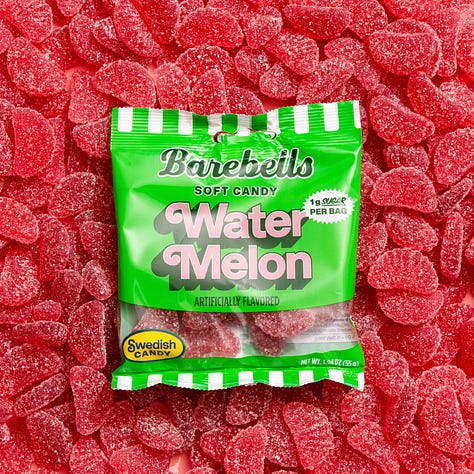
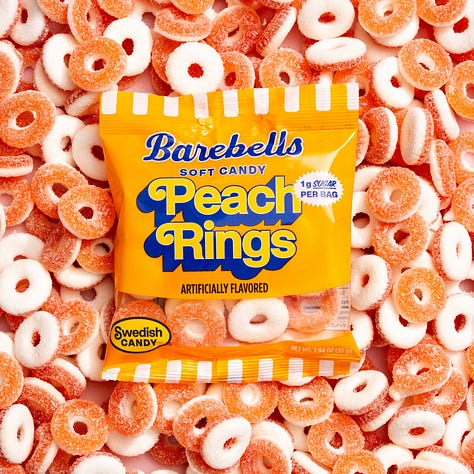
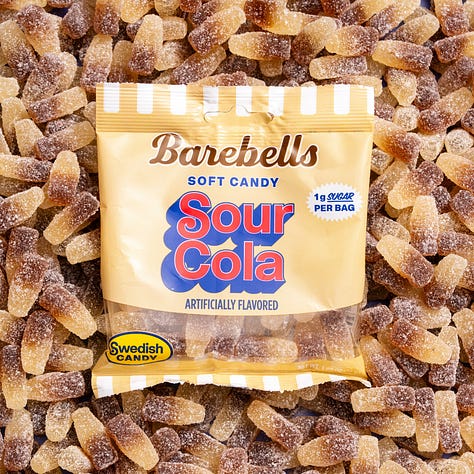
1g of sugar per bag is wild! Barebells built its name on protein bars, then expanded into protein milks and protein sodas (which sneakily pack in 200mg caffeine on top of the 10g protein; the brand just launched its Cola variety). The candy launch is the first time the brand has stepped fully outside its protein identity—low-sugar, better-for-you, but with none of the functional hook it’s known for.
Reading it as Barebells trying to become a platform brand rather than a protein brand. The throughline stops being “protein” and becomes “indulgence without the guilt,” which is a much bigger tent to stand under and a much more crowded one.
Everybody wants to be Cheez-It. Two brands launched “better-for-you” versions of the nostalgic cult classic—but for two very different consumers:
Back to Nature launched two new Cheezy Crackers flavors—White Chedda and Hot & Spicy—made with plant-based, non-GMO ingredients, no artificial flavors or synthetic colors and available at Sprouts, Whole Foods, and Amazon.
And on the opposite (omnivore) side of the world, Wilde launched Protein Crackers that also look a whole lot like our good friend Cheez-It but made with chicken breast, bone broth, and real cheese.
The worlds most controversial
ice creamfrozen dessert. David—the high-protein brand best known for its bars (and, yes, cod)—just launched its long-teased Protein Pints, and they reportedly sold out in a mere 28 minutes. Each pint has, like its bars, unheard of macros packing 30g of protein and less than 2g of sugar, and all powered by their EPG fat alternative.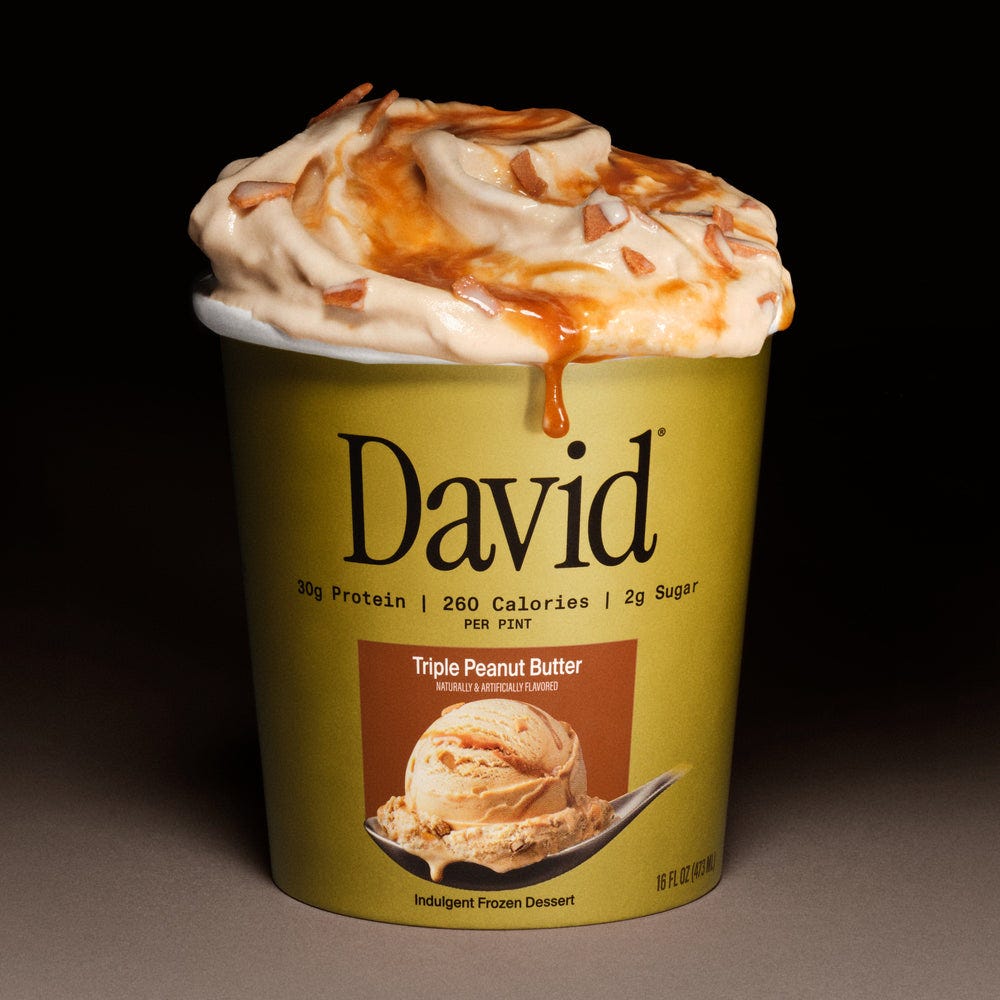
As with everything from this brand, people had a lot of opinions. Go to any video reporting on this product (like Nate’s) and you’ll see a mix of praise and a bunch of critiques: “they can’t even call it ice cream,” “they’re monopolizing EPG,” “it’s 15$ per pint” (okay yea fair), “it’s all chemicals and gums.” Moral of the story is, if you’re looking for “clean,” don’t look to David. David claims macros above all else—there are plenty of other, “cleaner” options like Smearcase in the changing ice cream aisle.
The new Fig Newton. Mondelez refreshed Newtons’ packaging with bigger type, sharper graphics, and a “made with real fig” tagline. The update aims to bring the 130-year-old fig bar to a new generation while keeping its signature yellow packaging.
On its own this isn’t the most exciting news to hit this newsletter, but it’s a clean example of a real trend: legacy brands changing packaging rather than formulas to meet the MAHA-era consumer. The “real fig” was always there—Mondelez is just signaling “better-for-you” by pointing at it, without doing the reformulation work to actually make a better product.
Fun fact: The first time I tried a real fig, I said, “wow, this tastes just like a Fig Newton!” which 1) how embarrassing and 2) shows how deeply removed we are from real, real food, no matter how much CPG brands want to make us think that’s what we’re eating. 🙃 - Jenna
Skincare straight from the vineyard. Beauty Crush Skincare is launching DTC with a four-product line built around patent-pending Falanghina grape exosomes and ingredients from founder and clean beauty pioneer Karen Behnke’s organic Sonoma vineyard. Products range from $36 to $68; industry sources project first-year sales to surpass eight figures.
Karen Behnke was the founder of Juice Beauty, known as a pioneer of the clean beauty movement (founded in 2005). After 20 years in business, Juice Beauty was liquidated last year after the business struggled during the pandemic, citing supply chain hurdles and heightened competition in the clean beauty space. It’s a classic example of being too early to a trend: Juice Beauty built its brand on the “no nasties” concept, a differentiator at the time, but one that has quickly become a baseline expectation for consumers.
As consumers grow more skeptical and seek the science behind skincare, Beauty Crush is presenting a new answer to their needs beyond “clean.” It’s relying on science-forward copy (”regenerative biotech skincare”; “exocellular antioxidant serum with peptides”) and clinical studies.


eCommerce
The cart that builds itself. Gopuff launched Go, a personal shopping assistant built with SpaceXAI that fuses frontier AI reasoning with Gopuff’s 13-year order history to generate a pre-loaded, personalized cart—before the shopper types a thing.
The bot learns the shopper’s habits and can build a personal cart based on time of day, location, order history, and real-time indicators. The pitch is a TikTok-style shoppable feed where a custom model uses Gopuff’s behavioral and inventory data plus live cultural signals from X to generate personalized product moments—if there’s a big game in your city, wings and drinks show up staged in a living room scene.
This is how Yakir Gola, Gopuff’s co-founder and co-CEO, explained Go: “Today, we believe the greatest friction left in commerce is not delivery or instantaneous access to the essentials customers need. It’s the moment before: the thinking, the deciding, the remembering.” It’s genuinely wild that “thinking” is now the friction to engineer out. The entire premise is that deciding what you want is a problem to be solved rather than, you know, shopping.
The thing I’d watch is dynamic pricing, because the same infrastructure that personalizes your cart can personalize your price. Instacart spent late 2025 pulling the plug on item-level price tests after a Consumer Reports investigation found nearly three of every four grocery items were shown to shoppers at multiple prices, drawing FTC scrutiny and letters from lawmakers. Prices differed by as much as 23% per item between customers, via a technique Instacart internally called “smart rounding.” Instacart insisted it wasn’t dynamic or surveillance pricing—just randomized A/B tests—but the backlash was the point.
Gopuff is now building a system that knows your habits, your location, the time of day, and what’s happening in your city in real time, then pre-fills your cart before you’ve thought about price at all. That’s a far richer dataset for individualized pricing than anything Instacart had, and the pre-loaded-cart format is exactly the interface where a markup is hardest to notice.
Retail
The Walmart win that breaks brands. Landing a Walmart PO is the biggest moment in a lot of brands’ trajectories, but the win comes with a bill that lands months before any revenue does. Between supplier deposits, a full production run, freight, and Walmart’s Net 60-90 terms, brands routinely wait 120 to 150 days from PO to payment—and because the gap scales with the order, a bigger win digs a bigger hole before it makes a dollar.
How brands cover that gap—equity vs. debt—quietly decides how much of the company they still own on the other side. We ran the actual math with our partners Bridge, the direct lender behind Walmart’s PO financing program, on what each option really costs.
Funding
Big CPG goes all-in on meal replacement. Nestlé has acquired a controlling stake in YFood, a European meal replacement drink brand, for around half a billion dollars. This comes roughly two years after buying an initial 49% stake in the business. YFood launched in 2017 and currently operates across 30 European countries.
Nestlé isn’t the only big European CPG giant making big bets on meal replacement. Earlier this year, Danone announced it was acquiring Huel for $1.15B—the UK-born brand that’s spent a decade making ‘food is inefficient, nutrition is the point’ sound aspirational rather than dystopian (we still think it’s a smidge dystopian…)
So why is all of this happening right now? Why it’s GLP-1s, of course! The boom in GLP-1 weight-loss drugs has quietly reshaped what the food industry is building toward. Consumers on GLP-1s have suppressed appetites but still need complete nutrition, and a nutritionally complete RTD or powder, maximum nutrition in minimum volume, is perfect for that use case. Meal replacement brands like Huel and YFood aren’t just convenient; they’re basically purpose-built for the GLP-1 consumer.
Danone has been deliberate and transparent about this: It launched Oikos Fusion—a drinkable yogurt specifically formulated for GLP-1 users—and even built a dedicated nutrition hub for GLP-1 users on their North American website. As we wrote in our deep dive on the Danone/Huel deal: the food-as-fuel proposition has gone fully mainstream. Soylent was a curiosity for people who openly didn’t care about food. Huel made the same bet much more palatable and built it into a $1Bn asset. Now the biggest names in CPG are racing to own this space.
Jolly Rancher iced tea worth $20M. Ryl Tea raised a $20 million Series C led by Purchase Capital, following 157% year-over-year growth (while the rest of the canned and bottled tea category declined 1.8% over the same period) and a multi-year licensing deal with The Hershey Company to produce zero-sugar Jolly Rancher-inspired RTD teas.
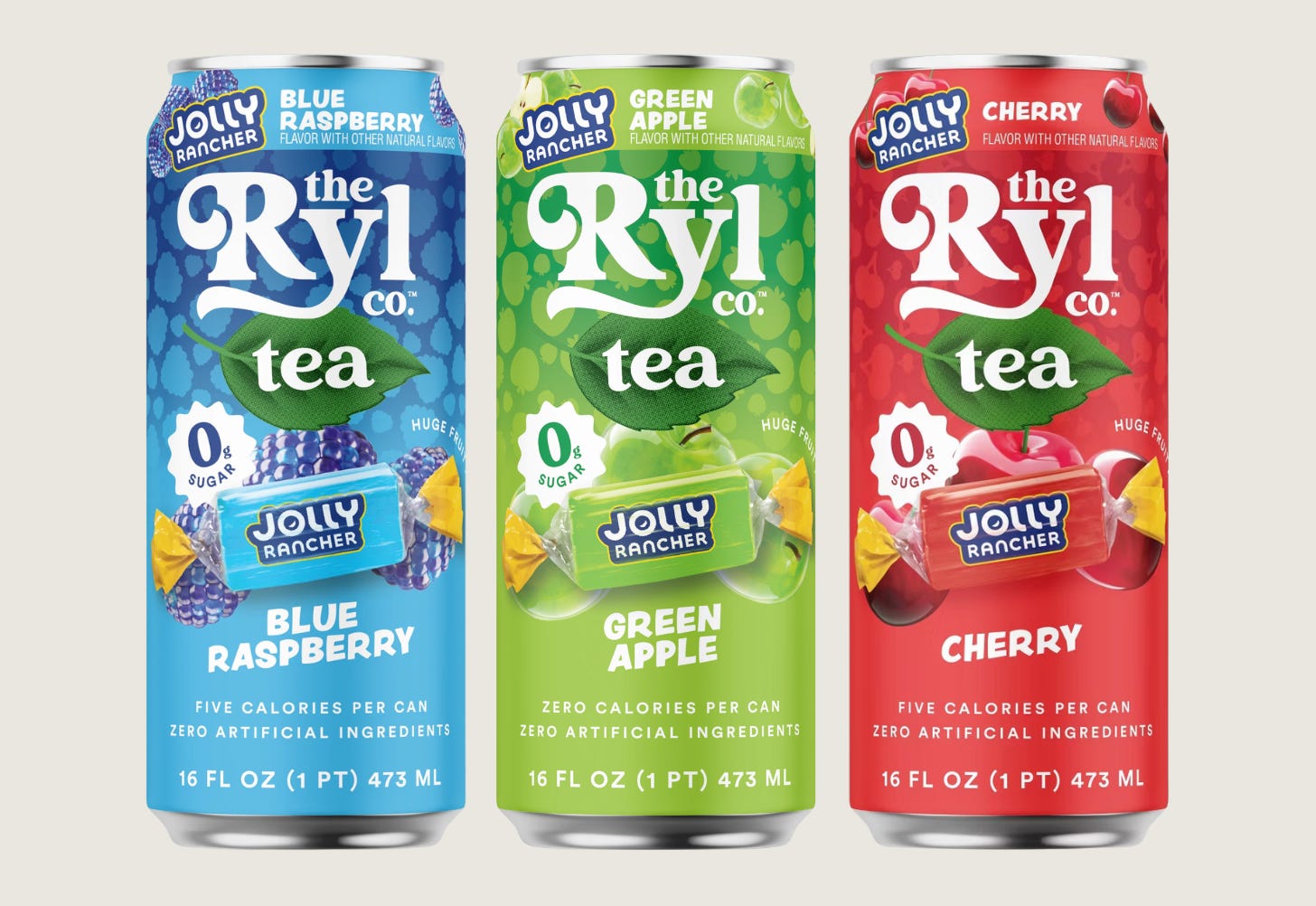
they’re real, and they’re delicious People are calling this the “modern tea” moment—basically seeing what happened in other RTDs (soda, energy, hydration) and claiming the same thing is going on in tea. But this summary feels a bit oversimplified: tea is better-for-you already. There have been zero-sugar and low-sugar bottled and canned iced teas for a while now. Ryl isn’t making a BFY version of an otherwise high-sugar product; it’s taking an otherwise stale tea category and making it look more like the energy category. Bright colors, licensing deals with candy brands, nostalgic flavors like Rocket Pop, a tall can, and spelling out the benefits (namely antioxidants) that were always in tea—they just weren’t explicitly highlighted.
A plant-based rollup takes shape. Trek One Capital acquired Good Karma Foods (flax milk) and No Cow (plant-based protein bar), adding to a Houston-based portfolio that already includes Alter Eco Foods.
As animal-based protein gets the spotlight, neither of these brands seems particularly appealing in the year of our lord 2026. The reality is, these plant-based assets are probably cheap right now—making them the perfect target for a roll-up. Trek One can consolidate operations of these brands, and hope that when the pendulum inevitably swings back to plant-based, they’ll be sitting on a sleeper brand.
Hart’s hustle, now PE-backed. VitaHustle, Kevin Hart’s plant-based nutrition brand, secured a growth equity investment from Charlotte-based Axum Capital Partners. The brand has sold more than 5 million of its shakes since its 2022 launch; deal terms were not disclosed.
The brand’s core product is an all-in-one nutrition shake (sound familiar?) with 20g plant protein, vitamins, probiotics, digestive enzymes, and adaptogens.
Kevin might be one of the best operators in celebrity-owned CPG right now. Alongside VitaHustle, he runs a tequila brand, Gran Coramino. He co-founded it in 2022 with beverage vet James Morrissey and Jose Cuervo’s Juan Domingo Beckmann, and it pulled in $85 million in sales last year, up more than 80% year-over-year. They sold 3.6 million bottles in three years, even as the broader spirits industry has seen shrinking demand. The brand says it’s crossed $200 million in lifetime retail sales and is funding its own growth with no outside capital. Seems like Hart has a special touch.
Affordable BFY, but in the beauty aisle. Personal care brand California Naturals raised a Series B led by Align Ventures, with participation from existing investor Elizabeth Street Ventures, to fuel retail expansion at Target, Ulta, and CVS. Founder Shelby Wild is handing the CEO role to former COO Hayden Hiatt, previously of Glossier.
California Naturals is winning in a way that looks a whole lot like Smash Kitchen—relatively neutral, straightforward branding and products with “clean” ingredients, at affordable prices. “Clean” plus accessible is the new “clean” plus premium. And we can’t forget, this is also a celebrity backed brand. Owen Wilson got involved with the brand back in 2024.
The next Olaplex? Filament Sciences raised a $2M seed round led by Wittington Ventures, with Willow as a secondary investor—its first outside capital after being self-funded by L’Oréal and Kiehl’s vet Nathan Puksta. Funds go toward inventory, salon channel expansion, and educator hires.
Filament leans into the same science-first playbook that helped Experiment Beauty and Olaplex reach the masses. Filament launched last year into salons and dermatologists’ offices with its TS.02/Tt, a professional-strength mask for post-chemical services. The mask was clinically tested for improving tensile strength across a range of hair types and textures.
Culturally relevant hydration. Austin-based sparkling agua fresca maker Bawi closed a $6M round, building on the $3.5M seed it raised in late 2024. The brand makes lightly carbonated, real-fruit aguas frescas under 100 calories, in flavors like limón, maracuyá, and guayaba, and is using the capital to push distribution.
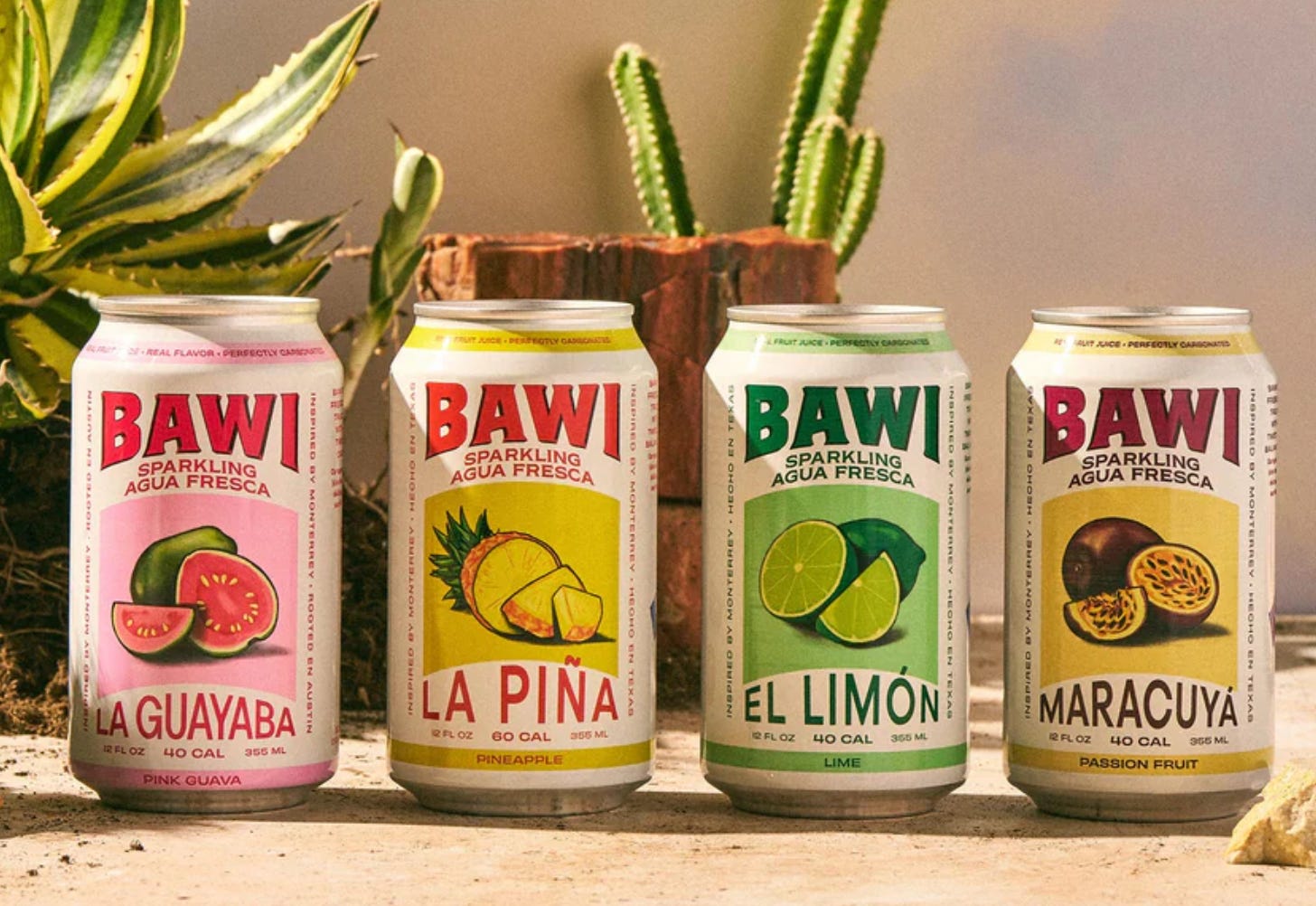
Founder Victor Guardiola has said the brand straddles both the agua fresca and sparkling water categories, which is exactly the positioning that lets it compete for shelf space in the new “modern soda category” rather than getting boxed into the Hispanic foods aisle.
Agua fresca went from white space to crowded fast, with startups like Agua Bonita and Frescos Naturales plus Coca-Cola and the former BlueTriton circling the category.
If you haven’t yet, please subscribe, like, leave a comment, and share it! It helps us continue to bring you the most interesting news + nuance in consumer and retail every week.
Enjoy the highlight on Smash Kitchen. The hypergrowth of a basic brand is genuinely impressive and worth paying attention to. It will be interesting to see how they scale. I definitely thought this was a Walmart Private Label when announced due to the partnership and launching nationwide with so many SKUs, definitely not a normal playbook.
The Walmart PO gap is the structural kill that ends more brands than any product failure. The 120-150 day cash conversion cycle is the moment most founders meet capital structure for the first time, usually under duress. Equity is the most expensive money on the table because it looks free until it's not.
The Smash Kitchen read is sharper than most coverage. The boring-broad-cheap playbook only works at scale, and scale requires capital structure that can absorb the launch math across 60 SKUs simultaneously. Collaborative Fund underwrote a working capital position most challenger brands can't replicate. That's the structural moat, not the packaging.
Private label closing the ingredient gap is the open question. Bettergoods is 28% household penetration without a celebrity. If Walmart can deliver Smash quality at private label price, the brand layer becomes the only differentiator, and that's a much harder defense than scale.