



Hello hello!
Whitelisting, Spark Ads, Partnership Ads—they’re your highest-ROI channel in 2026. And minisocial is the fastest way to scale them.
Heres what a brand recently had to say about their results with minisocial:
“minisocial helped us cut through the sameness of traditional digital advertising with authentic creator content and high-performing whitelisting partnerships. The results gave us one of the strongest returns we have seen from a paid media initiative; a 30x ROAS!” - Taylor J. Shafer, SEO & Digital Advertising Manager
With minisocial, it’s easy:
Just submit your brief, approve your hand-picked creators, and watch as content fills your dashboard for you to review and approve before it gets posted by high-quality creators, and you have access to the fully-licensed content AND permissions to run the posts as partnership ads/whitelisting ads!
Plus, for the next month minisocial is giving Express Checkout readers 15% off their first project!
Ready to turn creators into your best-performing ad channel? →
News of the Week
Protein isn’t a trend anymore. It’s a full-blown, undeniable, societal obsession.
It feels like like every other article or TikTok is an exploration of the growing protein demand, a recipe cramming cottage cheese and egg whites into some abomination called “dessert,” a new proteinified product launch, or a clickbaity piece investigating “if you really need that much protein” (answer: probably not).
Whether it’s the downstream effects of booming GLP-1 usage or wellness culture more broadly (likely a combination), consumer demand for greater grams is skyrocketing. And as a result, every consumable brand wants in on the gains.
Anyone who has ever taken a single econ class can tell you what comes next: when demand spikes this drastically, a supply challenge is on the horizon. There's a whey protein shortage going on, and no bulked-up brand or macro-tracking consumer is fully safe from it.
I know what you’re thinking: but why don’t they (the ambiguous, elusive “Big Dairy”) just… make more? What’s interesting is that whey actually isn’t a milk supply problem: milk production hit record highs in November 2025—up 4.5% YoY, the largest monthly gain since May 2021. There is, by historical standards, an absurd amount of milk in this country right now. And whey markets are still tight.
The bottleneck is downstream, at the cheese-making and processing-equipment step. when milk gets turned into cheese, the watery stuff left over is whey. Cheesemakers can turn it into low-value dry whey for animal feed, or invest in the expensive equipment to the liquid gold of 2026: whey protein concentrate (WPC; WPC 80, for instance, is 80% protein) or whey protein isolate (WPI; 90%+ protein).
Isolate in particular has been highly in demand as consumers get more protein literate—it’s more easily digested, quickly absorbed, and lower-calorie than its lower-percentage counterpart.
And the booming clear whey category—those juice-like, post-workout drinks—requires WPI specifically, because conventional whey concentrate is too fatty to stay clear. Every clear protein launch on Target shelves is, structurally, capacity that isn't going into a protein bar.
The byproduct has turned into THE product: Cheesemakers are now prioritizing whey protein value over cheese itself, but they can only process so much, so fast. Per a January market report from a major U.S. dairy ingredient supplier, “more WPC 80 and WPI is being produced than ever before, and further supply growth is coming, yet it will not be enough to flip the market.”
Okay but like… how bad is it really? When you have brands like Starbucks now triggering demand for over 10,000 kg of whey per day in the US (shoutout protein cold foam), things get spooky… fast. USDA spot pricing (open market where buyers without long-term contracts go to find product) has WPC 80 recently topping $11/lb and WPI sitting firmly in the $12s—both at or near historic highs. Some suppliers are already sold out for the rest of the year.
As a result, smaller brands are scrambling while the big brands with big contracts eat their gains-packed lunch:
Some are riding on “vibes,” like Waay—a sparkling protein bev that launched in Whole Foods, Sprouts, and Target in their first year (frankly, unheard of). Though retailer demand is booming, the supply chain is held together with what Kim Fuerth, Head of Ops, only half-jokingly calls “vibes.” Waay has no supply agreement—volumes aren’t yet large enough for a contracted commitment, and cash flow constraints make stockpiling impossible. So Kim sends blanket POs against 90-day lead times, forecasts month to month, and works constantly to keep her supplier relationship warm. “I’m always waiting for the rug to get pulled out from underneath me,” she told me. Her whey costs have increased 10% just in the last 5 months alone.
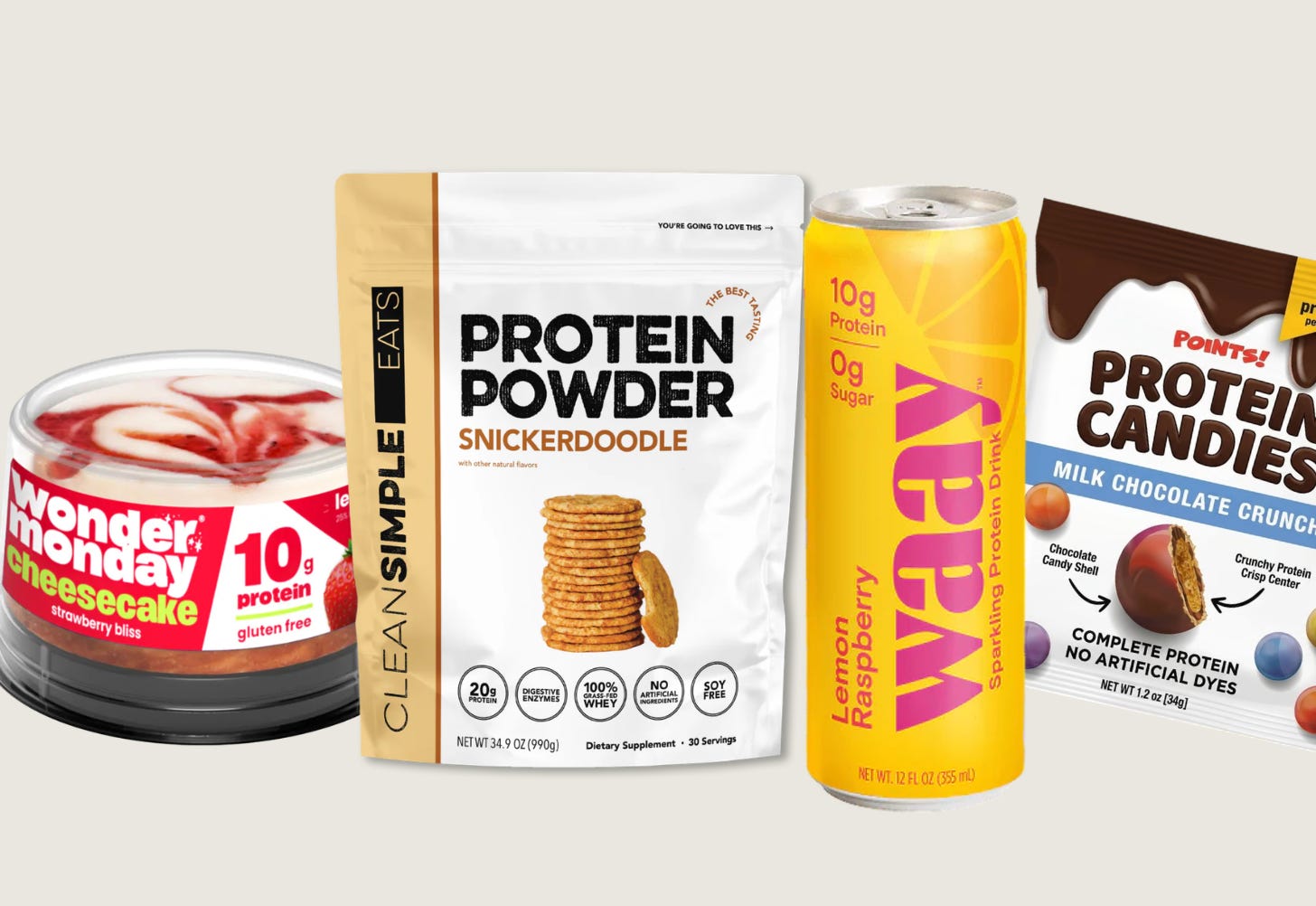
For Tyler Philips, founder of at POINTS! Chocolates, a lower-sugar, higher-protein startup chocolate candy brand, that rug-pull moment already happened. His whey protein isolate crisps sold out completely mid-planning for the next production run, forcing a 3-month wait and a format change.
But even those with contracts are struggling. JJ Peterson, co-founder of Clean Simple Eats (a fast-growing clean protein brand), is in the contract camp—locked through the end of 2026. That buys him some stability, but the price hits still land hard: “Since 2022, the cost of whey protein has tripled. In the last 12 months, we’ve seen a 43% cost increase. And we haven’t even seen the peak yet.” As JJ told me: “It’s hard to lock a price any further out than that. You don’t want to walk so far out that the dam breaks and costs begin to fall.”
Candace Wu, co-founder of Wonder Monday (a high-protein cheesecake brand), has seen costs roughly double over the last twelve months. She feels fortunate to have the scale to buy in pallet volume, with lead times holding at four weeks.
Who’s absorbing the cost? For now, the brands. None of the founders I talked to have raised consumer prices in response, and none plan to. And they know better than to seek out better whey prices, knowing that the whole market is experiencing the same fate—instead, they’re hunting for savings everywhere else:
JJ calls it “non-protein negotiations”—packaging, secondary ingredients, co-packing arrangements. At Waay, that’s translated into co-packer renegotiation and formula tweaks on the secondary ingredients (collagen alongside whey, partly for cost reasons). “It’ll never make up the gap that we’re seeing in protein,” JJ said, “but we’re doing everything we can to offset the cost.”
There’s only so much margin a brand can give up before something has to give, whether that’s a price increase, a formula change, or—for the brands without contracts—a missed production run. The longer the shortage holds, the closer that wall gets.
So why don’t they just reformulate? If whey is this expensive and this hard to source, why isn’t every brand swapping in a cheaper plant protein? Pea and soy are sitting right there…
For the protein-forward brands like Clean Simple Eats, “It comes down to the calorie cost of protein,” JJ told me. “If I can get 20 grams of grass-fed whey protein isolate for 90 calories, and I trade to pea or hemp, I’m at 250 calories for the same benefit. I’m going to choose the 90-calorie option every single time.”
For others, it’s a matter of taste parity. As Candace told me, “Taste is king. Moving away from milk protein to plant protein will compromise that.”
And for a brand like Waay, well… it’s in the name. 🙃
Other times, it’s a matter of perception: “Plant protein” in 2026 still carries a lot of baggage. Pea protein has spent a decade struggling with texture and taste challenges (grainy texture; earthy taste). Soy is dragging around outdated perception baggage about hormones and GMOs—despite being a complete protein with a protein digestibility-corrected amino acid (PDCAAS) score on par with whey. Tyler, who is actively reformulating his POINTS! chocolates with soy crisps, is building towards a “real first-mover window to help shift that narrative.”
But there is a bright spot in all of this: call it clichéd, but turns out, constraint does yield creativity. There’s a whole new class of brands emerging that are inventing or scaling new-to-market plant-powered protein sources, and you best bet I spoke with them, too.
More on those brands—and the future of non-whey protein—next week 👀 - Jenna
CPG & Consumer Goods
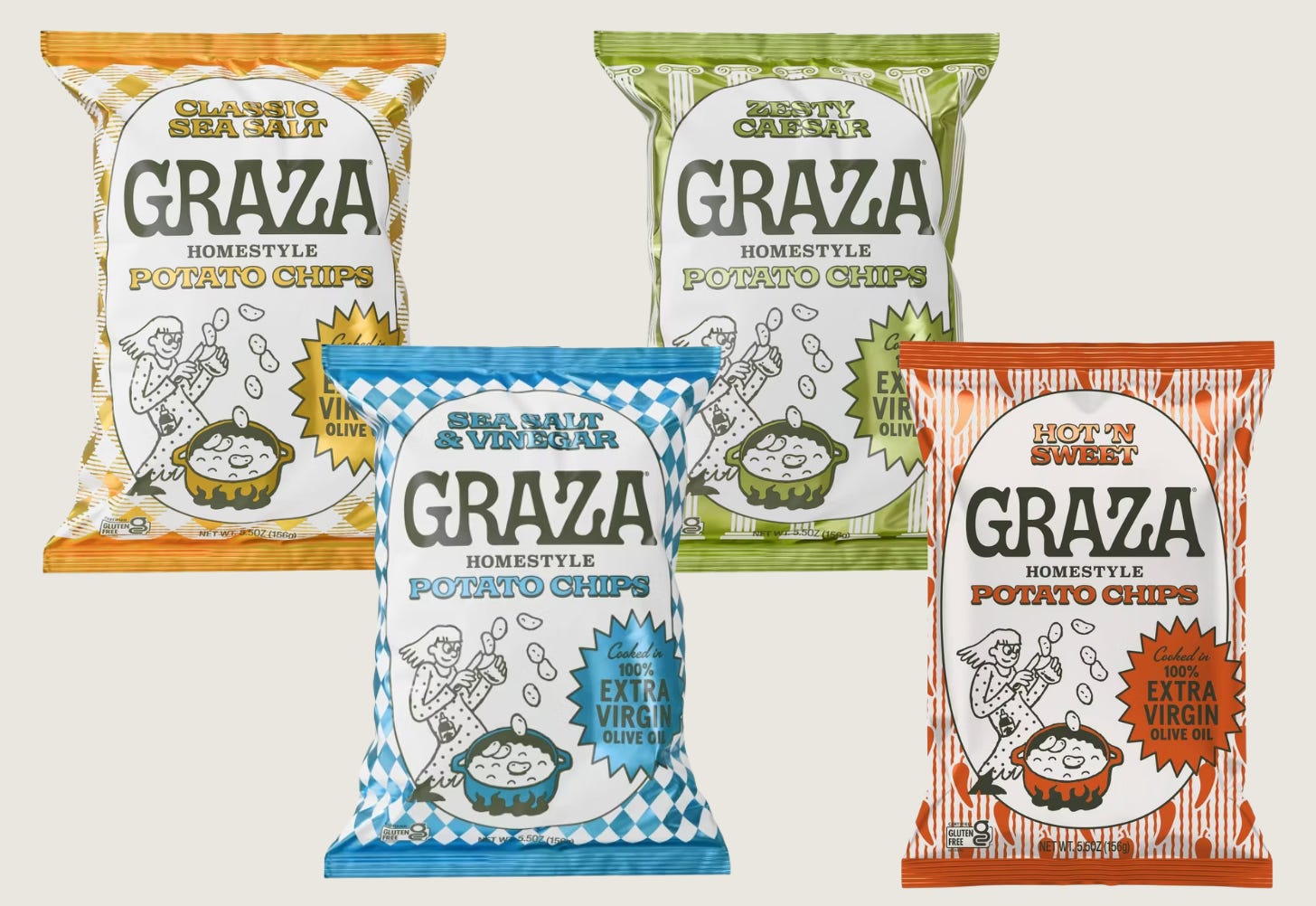
Expanding the Graza universe—or the GCU, as the kids call it. Graza launched four new homestyle potato chip flavors—Classic Sea Salt, Sea Salt & Vinegar, Zesty Caesar, and Hot ‘n Sweet—exclusively at Target. The brand’s original EVOO chips debuted in February 2024 and sold out multiple times on the website.
What started as a (controversial) olive oil brand has begun expanding into more of a platform company that sells olive oil-based products (chips, mayo) across aisles.
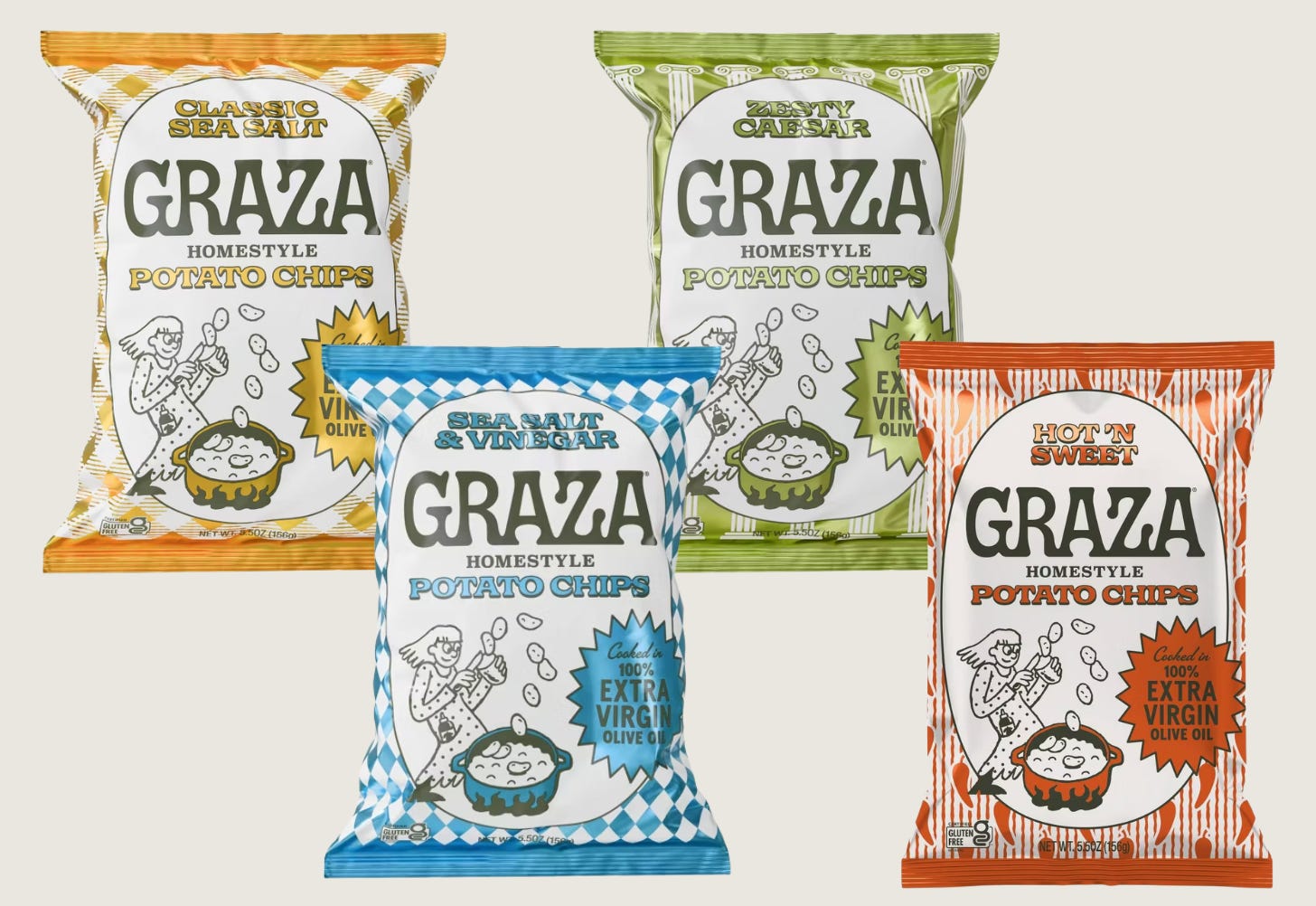
And these are DAMN GOOD chips This makes so much sense for Graza. After establishing itself as a premium, buzzy brand with strong name recognition, it is primed to move into different aisles. Olive oil is a low-frequency, high-consideration purchase—consumers only buy it a few times a year. Chips, in contrast, are a high-frequency, low-cost impulse purchase. A chip line puts Graza in the cart weekly instead of monthly, building familiarity and loyalty that can actually pull the core SKU. It can also command a premium price point within a high-velocity category—making them, by comparison, a low-cost entry point into the brand for the curious consumer who’s been wanting to try Graza.
Annnnd it comes as no surprise to us that this launch is a Target exclusive. As we’ve now iterated ad nauseam, Target is becoming the retailer for brand and product discovery.
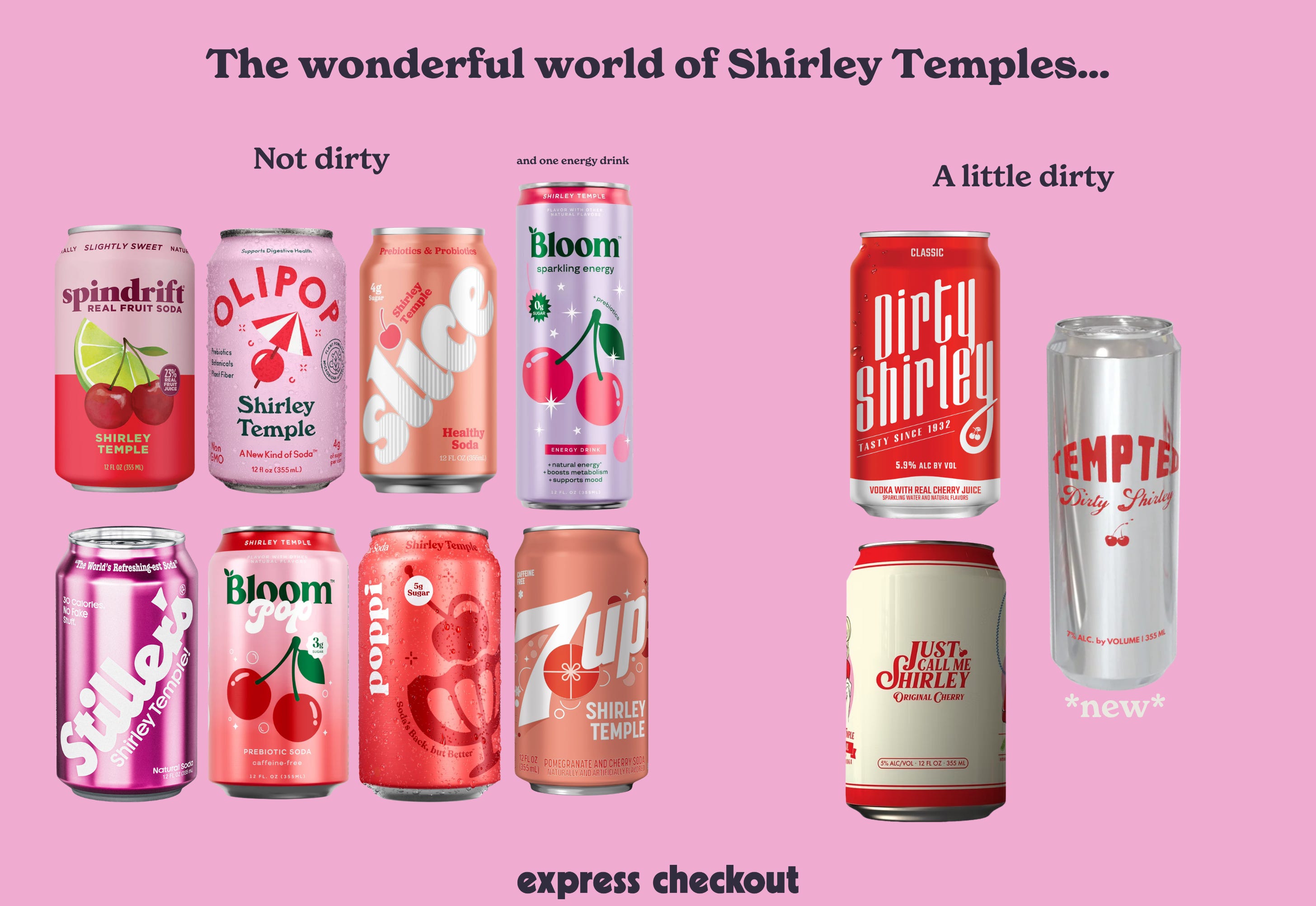
We’re all just seeking nostalgia in a can. Fitness influencer Sommer Ray launched Tempted, a 7% ABV ready-to-drink Dirty Shirley with cherry, pomegranate, and lime flavors, now available exclusively on Gopuff in select markets.
Shirley Temple is popping off right now. Poppi, OLIPOP, Slice, 7Up, Bloom, and Stiller’s Soda have all launched a Shirley Temple flavor in the last year.
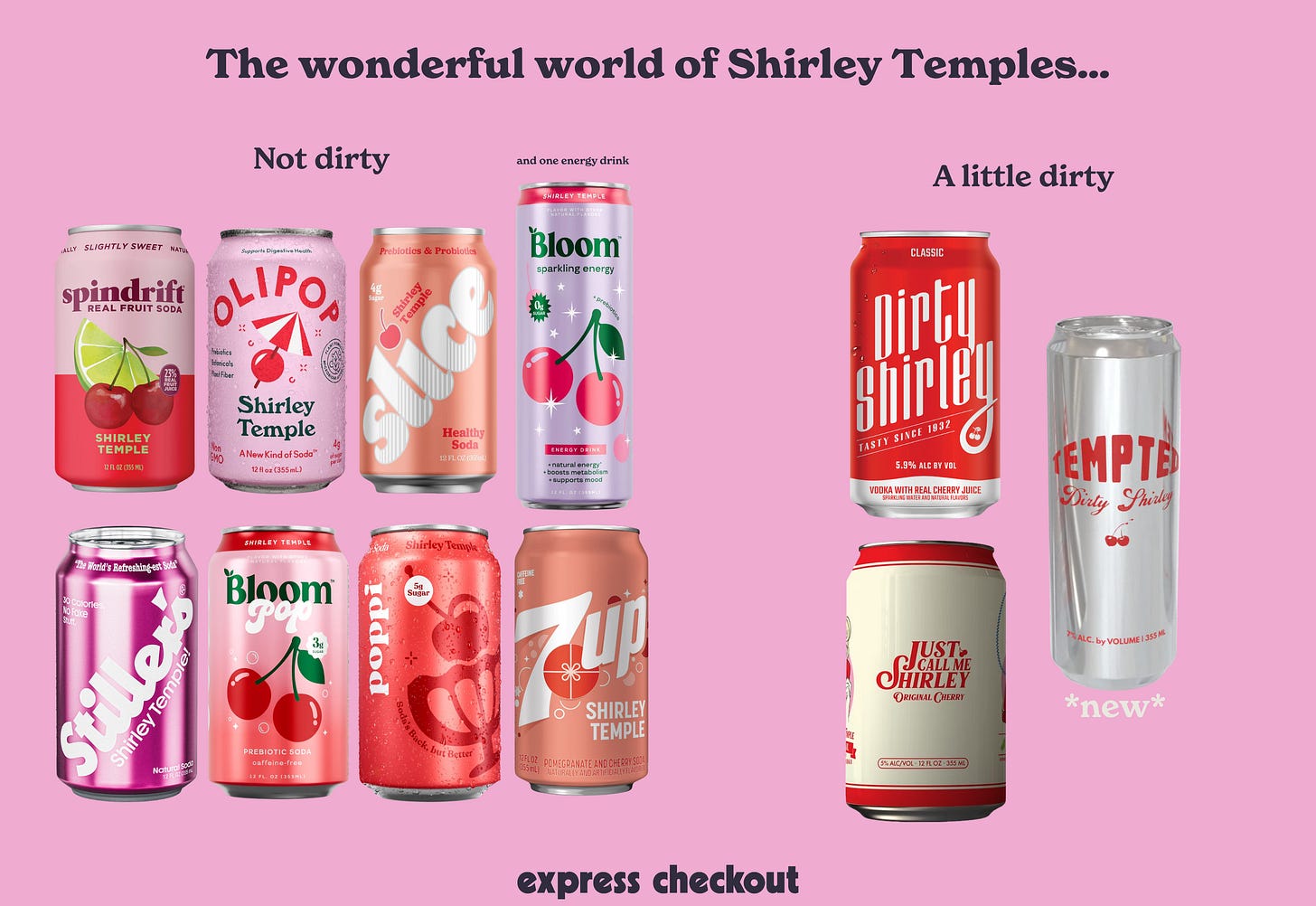
And they’re not the only adult Shirley temple out there either: Back in March, Sazerac acquired Dirty Shirley for an undisclosed sum. Loverboy introduced a “Flirty Shirley” LTO, and Just Call Me Shirley launched as a canned cocktail and NA collection last year.
We don’t need to point out the obvious: nostalgia is everything. But why in RTD specifically? The RTD category exploded, but a lot of it tastes, well, the same—seltzers, teas, hard lemonade. Consumers have no strong loyalty anchors. Nostalgia solves that by importing a pre-existing emotional relationship. You’re not asking someone to try something new; you’re asking them to revisit something familiar, which dramatically lowers the bar. The Shirley Temple just happened to be the perfect vehicle: universally known, visually distinctive, emotionally warm, and totally unowned by any single brand until very recently.
Muscle Milk’s midlife makeover. PepsiCo reformulated Muscle Milk with 50% fewer ingredients, no artificial sweeteners or colors, and protein sourced entirely from ultra-filtered milk. Early results reportedly show sales up 30% since reforluation.
The protein drink shelf has gotten considerably more competitive since PepsiCo acquired Muscle Milk in 2019. There’s Core Power, Coca-Cola’s Fairlife line, Danone entered with Oikos Protein Shakes, Barebells launched a Milk Drink, Slate Milk, and Nurri just to name a few. For Pepsi to compete, they have to take bets on what consumers want. Overwhelmingly, data shows that consumers want cleaner ingredients, more protein, and no artificial sweeteners or dyes—a shift being accelerated by fitness going mainstream, GLP-1 drug users prioritizing protein to preserve muscle mass, and the MAHA movement’s broader turn against synthetic additives. It’s not like there’s not enough consumers to go around either, over 70% of American consumers want to consume more protein daily.
PepsiCo hasn’t just been adding more protein to its protein products, they’ve been adding protein across its portfolio— from Doritos to Starbucks ready-to-drink coffees to Propel water.
Kefir’s moment has arrived. Lifeway Foods reported its strongest quarter ever, surpassing $60M in Q1 2026 sales as consumer demand for protein-rich probiotic foods and gut health awareness drove record results.
This is something of a cottage cheese story: a protein-rich product that has been around and considered relatively unsexy, only to be highlighted and re-popularized by the protein and gut health craze.
The protein products NEVER STOP. Better-for-you brands all seem to be launching the same product: higher-protein versions of their most popular SKUs. This week, Purely Elizabeth launched “Protein Ancient Grain Granola” with 10g protein per serving, while Hippeas launched “Protein Crunch” puffs, featuring 8g protein per serving (double their OG recipe).
Both Hippeas and Purely Elizabeth were part of the OG wave of better-for-you snacking brands. Both brands achieved national distribution in 2016. In 2021, Hippeas closed a $50M investment; in 2022, Purely Elizabeth closed a Series B for the same amount. Now in 2026, Hippeas feels more like a mature mainstay while Purely Elizabeth is experiencing a mainstream breakout (15+ years in the making).
Now, they’re intersecting once again to introduce the new wave of “clean” protein: Purely Elizabeth is proudly calling out its protein source: no protein powders, fillers, or isolates, just added pumpkin seeds and nuts. Meanwhile, Hippeas uses pea protein. “Clean” messaging is smart from the demand side, while the formulations are clever on the supply side—avoiding reliance on high-cost, low-supply whey.
Supplements and skincare continue to merge. Lemme and Starface launched their first-ever collaboration, a three-piece limited-edition skin collection available at Target (gummies, patches, and a lip balm).
Influencer, YouTuber, and now beauty entrepreneur. A classic story. Olivia Jade Giannulli launched O.Piccola, a self-funded minimalist beauty brand debuting with a singular hero SKU, the Bronze & Glow Balm—a dual-sided bronzer and highlighter stick in three shades.
Retail
Honey, I shrunk the stores! Whole Foods Market announced its Daily Shop smaller-format concept will expand to Boston, Chicago, and Philadelphia over the next two years. The format launched in NYC in 2024 and now has eight locations across the NYC metro, Arlington, and London.
The numbers back the expansion. According to Whole Foods’ own data, 42% of shoppers at the Lenox Hill Daily Shop between September 2024 and May 2025 were either new or re-engaged customers who hadn’t visited any other Whole Foods in the NYC metro during the same period the year prior. The Daily Shop is doing something the mothership can’t: fitting into neighborhoods where a 40,000 sq ft flagship never would.
Small-format is having a broad moment across retail, and grocery in particular. Smaller-format grocery stores under 30,000 square feet saw a 3.2% rise in foot traffic, outpacing larger stores significantly. The winners in grocery right now—Trader Joe’s, Whole Foods, Aldi—all share a smaller, more curated footprint philosophy. Same-store foot traffic growth in 2025 was led by Trader Joe’s (up 10.4%), Whole Foods (up 9.8%), and Aldi (up 8.3%), with the industry also noting an ongoing trend toward more frequent, shorter grocery trips and smaller baskets. Consumers aren’t doing one big weekly haul anymore. They’re stopping in multiple times a week, and small-format stores are built for exactly that behavior.
Funding
Not your average makeup wipe. 4AM Skin raised $4M+ in an oversubscribed seed round led by CAVU Consumer Partners. Alongside the raise, the brand is launching their newest product Clean Sheets, a serum-grade facial wipe, in 1,745 Target stores.
The brand launched back in 2021 with serums an eye patches. It saw success with these products but, the space was crowded. Then, last year the brand decided to launch its take on a makeup wipe, Clean Sheets. These instantly were a hit, they saw a 4x year-over-year revenue growth and four sold-out production runs! The virality of this new product led to Target DMing them about launching in their stores.
The kids bev space is booming. Roxberry raised an undisclosed round after growing ~900% since its January Walmart launch, with distribution now expanding from 2,200 to 3,300+ Walmart stores, plus a recent launch in H-E-B.
We talked about this last week, but this category is really heating up. Countless brands (especially canned kids drinks) are launching and raising capital to expand nationally. The kids are eating (and drinking) good these days.
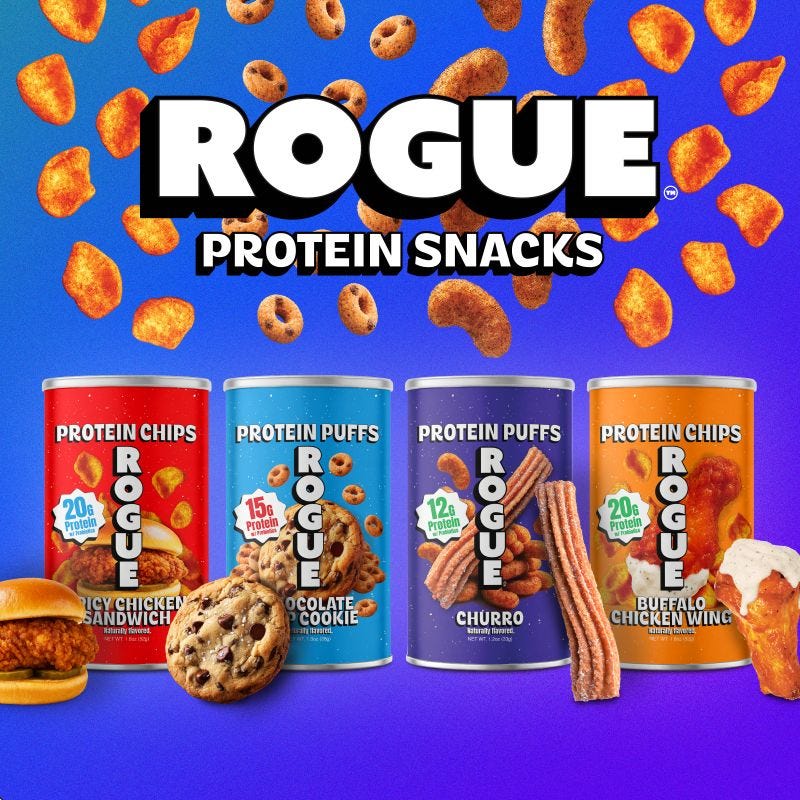
High protein! Probiotic! Seed oil free! Rogue, a new snack brand with chips and puffs that feature all of the above, just raised a $2.5M pre-seed, led by Science Inc.—the studio behind Dollar Shave Club and Liquid Death—with Uncommon VC and Simple Food Ventures joining. The brand launches in 2,800 Walmart stores in July.
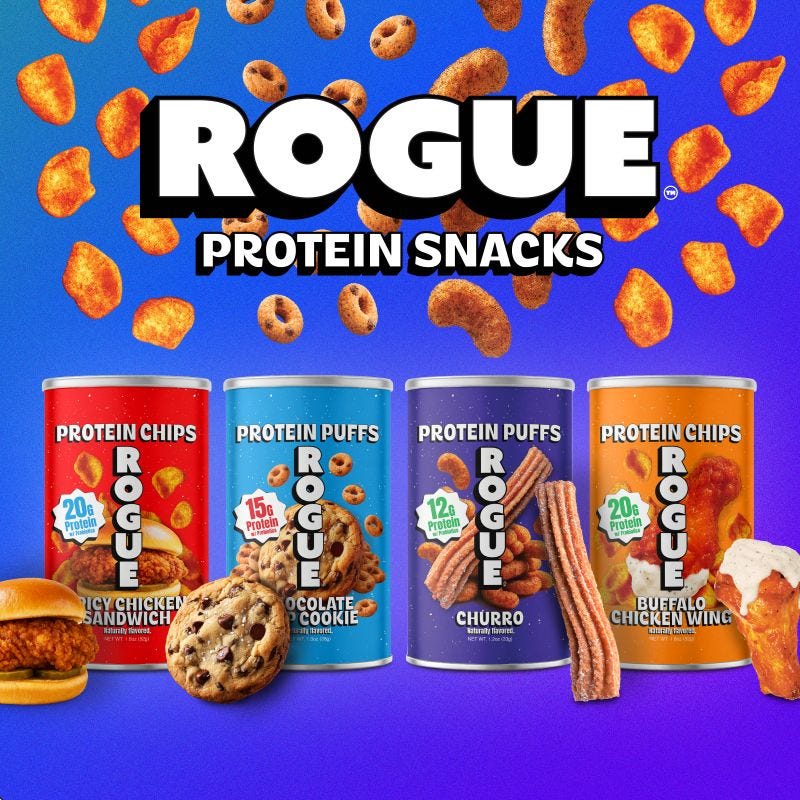
I’m sorry y’all, but this is the most AI-coded brand I have seen in a MINUTE. There is zero human life behind this brand.
Eggs aren’t enough anymore. Cal-Maine Foods, the largest egg company in the US, acquired Van’s Foods waffles and other assets from Sara Lee Frozen Bakery (owned by PE firm Kohlberg) for an undisclosed amount, expanding into gluten-free frozen breakfast. The deal is expected to lift Cal-Maine’s prepared foods annual sales by ~10%.
As commodity prices remain volatile, it makes sense to transition into products that are ready for retail to diversify its portfolio.
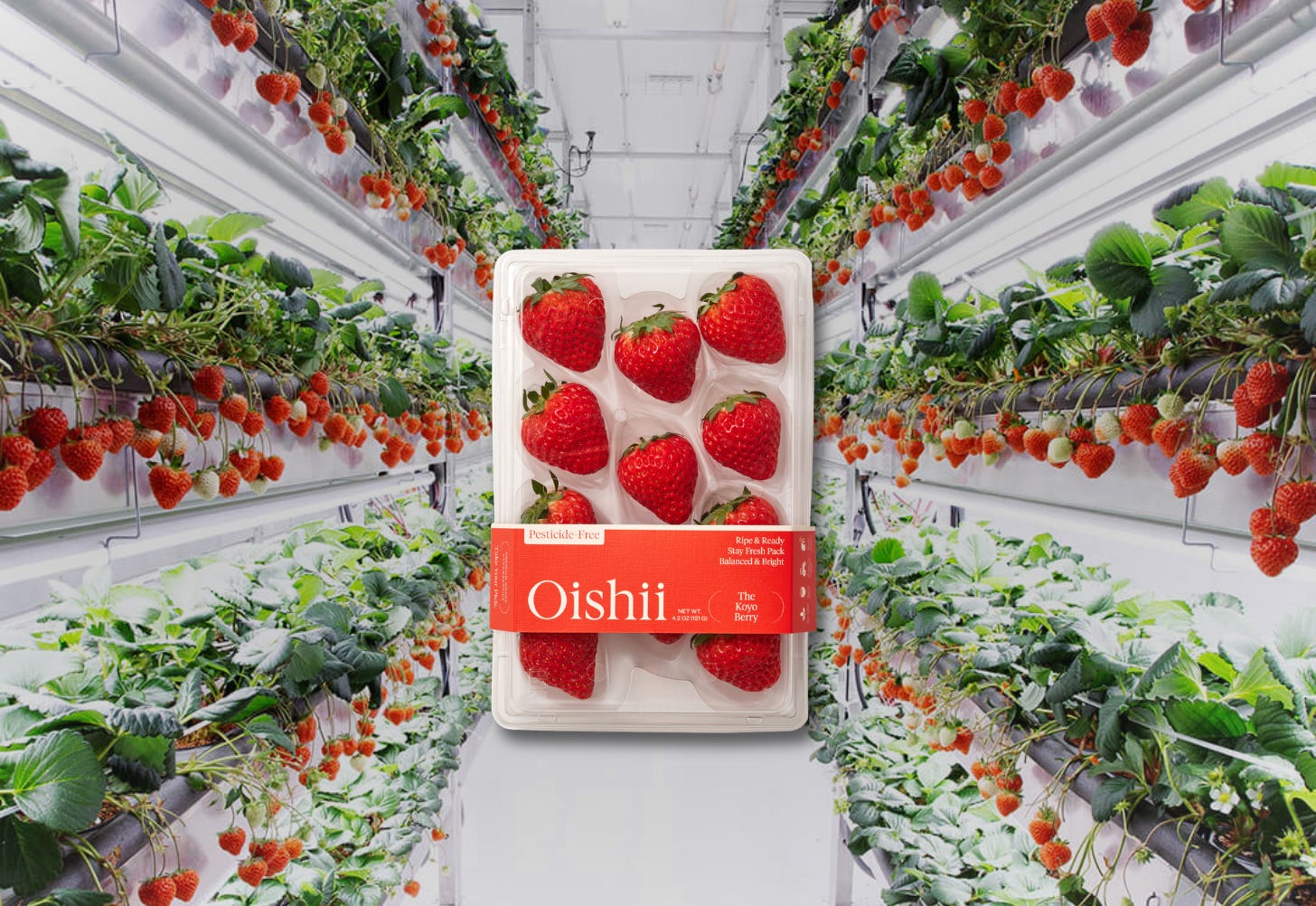
From $50 strawberries to $150 Million. Oishii—the Jersey City-based indoor vertical farm best known for its premium Japanese-varietal Omakase strawberries—raised $150M in Series C financing led by SPARX Asset Management, bringing total funding to $370M, as it expands distribution across 18 states and opens its first international retail market in Toronto.
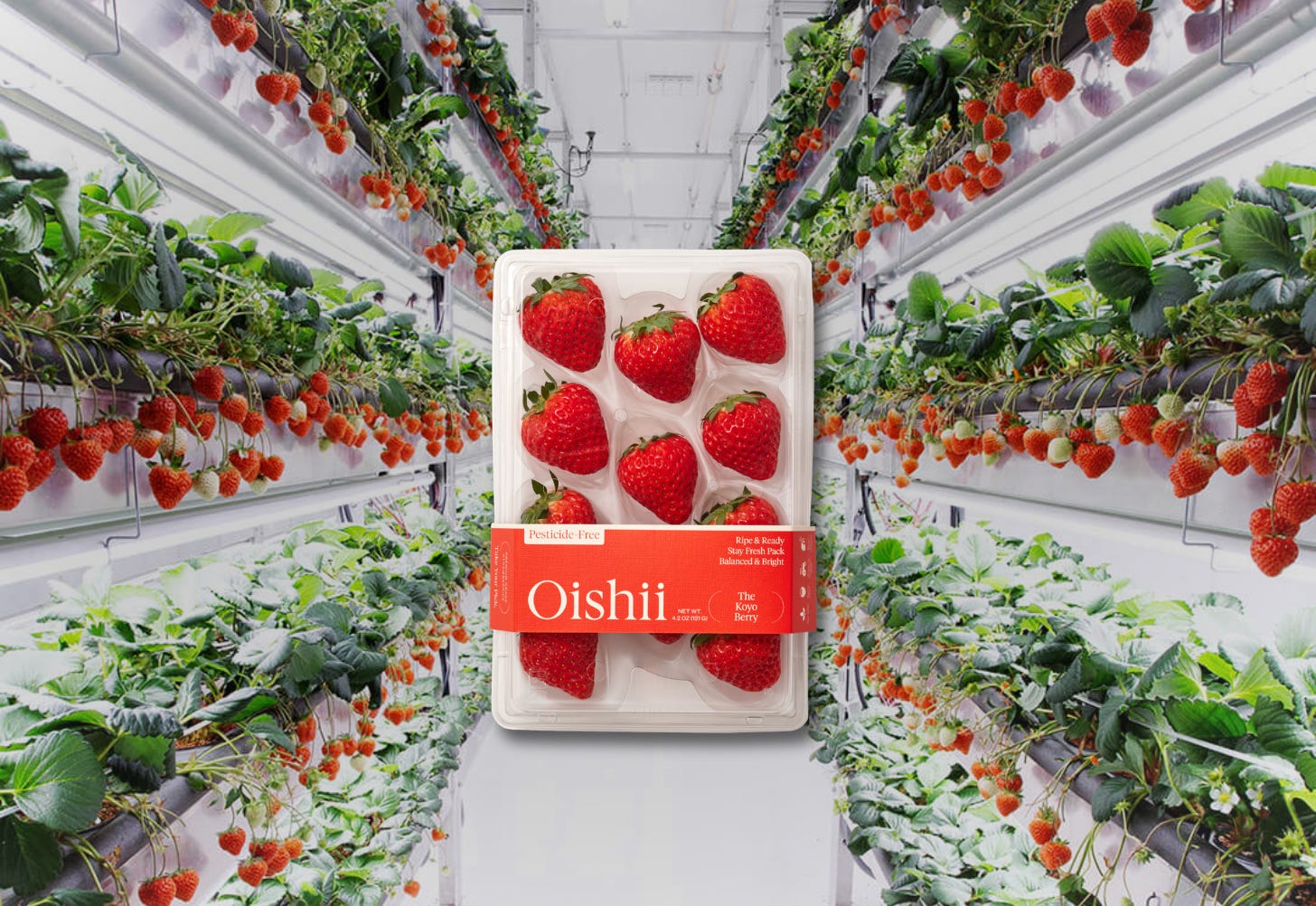
Oishii was founded in 2017 the goal of bring Japanese fruit culture, specifically the omakase strawberry, to American consumers while using that as a trojan horse to prove out what indoor vertical farming could do. They went viral for selling their Omakase Berry for as much as $50 a pack (they’ve since come down significantly in price), using the premium positioning as a showcase for what’s possible when you grow pesticide-free, non-GMO strawberries year-round in climate-controlled smart farms blending robotics with centuries-old Japanese techniques.
Oishii’s raise is notable in an industry that’s had a rough few years. Bowery Farming—once one of the most well-funded vertical farms in the country—shut down entirely, while Plenty shuttered its massive lettuce facilities to pivot toward higher-value crops. The core issue was that lettuce is a low-margin commodity that can’t justify the energy and infrastructure costs of indoor farming. Strawberries and tomatoes, both of which Oishii currently exclusively focuses on, have far better economics.
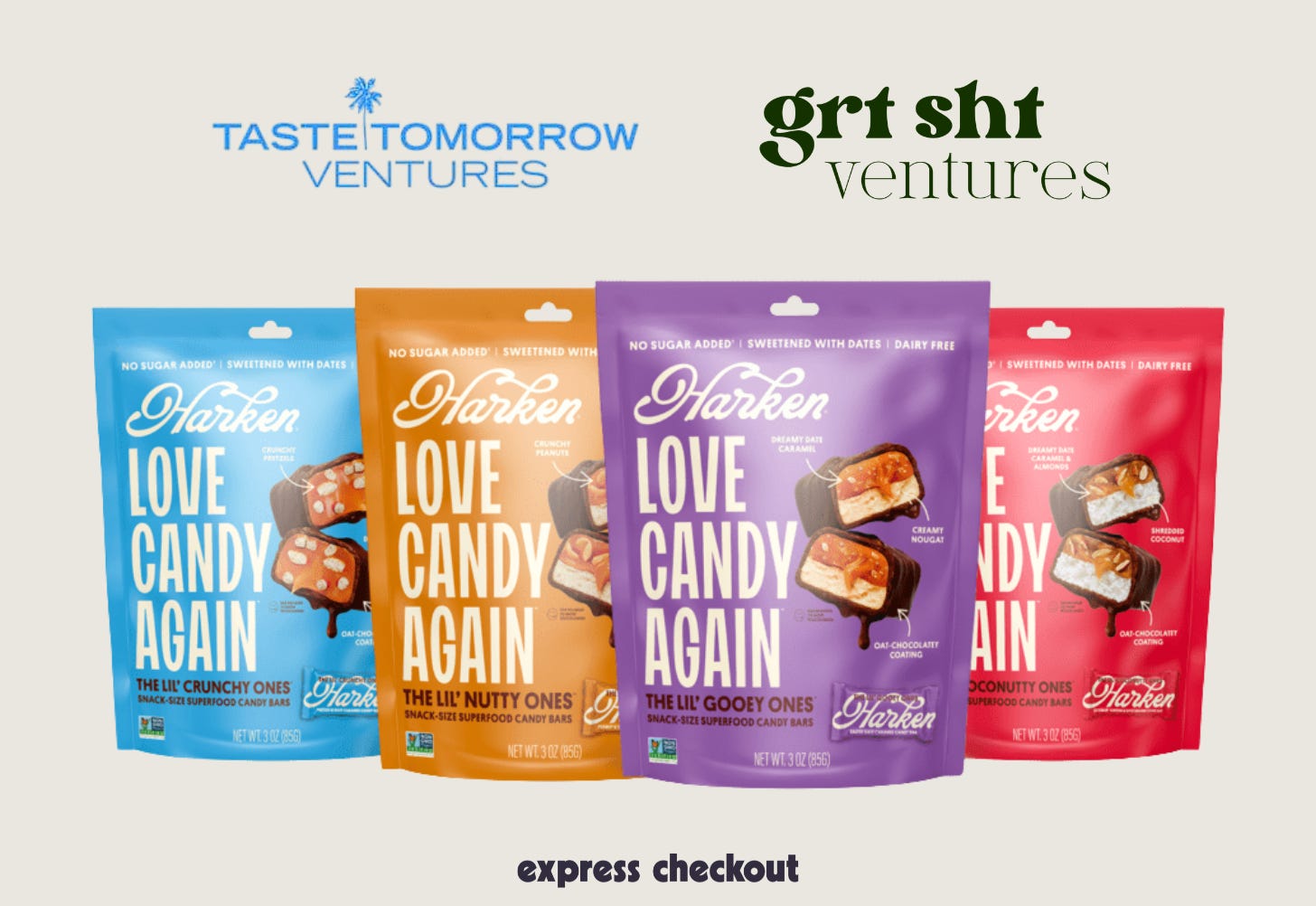
The “healthy Snickers” play gets more muscle. Harken Sweets raised from Taste Tomorrow Ventures and grt sht ventures to expand its date-sweetened line of chocolate candy bars into Costco and further build out inventory and ops. This plant-based, low-sugar candy bar brand is currently in 7,500 doors and posted 50x QoQ revenue growth in 2024.
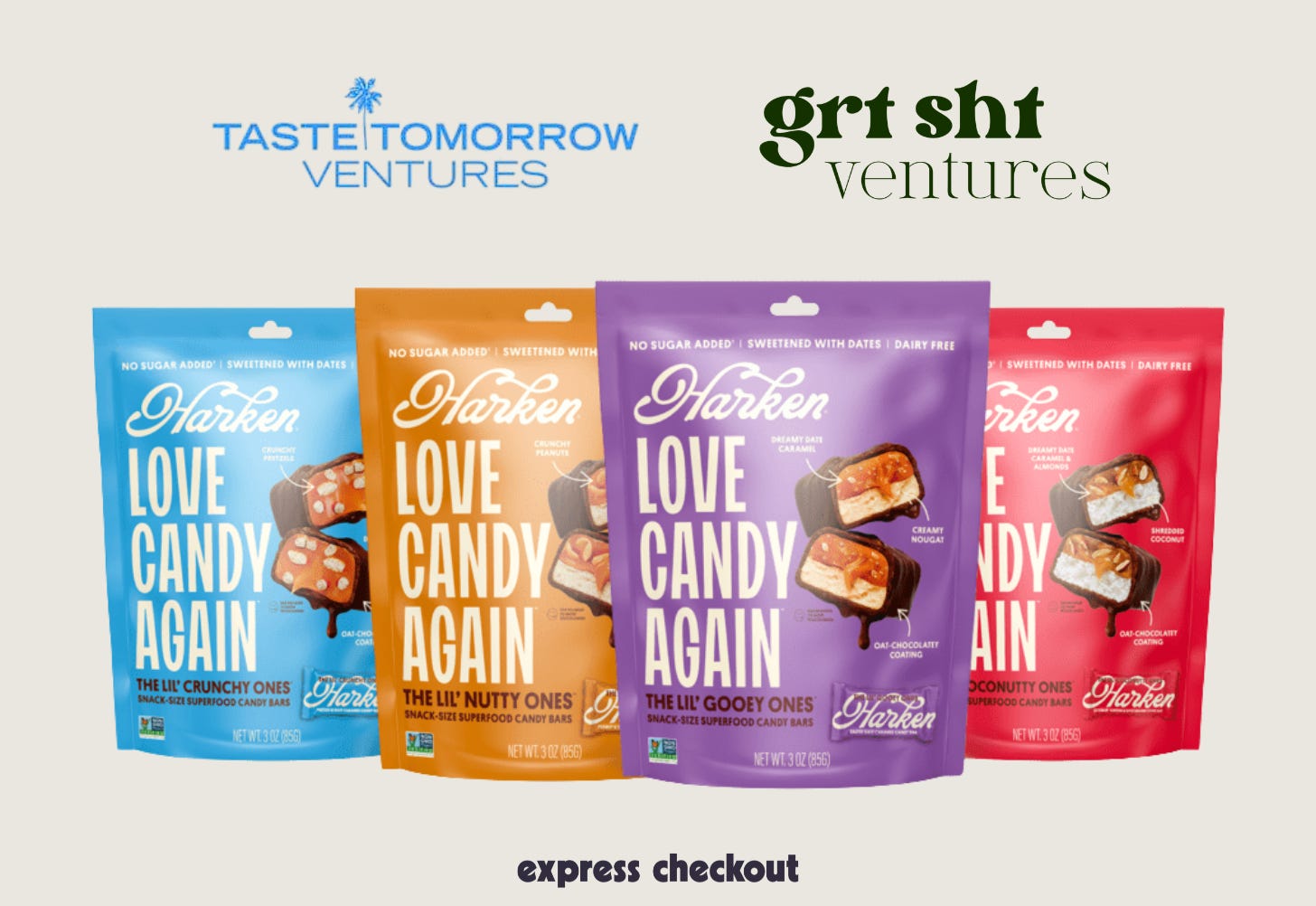
This marks Taste Tomorrow Ventures’ second bet in the better-for-you indulgent snacks category —a signal that investors are starting to treat this not as a niche but as a real aisle opportunity. Harken isn’t alone: Behave (low-sugar gummies) has gone viral on TikTok and Instagram, Blobs has expanded into Whole Foods and regional retail on a clean-label gummy play, and Protein Candy launched earlier this year marketing itself as the “world’s first super candy” with 14g protein per bag. The better-for-you candy shelf is getting crowded fast.
The consumer intent is there, even if the follow-through is spotty. 62% of consumers now recognize that better-for-you confectionery exists, but only 10% frequently purchase it —which means the gap between awareness and habit is the whole game. Brands like Harken that lead with taste and lean on a recognizable format (chocolate bar, Snickers-adjacent) have a better shot at closing that gap than brands that lead with health claims. Only 16% of Americans trust on-pack health claims, so “date-sweetened” has to taste good before it gets to be virtuous.
Do we have the next BuzzBallz on our hands? Sazerac acquired an equity stake in SIPMARGS, the RTD sparkling margarita brand backed by Alix Earle and Palm Tree Crew, and will serve as its exclusive national distributor.
Sazerac has been on a tear in the RTD space. The playbook here mirrors what it did with BuzzBallz in 2024—pick up an influencer-driven, social-first RTD brand and plug it into professional national distribution infrastructure. Since then, Sazerac acquired Dirty Shirley (March 2026) and took an equity stake in Kendall Jenner’s 818 Tequila (April 2026), becoming its exclusive US distributor.
Zoom out and it’s clear why: spirits-based RTDs are the fastest-growing segment in alcohol right now, hitting 80 million cases in 2025—up more than 10 million cases year-over-year. The category is currently dominated by E. & J. Gallo’s High Noon at around 24 million cases. So, tather than launch a new brand from scratch, Sazerac is assembling a portfolio of culturally relevant brands to compete in this category—BuzzBallz, Dirty Shirley, 818, SIPMARGS — each built around a different consumer hook, and then of course plugging them into its national distribution network to scale out fast.
More $$$ for consumer brands on the horizon. S2G Investments closed Solutions Fund I at $1B—its largest fund to date—targeting growth-stage food and energy companies with $25–$100M checks. The Chicago-based firm, founded in 2014 by Walmart heir Lukas Walton, now manages $2.8B in AUM across 120+ portfolio companies.
If you haven’t yet, please subscribe, like, leave a comment, and share it! It helps us continue to bring you the most interesting news + nuance in consumer and retail every week.
lol good one re the title