



Hello hello!
It’s late October, and the what-ifs are officially piling up:
What if a TikTok mention triples demand overnight? How much hot sauce did we sell last BFCM? What if we have to re-route orders to our second warehouse?
Introducing Endless MCP. Get answers about your inventory, wholesale orders, incoming POs, and demand across channels. All the context of an ERP, at the speed of AI, right in your lil chatbot.

And what if… you got $5,000 off your first year? The first 20 Express Checkout readers to book a demo get dibs on this exclusive offer!!!
🚨 Calling all SF-Based founders!!! 🌁 🚨
Next Monday (10/26), we’re putting on our FIRST event in SF!!! Our wonderful former intern Natalie, an SF resident, is bringing together an exclusive group of folks from the SF CPG community for a post-work sauna + cold plunge wellness experience in partnership with RetailReady!
If you’re a CPG founder or brand operator in SF, or know someone who is, request to join here.
Now, onto the news of the week →
CPG & Consumer Goods
Pepsi is having a no-good, very bad week:
Poppi is going flat. PepsiCo marked down what it expects to owe Poppi’s founders after a $1.95B buyout. The earnout, once promised at $300M if Poppi hit certain growth targets by Q3 2027, is now valued at $12M, down from $117M in June and $278M in December. 😱
According to Pepsi, Poppi’s volume is still growing (double digits last quarter). But that growth isn’t close to what the brand was seeing pre-acquisition.
There are many factors at play here, but one of them is simply that the category may be peaking. Coke has Simply Pop (and now, is playing with its prebiotic versions of its OG brands), Pepsi has two prebiotic sodas, and the shelf is crowded. Mintel’s analyst said as early as this spring that prebiotic soda growth could be close to topping out, since most people still drink soda for a familiar, indulgent taste. Olipop is slowing down too, so this isn’t only a Poppi problem.
Though it’s worth noting: earnouts are mostly IOUs anyway. 🤷♀️ Drew Fallon points out that earnouts rarely pay in strategic CPG deals. In his analysis of 100+ M&A deals from the past few years, only about 12% of total earnout value was ever paid.
Meanwhile, KFC gives Pepsi the boot. KFC announced it’s ending a 40-year exclusive Pepsi partnership in the U.S. The switch starts in January 2027 and covers roughly 3,700 U.S. restaurants by spring. This one especially stings, because Pepsi used to own KFC. PepsiCo bought the chain in 1986 and spun it off in 1997, and KFC and Yum stayed with Pepsi anyway. The WSJ reports KFC was one of Pepsi’s biggest U.S. restaurant sellers!!
A moment of silence for Mountain Dew Sweet Lightning, the KFC-exclusive peach-honey soda, which will be phased out of KFC locations in spring 2027. May we all pray that Taco Bell’s Baja Blast doesn’t see the same fate.
And then Gatorade got recalled. PepsiCo pulled 122,021 cases of Gatorade Lemon Lime, Lemon Lime Zero, Orange, and Orange Zero across 37 states (objectively the worst flavors, but I digress), because the bottles contained Yellow No. 5 and/or Yellow No. 6 that weren’t on the label.
The extra awkward part is that those are the exact flavors Pepsi promised would go dye-free. This fall, fruit punch, lemon lime, and orange Thirst Quencher and Zero were set to switch to colors from fruits and vegetables only. Pepsi hasn’t said what went wrong, but synthetic dyes missing from the label—in the flavors you’re actively marketing as moving off dyes—is a rough look.
A big week for the future of caffeination:
Never enough (clean) caffeine. Just Ice Tea launched Awaken Cold Brew Tea, bringing 120mg of caffeine from yerba mate, green tea, and white tea to a 12-ounce can. It comes in Strawberry Spark, Tropical Takeoff, and Honeydew Lime Lift, with 17g of sugar and 80 calories.
This feels like a natural next step for Just Ice Tea: take a familiar brand, and move into a new, but complementary, occasion. Plus, energy drinks are seriously growing in popularity: US energy drink spending has grown 8% annually since 2019, with better-for-you options bringing more people into the category. Just look a Bloom’s Sparkling Energy Drink brand; since launching 2 years ago, they’ve already surpassed 500 million cans sold!
Our thesis is that Just Ice Tea doesn’t need to convince, say, a Celsius or Alani Nu consumer to convert. It’s there to bring the “not really an energy drink person” crowd something they’re more comfortable trying—something organic, without all the bright branding and candy-adjacent flavors, that offers a more premium aesthetic and more approachable caffeine content than the other brands in its category.
We can’t not point out the sugar content here. This bev, which boasts being “Just Sweet Enough®” has a whopping 17g of added sugar, which certainly makes it stand out among the category’s fastest-growing brands (many of which have 0g sugar). The source is Organic Cane Sugar, which presents an interesting question for natural shoppers: do they care more about organic, natural ingredients and a “clean” sugar source, or grams of sugar?
RTDs, watch out. There’s a new format on the block. C4, Bucked Up, and Rockstar unveiled nicotine-free caffeine pouches at NACS, joining the growing crowd of brands offering an energy boost you tuck under your lip instead of a drink from a can.
With the rise of ZYN, it was only a matter of time before other brands started using the pouch format to deliver something besides nicotine. And there are so many now: Ultra, Sesh, WIP, Mojo, Nectr… even the founders of Starface got into it with Blip (which did happen to shut down less than two months after launching its functional pouches). Same thing happens anytime a format is “proven.” See: gummies.
One thing these pouch brands seem to understand, though, is who they’re talking to. There’s an obvious overlap with the consumer who already reached for a ZYN—largely young men and in finance and tech. They’re discreet, easy to use at your desk or the gym, and already part of the routine for many of these consumers. The bet is that people like the pouch format itself, not just the nicotine or whatever functional ingredients are in there.
Going beyond the beyond. Beyond Meat, now branding itself as Beyond the Plant Protein Company, is giving its protein drinks a caffeine kick. The brand launched Beyond Immerse Protein + Energy, a sparkling drink with 20g of plant protein and 160mg of caffeine, in Cherry Berry and Watermelon Strawberry.
Beyond is clearly having an identity crisis. This follows September’s trend-stacked Phytosphere lineup—protein powder, jerky, and veggie burgers—which we shared many thoughts on here. We get the impulse to move beyond meat alternatives, but checking every wellness and wellness-adjacent box isn’t really the same as giving shoppers a good reason to choose you.
Back to ACV? Bragg announced Tropical Zing, a sparkling beverage with one tablespoon of its organic apple cider vinegar (ACV), real fruit juice, 40 calories, and no added sugar per can.
It’s interesting to see Bragg launch this now, especially when brands like Olipop and Poppi (which originally launched as an ACV drink) have pivoted away from leading with gut health and toward simply saying “we’re a better-for-you soda.”
More broadly, we don’t really hear much about ACV as a wellness ingredient anymore, so maybe this is Bragg trying to bring it back into the zeitgeist. But with fiber getting more popular, gut health is due for another wave of attention—and maybe a classic wellness ingredient like ACV gets to come along for the ride.
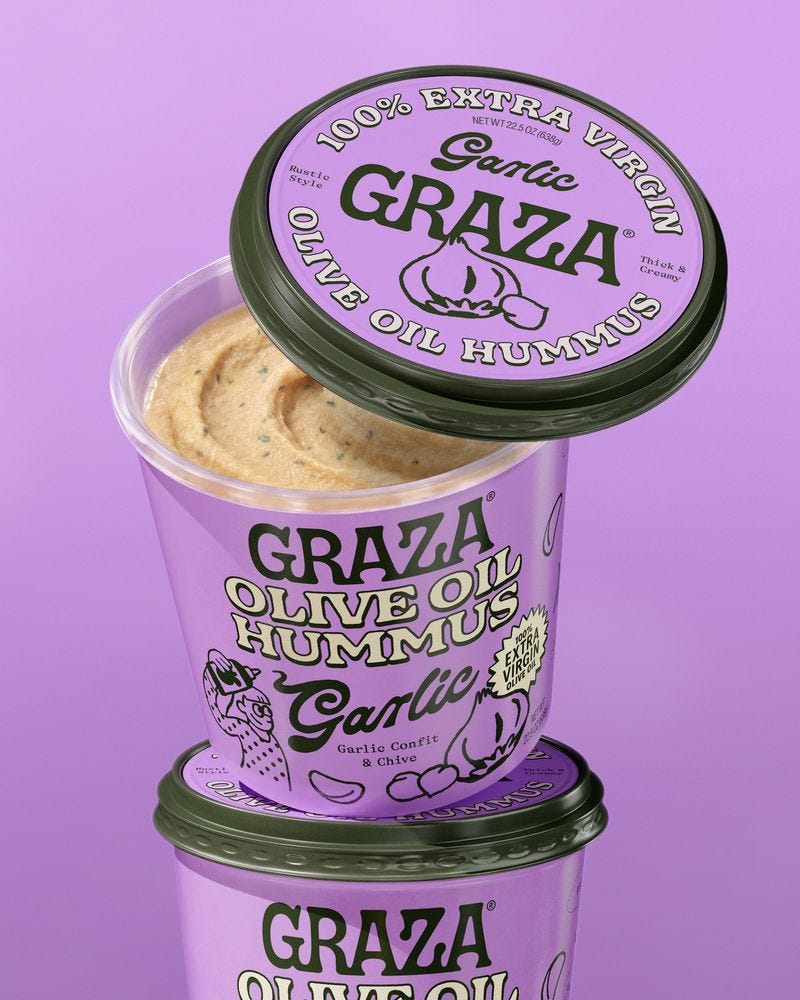
Graza takes another dip. Graza launched Garlic Confit & Chive Hummus at select Costco stores in the Southeast. Made with its extra virgin olive oil, slow-cooked whole garlic cloves, and fresh chives, it comes in a behemoth 22.5-ounce (1.3 POUND) tub suited for its Costco launch.
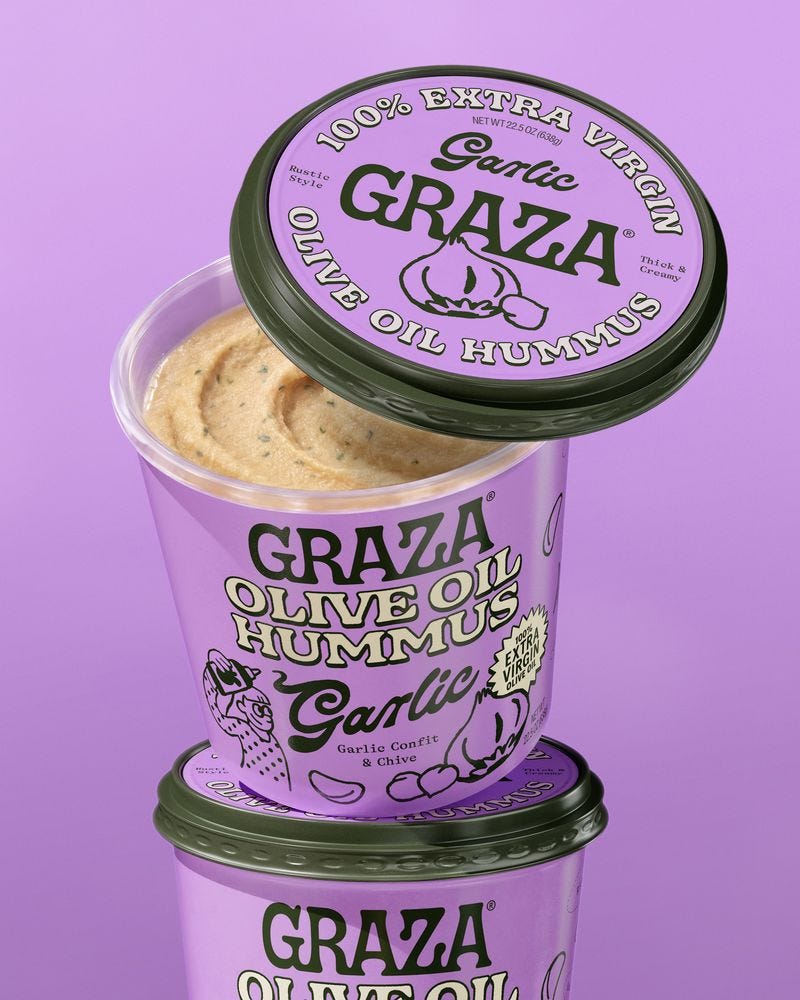
Graza has come a long way from putting olive oil in a squeeze bottle. The brand now offers a full line of olive oil potato chips, mayo, and now, hummus. Graza made its name in olive oil, got people to obsess over and trust the brand, and is now bringing that into other products with olive oil at their core. You don’t have to reinvent every aisle you enter. Sometimes making really good food that your existing customers want to try is enough. All while reportedly exploring a $600M sale with Lazard. Hard to deny what they’ve built.
What’s especially interesting about this launch is that hummus isn’t new territory for Graza. Its 2025 collab with Ithaca Hummus made its way into Whole Foods, Target, and Costco, and picked up a NOSH Best New Product award. While we don’t know the details of the split, Ithaca now has its own Olive Oil SKU, and Graza has become a shelf-mate at Costco.
This whole collab-to-launch pipeline has us thinking: do brands see collabs as soft entries into other categories? The Ithaca collab is looking more like a testing ground than an authentic collab in retrospect…
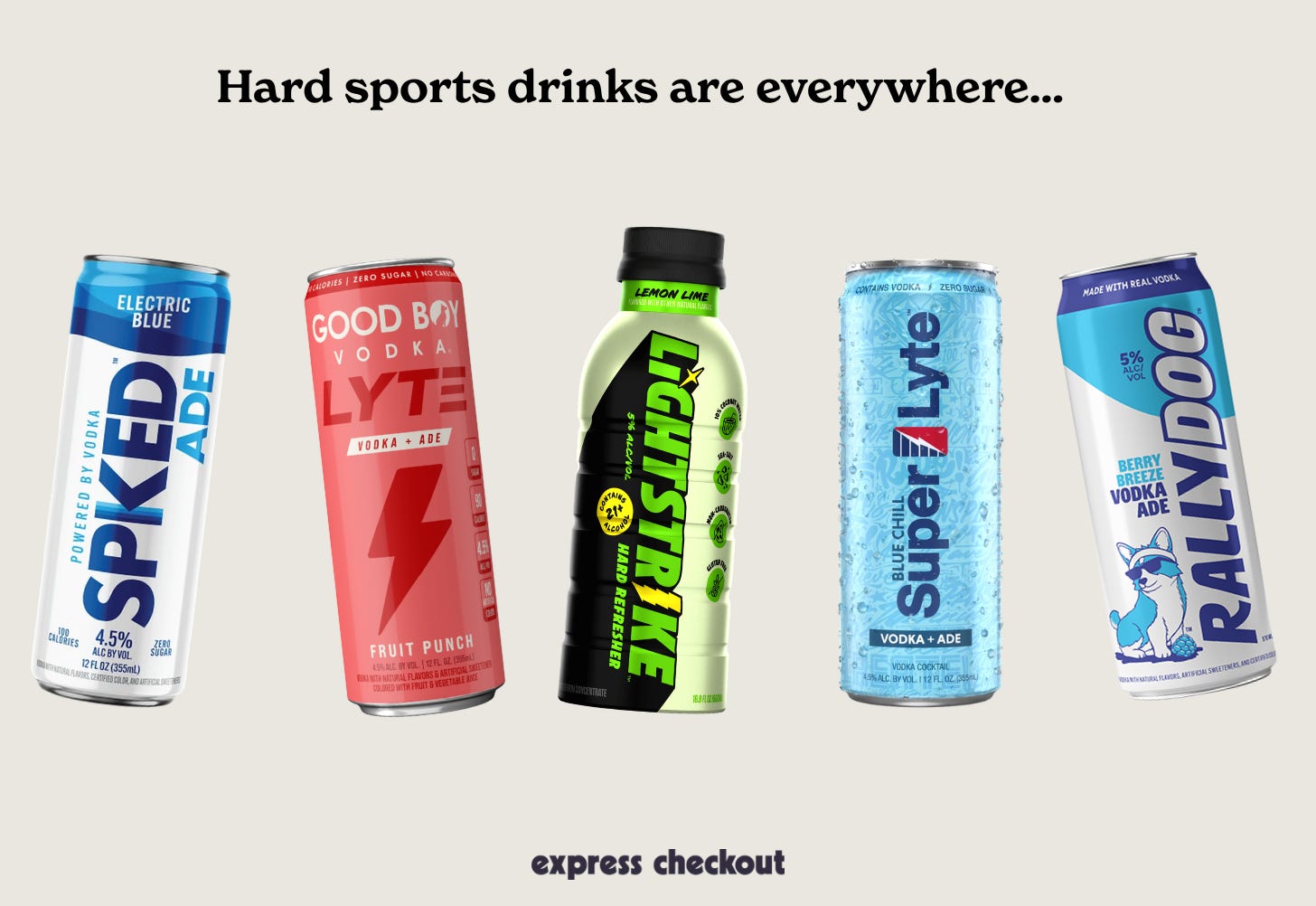
The 3-in-1 body wash of booze. Why have separate drinks for the party and the morning after? For everyone who thinks shampoo, conditioner, and body wash belong in one bottle, apparently your booze and morning-after sports drink do, too. White Claw maker Mark Anthony Brands introduced RefreshAde, its take on a hard sports drink. Yes, that’s a sports drink with booze included, and no, that doesn’t make it a hangover cure. It joins Super Lyte and SpikedAde in this growing hard sports drink category.
We went from drinking Gatorade the day after a night out, to chugging a Liquid IV while leaving the function, to putting the sports drink and the booze in the same can. The low-calorie, low-sugar pitch that helped sell the first wave of hard seltzer apparently isn’t enough anymore. Today, consumers are looking for added function, not just a lack of the “bad” stuff.
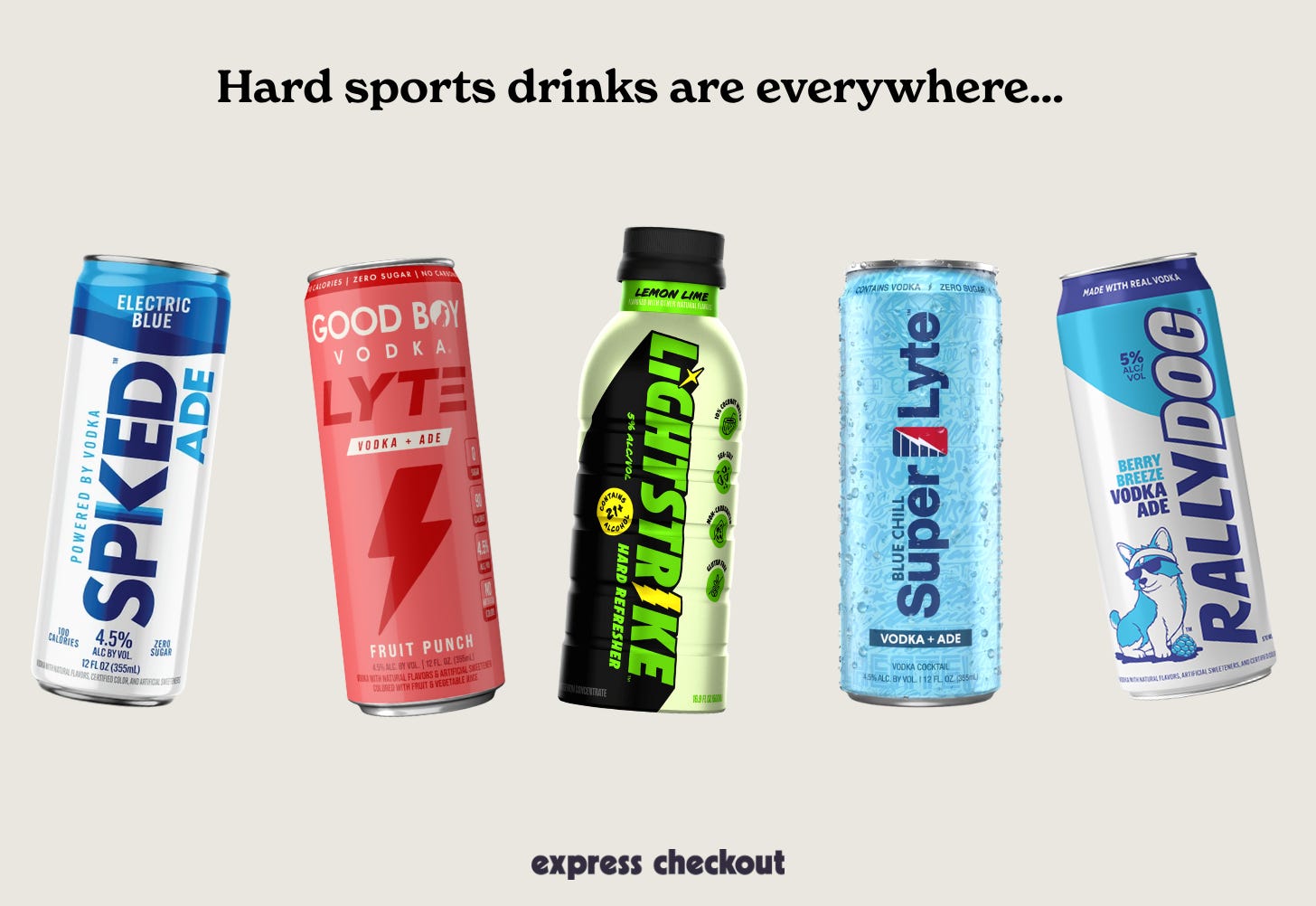
And the category is booming. Super Lyte, a vodka + electrolytes RTD from the company behind Surfside, moved 120,000 cases in its first five weeks after launching in March and is now projecting 4 million cases by end of 2026. Last month, Boston Beer incubated Rally Dog Vodka Ade, another “vodka ade” made with real vodka and a hint of sea salt for electrolytes. And just last week, Constellation Brands acquired SpikedAde for $75 million, with up to another $278 million tied to performance. These are pretty big bets on sports-drink-inspired booze. With that kind of traction, it’s not surprising the company behind White Claw wants in on the category too.
Target may be the next Whole Foods, but Walmart is becoming the next Target. We’ve spoken ad nauseam about Target’s new focus on better-for-you groceries and wellness, and now, we’re seeing Walmart take on a similar thesis:
This week, Reprise Health, a brand that brings traditional Eastern herbal remedies into convenient, tasty gummy formats, has expanded into 470+ Walmart stores nationwide through the retailer’s new Trending in Wellness set. This is Reprise’s first entry into mass retail after launches at Whole Foods, Sprouts, and The Vitamin Shoppe.
Reprise Health is one of my favorite supplement brands! The founders both grew up with Eastern herbal remedies, and these vegan gummies are their modern answer to an accessible version of that tradition. They are incredibly thoughtful about sourcing their ingredients (from a 5th generation Taiwanese family), care deeply about quality and testing (they lab-test each batch 3x!), and develop all of their blends with doctors. Great find by Walmart!! - Jenna
This feels especially timely, because earlier this month, Walmart launched a new category: Mood & Mind, a beverage set specifically focused on functional drinks, in ~1,000 stores. The category includes brands like TRIP, Recess, Neutonic, Nowadays, and more.
With the focus on up-and-coming, buzzy wellness brands—like Reprise Health—and spotlighting functional, wellness-forward categories, Walmart is solidifying itself as yet another mass-retailer-turned-brand-discovery-destination.
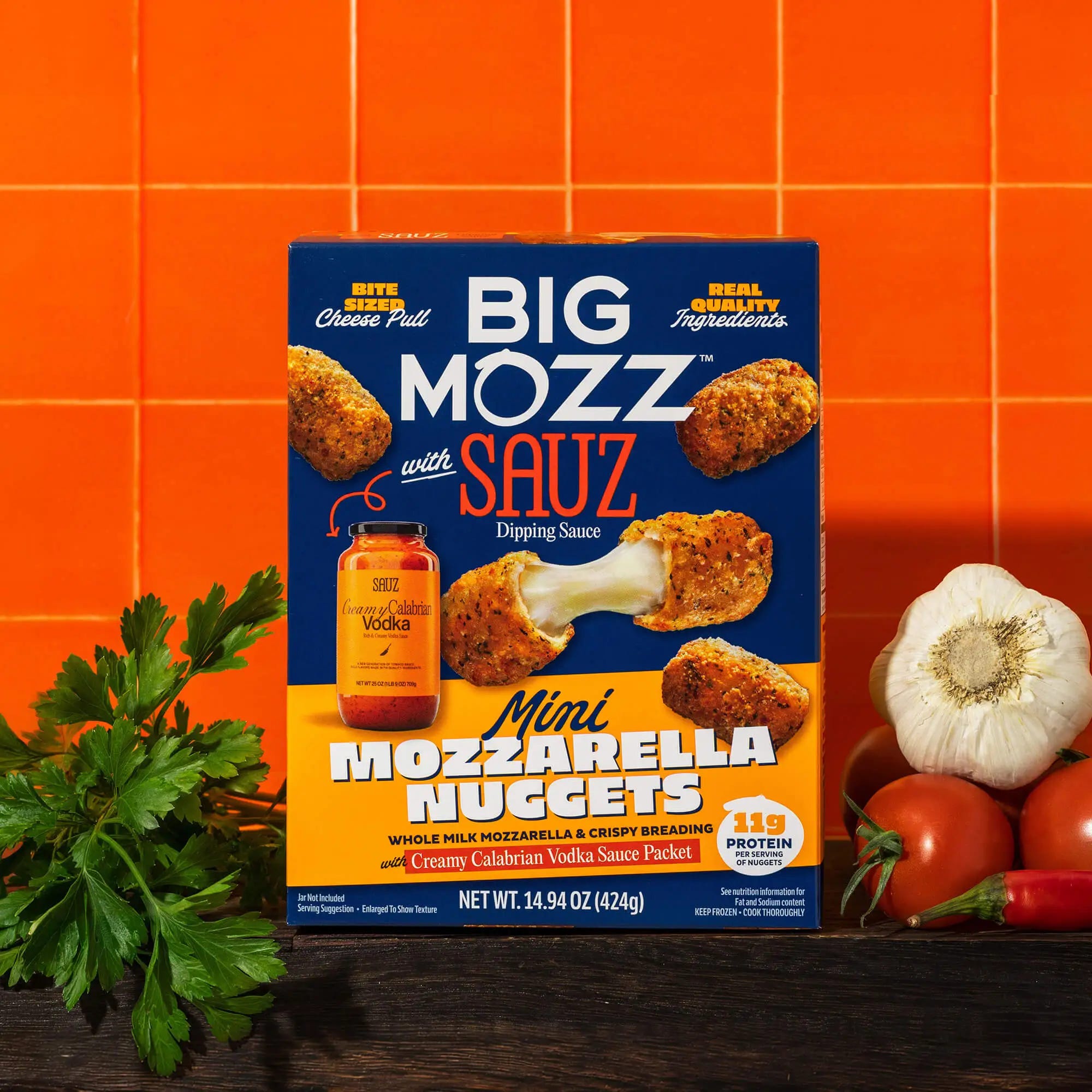
A big W for the frozen aisle. Big Mozz, the frozen mozzarella stick brand, is launching its Original Mozzarella Sticks nationwide at 1,500 Target stores. Also joining the freezer: a Target-exclusive SAUZ collab pairing Mini Mozzarella Nuggets with Creamy Calabrian Vodka Sauce. Brilliant. This might be the most well-aligned collab we’ve seen in a minute—not surprising once we learned that the collab’s impetus was a Target buyer dreaming this up on the Expo West floor!!
The fact that they went with the Creamy Calabrian Vodka Sauce, instead of a traditional marinara, adds to the brilliance of this collab. Big Mozz is known for its “big flavor,” and SAUZ is known for its nontraditional pasta sauce flavors. This collab beautifully marries the two, and we actually cannot run to Target fast enough to try this.
Proda’s bringing protein back, yeah! Justin Timberlake and Jessica Biel have joined Proda, a zero-sugar protein soda brand, as co-founders in their first joint business venture. They join original co-founders and co-CEOs Matthew Postlethwaite, an actor and wellness entrepreneur, and Jeff Church, who previously built Suja Organic. Barry’s executive chairman Joey Gonzalez is also joining as a co-founder.
We’ve spoken before about what it takes to build the “perfect” celebrity brand, and honestly, we’re waiting with baited breath to see how this one plays out.
Another influencer tequila RTD. Haley and Hanna Cavinder, former college basketball players turned twinfluencers, are joining Azúcar Tequila as Creative Directors, helping shape its content, storytelling, and events. The canned margarita brand is rolling out in Dallas and Austin, and is made with real tequila, fruit, and agave nectar.
Feel familiar? It should, because Alix Earle did something very similar with a very similar product when she joined SipMARGS as an investor and partner. Apparently, everyone needs a tequila RTD to go with their following (or, more likely, every tequila RTD needs an influencer to stand out in an increasingly competitive category…).
The Hunger Games of haircare. Jennifer Lawrence is officially entering beauty with her first brand, mes°, a hair-care line. The brand was co-created with Arcaea a biotechnology that raised $78M from Chanel, Givaudan and Olaplex back in 2021. More details are teased for October 27th.
JLaw’s entering a crowded haircare aisle, but an even more crowded celebrity haircare aisle: Beyoncé’s Cécred, Blake Lively’s Blake Brown, Shakira’s Isima, Tracee Ellis Ross’s Pattern and Jennifer Aniston’s LolaVie.
Fragrance at the speed of TikTok. Bath & Body Works launched Hype Lab, a small-batch fragrance initiative that develops scents in 8-12 weeks based on social trends, in partnership with MANE fragrance house. The first drop—a viral dessert-inspired trio—sold out online in three minutes. Hype Lab will be hosted on Bath & Body Works’ new online platform, [Drops](https://www.bathandbodyworks.com/t/drops?), which releases early-access products and other online exclusives.
This is part of a larger play by the retailer to turn around the business: Bath & Body Works’ Q2 sales fell 2.3% year over year to $1.5 billion, with U.S. and Canadian store sales down 5.4%. The only bright spot remains seen in digital sales, which grew 3% (likely partly due to the brand’s Amazon launch in February). Looks like B&BW will be leaning in further to digital sales (and other retailers, like Ulta) as part of its Consumer First Formula turnaround plan.
eCommerce
As TikTok Shop volume grows, value shrinks. TikTok Shop beauty sales reported $992.9M in Q3 2026—up 39.1% year over year, but growth has slowed sharply from 96% in Q1. GMV (gross merchandise value) per active beauty video collapsed from $379 in Q3 2024 to $96 today as video volume surged 76% YoY.
TL;DR: As TikTok Shop Beauty sales get closer to $1B, and more and more brands join the platform and pump out content, the category’s growth rate is slowing down and the value per video decreases.
K-Beauty continues to lead the platform, with brands like Medicube and Dr. Melaxin holding strong at the top—though they’re now subject to the same sales dips seen across the platform.
Google wants in on every transaction. Google launched Universal Cart in the US, a shopping hub in Search and Gemini that tracks price drops and surfaces promo codes across retailers (right in time for the holidays). It’s built on the Universal Commerce Protocol, Google’s open standard for AI-assisted checkout.
As Amazon and OpenAI continue building out their own agentic shopping experiences, it will be interesting to see who wins the next era of ecommerce.
Retail
Carbone’s parent just put money into groceries. Wilder Market & Kitchen is opening this fall in Miami as an 8,000-square-foot neighborhood market backed by Major Food Group as a founding investor—MFG’s first investment outside its own restaurant operations, with Michelin-starred Grassfed Culture running the food program.
Danielle Axman, founder of Wilder, told Forbes: “We are reimagining the neighborhood market by bringing together thoughtfully sourced groceries, a café, and chef-driven prepared foods under one roof. Everything we carry and make is held to the Wilder Standard, our vetting framework that brings together thoughtful sourcing, high-quality ingredients, and food that tastes great, so the homework is done before anything reaches the shelf.”
TBH, this sounds a whole lot like a few other fancy grocery stores we’ve encountered—including another one in the same city, Nude Miami. In June, we wrote about how everything is Erewhon now, and this is yet another supporting point.
Funding, Mergers, and Acquisitions
TikTok to Target to $25M in under two years. EZ Bombs raised $25 million from CAVU Consumer Partners. The brand’s shelf-stable Mexican seasoning bombs scaled from zero retail doors in 2025 to 8,000+ locations—including Walmart and Costco—after going #1 on TikTok Shop last year.
We’ll be watching this one closely, because this really is a new model for CPG growth. Where DTC-first was king for a decade or so, we’re now seeing this model arise: social shopping first. For a product like EZ Bombs—which requires some education for use—the social-first, visual-first strategy just makes sense. What CAVU is betting on, really, is that the virality (and subsequent retailer validation) catalyzed by TikTok Shop is sustainable.
The Kelce bros have cracked beer. Garage Beer, the Ohio-based light lager brand co-owned by Jason and Travis Kelce, secured a $20 million revolving credit line from Tiger Finance to expand its product lineup and enter new markets.
Beer is having a rough go of it lately. The industry is facing rising supply chain costs, big swings in drinking habits, and breweries shutting their doors or filing for bankruptcy left and right. Garage Beer, meanwhile, is now Ohio’s biggest craft brewer by volume and 12th largest nationally—and is growing faster than the overall beer category itself! As of late 2025, it was already valued at roughly $200 million, just two years after it spun off from Braxton Brewing into a standalone company. Jason and Travis obviously play a role in selling Garage, but that overlooks what’s really being built here. We think this could be America’s next big beer brand—unless someone bigger scoops it up first 🤷.
What’s especially interesting is that this is a celebrity brand that doesn’t fully feel like a celebrity brand. The Kelces are heavily involved, but if we’re being honest, nothing about two football guys selling a beer called Garage Beer feels like much of a stretch. Everything about this brand makes sense for them and the people who follow them, which transcends to what’s actually in the can: a no-frills light beer that comes in classic or lime.
Big skincare money is at the doctor’s office. Galderma, a pharma and skincare company (known for injectables) has acquired ZO Skin Health, a dermatologist-founded skincare brand primarily distributed through physicians and med-spas, for $1.5 billion, or ~4.5x its $330M in net sales. Blackstone (majority owner) and the founding Obagi family are selling; combined with Alastin, Galderma now holds 19% of the U.S. professional skincare channel.
Physician-dispensed skincare has a major leg-up on the broad, non-sticky skincare category. As Hayden Williams, partner at BrandProject, told Beauty Independent: “Skincare shoppers are not known for their loyalty. Every week brings a new TikTok trend, a new hero ingredient, a new brand promising glass skin by Friday. Most brands end up paying to win the same customer over and over again. A brand whose customers actually stick around is rare, and rare is expensive, which is where physician-dispensed skincare has an edge.”
If you haven’t yet, please subscribe, like, leave a comment, and share! It helps us continue to bring you the most interesting news + nuance in consumer and retail every week.