



Hello hello!
We have two very exciting events coming up in NYC, and we’re looking for the right folks to join us:
First, we’re hosting a private dinner next Tuesday at a stunning NYC spot, exclusively for marketing and growth leaders at $20M+ brands. We’ll be chatting about how to turn AI discovery into your next major growth channel! We have very limited seats remaining for some of our lovely newsletter readers—if you fall within that category and you’re hoping to attend, reply to this email.
And on October 6th, we’re putting on our most exciting event yet: the second edition of In Season, Express Checkout’s quarterly event featuring the top three biggest trends of the season and the brands behind them. This time around, we’re hosting at a gallery in downtown NYC… basically a museum of trends, where tasting opportunities are abundant (giving Willy Wonka a run for his money).
Note: This event is for select brands, investors, media, and tastemakers only—if you’re a B2B platform or service provider hoping to join + activate, please reply to this email to chat about remaining sponsorship options!
We’re so excited to see some of our incredible NYC community in one room. :) If you’re interested in putting on a highly-curated, private dinner with our network of CPG professionals, or if you want to learn more about getting involved in our larger-scale events, hit reply to this email.
News From the Week
If everybody else is proteinmaxxing, how do you retain your status as a superior, highly-informed wellness consumer?
You supplement your supplements, of course.
This week, Thorne launched Protein Optimizer, a probiotic-enzyme formula combining active cultures with the digestive enzyme, amylase, marketed to “work along the gut-muscle axis” to “maximize the benefits of every gram of protein you consume.”
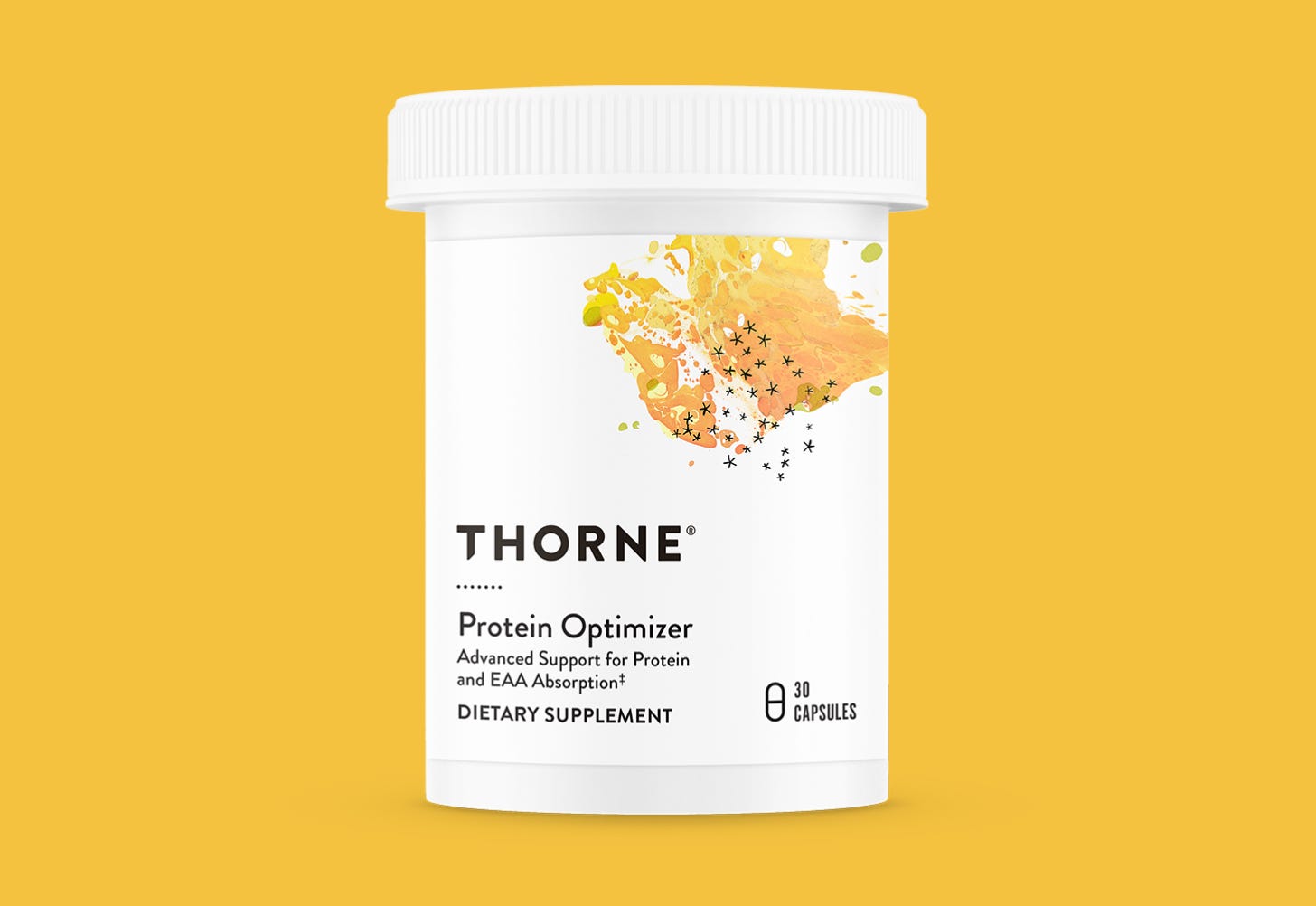
In other words, it’s a supplement for your supplements. A meta-supplement, if you will. Welcome to wellness dystopia 😈.
How the heck did we get here?
We don’t need to tell you that protein is everywhere now. But just to really drill it in: this week, Optimum Nutrition launched a non-alcoholic protein beer, and Folgers launched protein coffee (more on both in the newsie below). Every category has been utterly doused in protein, to the point that the latest wellness trend, proteinmaxxing, is inescapably mass-market.
But the whole point of wellness is to keep consumers forever striving towards something that’s juuuust out of reach. Once Folgers is offering protein, once it’s in every single category including NA Beer, it’s probably too reachable. And the industry must do its job to introduce something that, once again, reminds you that you aren’t doing enough.
Once an ingredient goes mass-market, the category doesn’t die—it just moves up a level of abstraction, from “do you take X“ to “are you taking X correctly? How fluently can you describe what happens to it once you’ve swallowed it?” (followed by a slew of terms that trigger AP Bio anxiety like: Gut-muscle axis, amino acid absorption, bioavailability). The meta-supplements layer is where the next round of premium pricing and consumer anxiety gets manufactured.
Just look at what’s happening to the GLP-1 market. GLP-1s went mainstream fast (15% of Americans have now tried GLP-1s), and once being on one stopped being differentiated, an entire secondary industry sprang up purely to manage what the primary product does to your body:
Nestlé built an entire brand, Vital Pursuit, explicitly for GLP-1 users—cauliflower-crust pizzas, chicken bowls, sandwich melts, while Danone launched Oikos Protein Shakes “geared to GLP-1 users.”
Conagra put the words “GLP-1 Friendly” directly on packaging, an “On Track” badge slapped across 26 Healthy Choice frozen meals.
Herbalife launched a GLP-1 Nutrition Companion line built around its existing protein shake, marketed to fill the nutritional gaps created by appetite suppression.
None of these compete with the GLP-1, but they all exist because the GLP-1 alone wasn’t enough to feel “done.”
“GLP-1 creates new nutritional gaps” is similar in rhetoric to “you’re not absorbing all your protein”; it takes something people feel good about doing correctly and reveals a new, previously invisible problem underneath it.
So what’s next? If the pattern holds, meta-supplements won’t stay a one-off Thorne launch—they’ll become their own aisle. Here’s what we’re watching for:
Gut-muscle-axis vocabulary migrating out of sports nutrition and into everyday wellness. Right now “optimizer” language lives mostly in performance and longevity circles. Expect it on mainstream shelf tags within the year like Nature Made, Olly, and the private-label brands that usually lag trends by 12-18 months.
Bundling, not swapping. These products only work as an add-on, never a replacement—so we’re watching for protein powder sold packaged with its own optimizer, at a combined price higher than either would command alone.
A GLP-1-style taxonomy forming around protein specifically: side-effect mitigation (bloating, digestion), gap-filling (absorption, amino acid completeness), and eventually post-optimization support—something to help you taper off the Optimizer once your gut’s “recalibrated.” Because of course there will be an off-ramp product too.
And if we’re really getting meta here, we just might see a product positioned to help you absorb your absorption enzyme. Dear god….
There is always a higher-order function to be sold in the hamster wheel that we call Wellness. Just make sure you know why you’re running on it in the first place.
CPG & Consumer Goods
Beyond Meat is having a major identity crisis. In the latest edition of “Beyond Meat tries something weird in hopes of making a comeback” (see two more examples here), the brand launched its “Phytosphere portfolio”—protein powder (”Beyond Starmatter”), jerky (”Beyond Starcut”), and a veggie burger (”Beyond Veggie”). Every product in the line is focused on complete nutrition featuring protein, fiber, and in the case of “Starmatter,” polyphenols, adaptogens, and biotin.
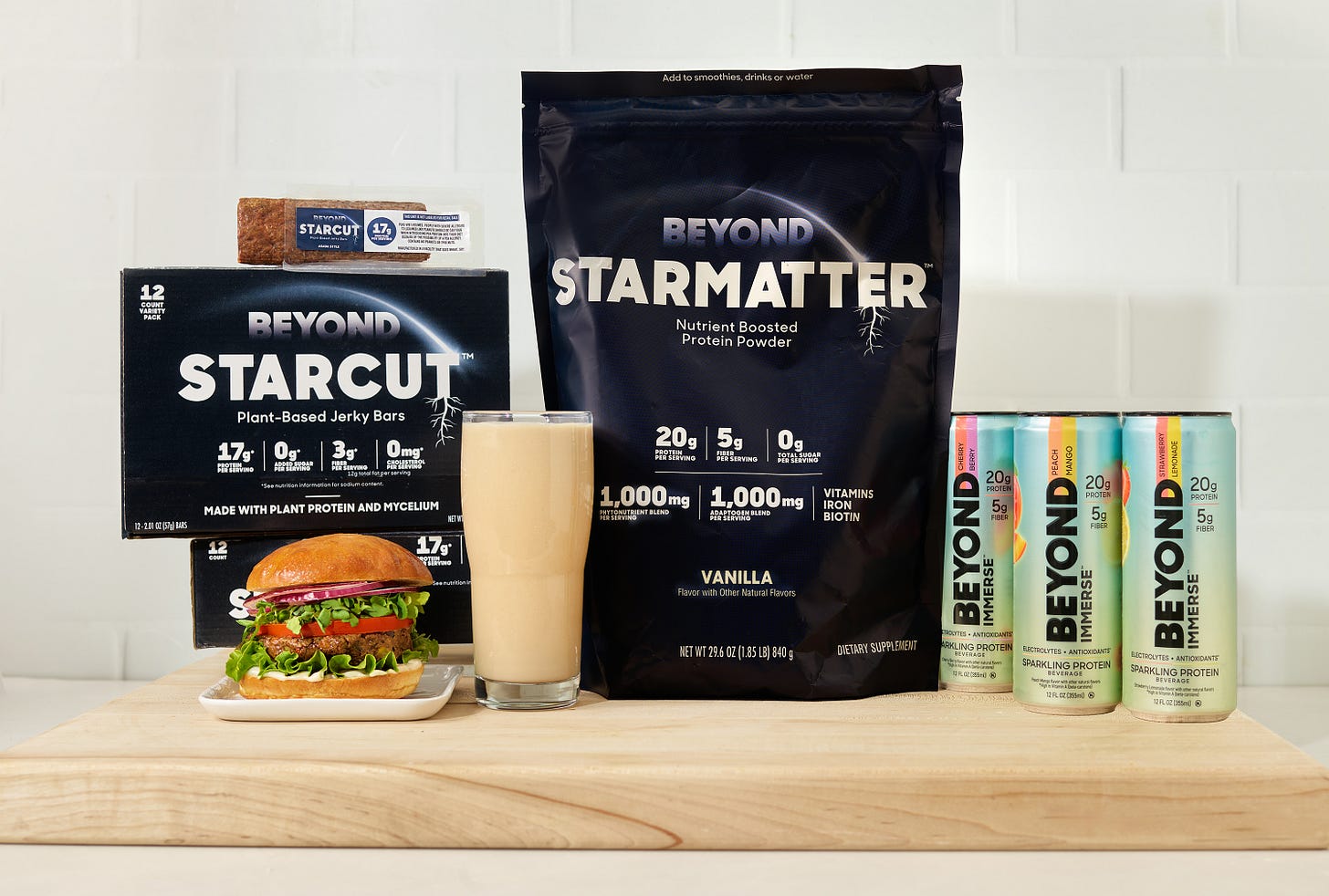
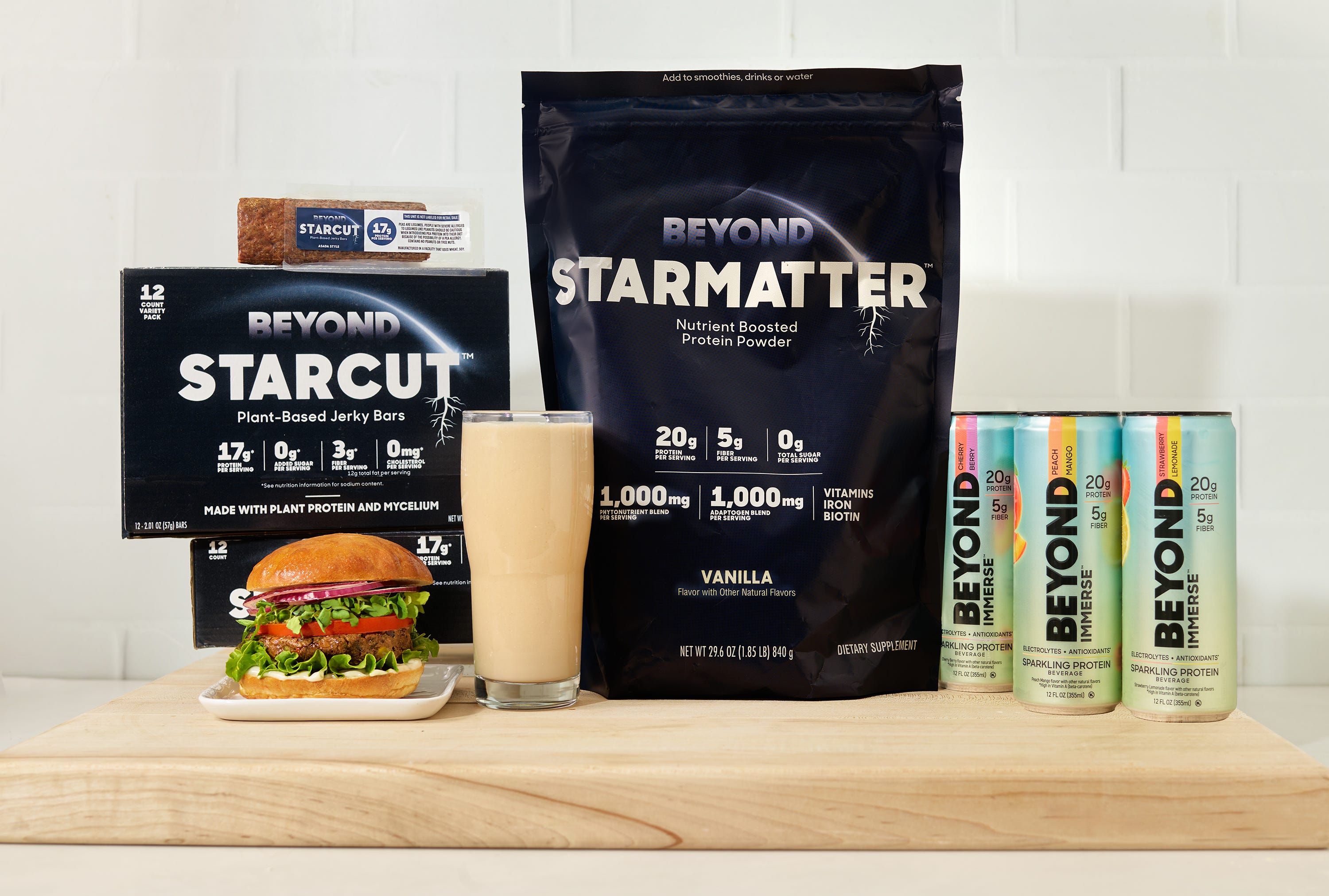
As a veg girl, I was really rooting for Beyond’s comeback, and I cannot stress enough how disappointed I am to see where it’s landed. For starters, “phytosphere” is giving me chilling flashbacks to “metaverse,” AKA out-of-touch tech company attempting to sound hip. But my biggest gripe with this line is that the core objection to alt meat has always been its “lab-made” framing, that consumers “don’t know what’s in it.” Leaning into this celestial theme only further alienates the product—and the literal black-box design, which offers no on-pack product imagery, wholly removes any possibility of gaining trust.
Just last year, Beyond’s CEO Ethan Brown told Inc that he wanted to focus on “producing food that doesn’t imitate anything,”—clearly aware that trying to compete against animal-based protein wasn’t a winning game. While the veggie burgers (which are made from whole-ingredients, reminiscent of Actual Veggies) do seem in line with this thesis, Starmatter and Starcut both diverge. Starcut is literally marketed as jerky…during the height of the meat stick craze, no less. And Starmatter, the protein powder that seems to have thrown every single nutrition trend into one bag, competes with countless whey powders and, by nature of its format, drives the consumer even further away from the “whole food” messaging. Color me (galactically) confused.
Cookies for all! The Girl Scouts are adding two new cookies to the 2027 lineup, and both arrive by way of a collaboration: Patch Pals, a blueberry dog treat made with BARK, and Girl Scout Sparkables, an allergy-friendly oatmeal cookie made with Partake. Both of these are a first for this organization—its first cookie for dogs, and its first free of the top nine major allergens.
Partake is a fascinating brand to watch. The brand itself, founded in 2016, seemed to peak when allergen-friendly products were all the rage, hitting national retail in 2024. Since then, it’s maintained relevance through smart co-branding and ingredient supply: The Ben & Jerry’s Oatmeal Dream Pie (2023, a permanent non-dairy flavor using Partake’s oatmeal cookies), plus deals with JetBlue and DoubleTree by Hilton, show a company that licenses its allergy-friendly credibility into other people’s products, just like it’s now doing with Girl Scouts. It’s a great example of a brand creatively transcending the perceived ceiling of nationwide mass-market retail distro.
Ice cream for breakfast. Alec’s Ice Cream just launched the Ice Cream for Breakfast Culture Cup with Purely Elizabeth, a probiotic cereal milk ice cream under a crackable strawberry shell, finished with Purely Elizabeth granola clusters.
Alec’s Culture Cup, a A2 regenerative-organic dairy, single-serve, pre- and probiotic, clean-label, gluten-free ice cream cup, launched in early 2025 and had a viral sellout. Though Alec’s was already known for its A2 pints, it was these single-serve cups that really helped the brand take off. By October 2025, the brand closed an oversubscribed $11 million Series A.
“Ice Cream for Breakfast is more of a feeling than a flavor and Purely Elizabeth was a natural partner to bring this to life! We share the same philosophy: craveable foods and foods that make you feel good don’t have to be mutually exclusive.” - Alec Jaffe founder and CEO of Alec’s Ice Cream
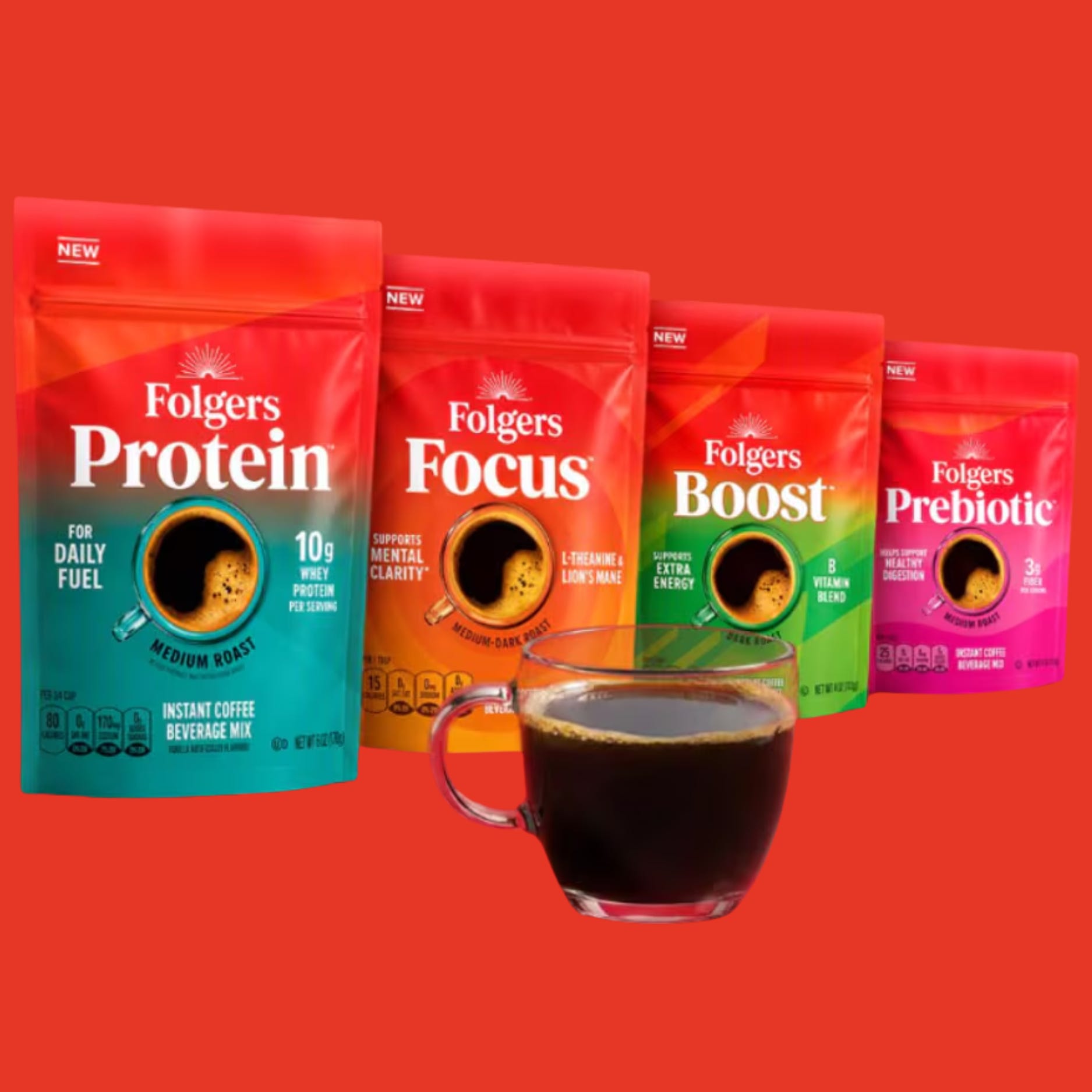
Now THIS is peak function. JM Smucker’s Folgers, AKA the coffee that’s been in your grandparents’ cabinet since the 60s, is launching its first-ever instant functional coffee blends this November: four varieties including Protein, Focus, Boost, and Prebiotic.
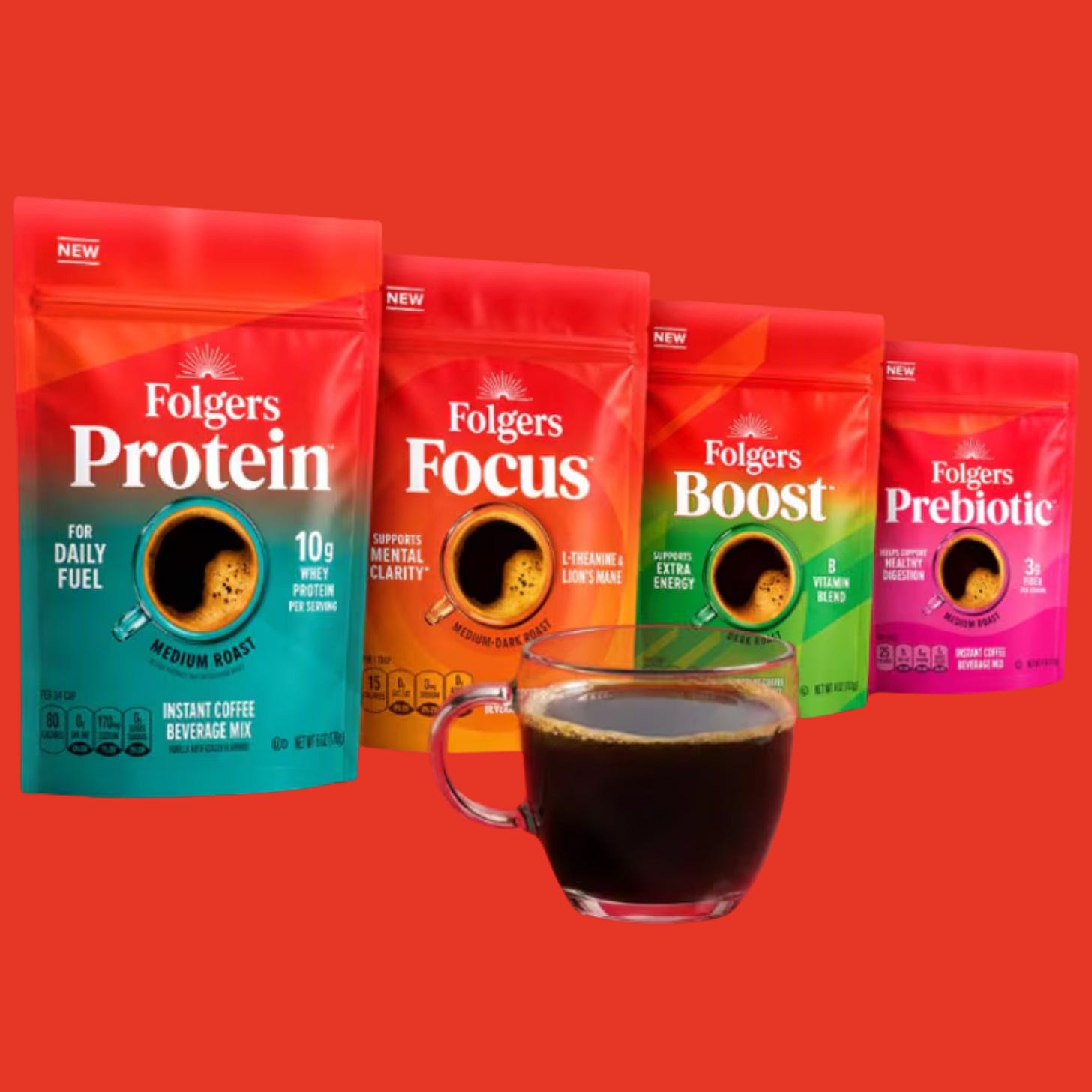
You heard that right folks, the legacy players are coming for functional beverages. And you know what that means: we’ve reached the peak. Enough functional brands have launched in recent years that there’s no clear winner, which communicates to legacy players that they can develop something like this internally rather than acquiring it.
It’s further proof that wellness culture is now mass‑market and everywhere. If Folgers is doing this, there’s no stopping the wellness boom that we’ve been seeing over the past few years.
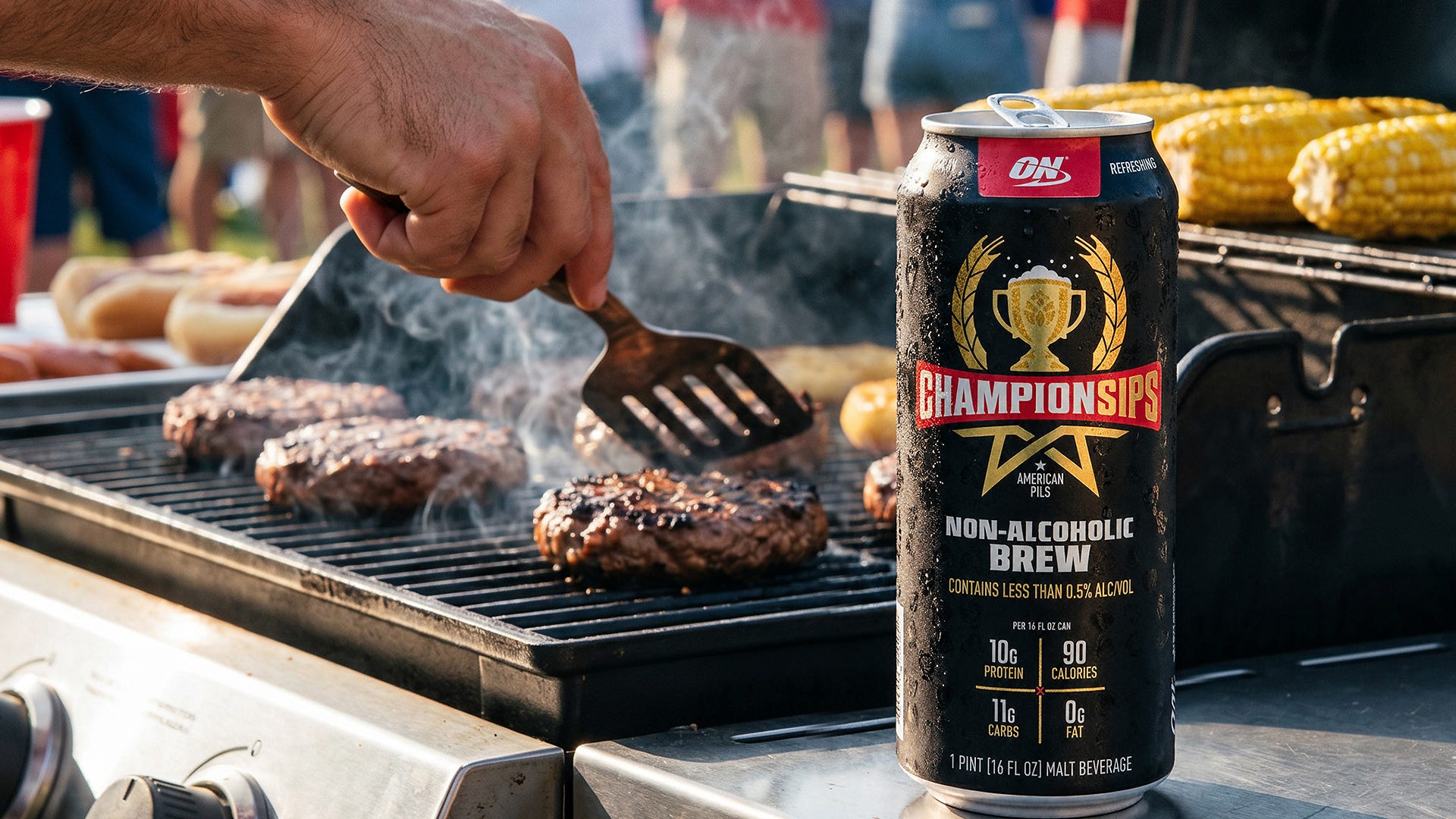
….this also might be peak function. Optimum Nutrition, the world’s No. 1 sports nutrition brand, launched ChampionSips, a limited-edition non-alcoholic beer with Wisconsin Brewing Company, featuring 10g of protein.
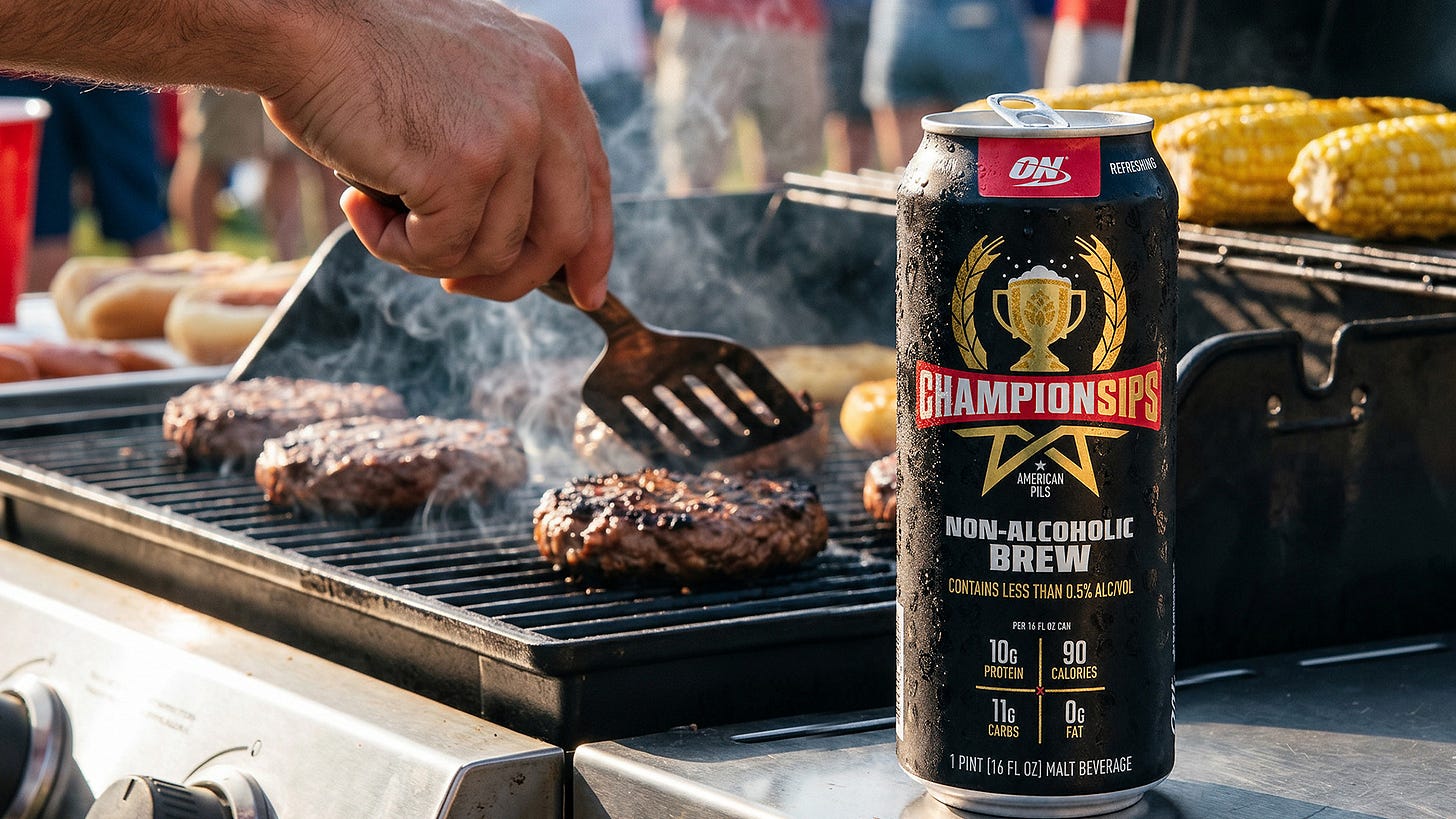
It’s not just protein beer; it’s protein non‑alcoholic beer, which is just putting too many different trends into one can. At least it’s limited edition and not something sticking around on shelf. I personally do not want protein beer. I would like to keep those things to be as separate as possible - Nate
We told you, Apple is fall’s new flavor. Culture Pop is joining the apple craze with a limited-edition Sparkling Apple probiotic soda, sold at Albertsons, Wegmans, H-E-B, and Amazon.
Side note: Culture Pop is a sleeper brand in the better-for-you soda category! This fast-growing brand is tracking toward more than $25 million in revenue this year. What’s different about it is that it’s made with organic fruit juice and no added sugar or sweeteners, and it’s probiotic, not prebiotic.
The DTC-to-retail pipeline strikes again! Factor is expanding its fresh, refrigerated, ready-made meals to 800+ Target stores across 47 states. This comes nine months after a 70-store Midwest pilot where its meals became top sellers in the category.
But why now? Like so many things, it traces back to the pandemic. Everyone was trapped inside, at home and online subscriptions surged. Now that the world has fully reopened and shoppers have returned to many of their usual routines, most shoppers want to shop IRL… while maintaining the convenience shortcuts they learned during Covid times. They want Factor to be their meal-plan provider and a stop on the grocery run where they can pick up other essentials, and a store like Target is where that happens.
And then there’s GLP-1s. It’s 2026 after all! Ready-to-eat, pre-portioned meals are winning right now partially because there’s a large, motivated group of people who need exactly this type of product. In the US, there are roughly 16 million active GLP-1 users and this is projected to hit ~30 million by 2030. Per BCG’s new survey of GLP-1 users, they’re willing to pay for it too. Active users plan to spend 11% more each month on high-protein foods. Total calorie intake might be shrinking, but budget is not—the perfect set of conditions for a premium, high-protein, prepared meal line to take off.
I also loved this take from one of my favorite Substacks, Kevin Ryan’s FoodStuff, on how we’re “post-meal kit now.” HelloFresh, Factor’s parent company, is betting on Factor’s ready-to-eat meals instead of its own meal kit subscription as Americans move further and further away from cooking. Kevin also offered the other great point that a deli case communicates higher-quality and fresher than many frozen meals, even as the frozen aisle constantly improves.
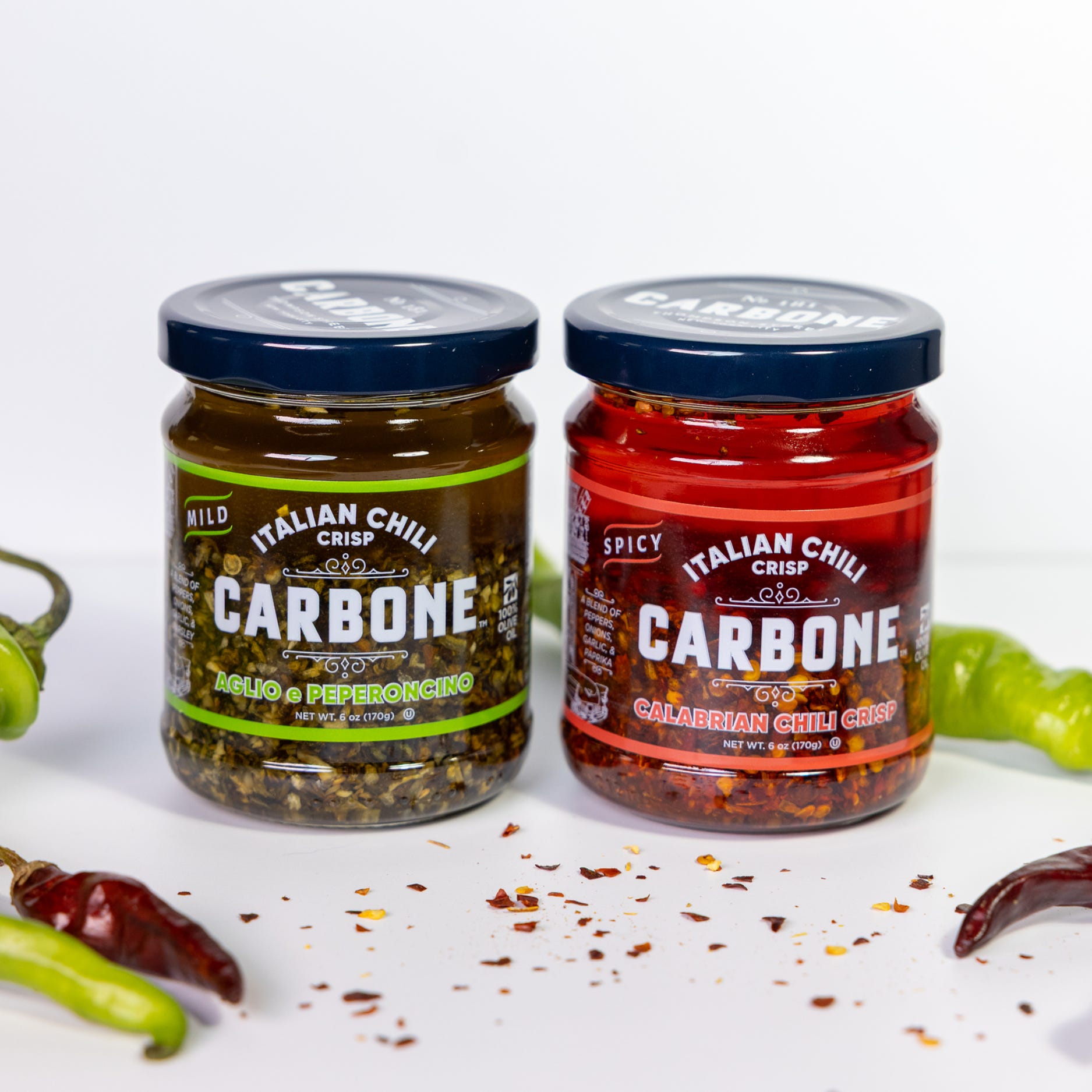
Carbone exits the pasta aisle. Carbone Fine Food launched Italian Chili Crisp in two varieties, Calabrian Chili Crisp and Aglio e Peperoncino, exclusively at Whole Foods for $13.99 a jar. It’s the brand’s first category expansion since launching pasta sauce in 2021.
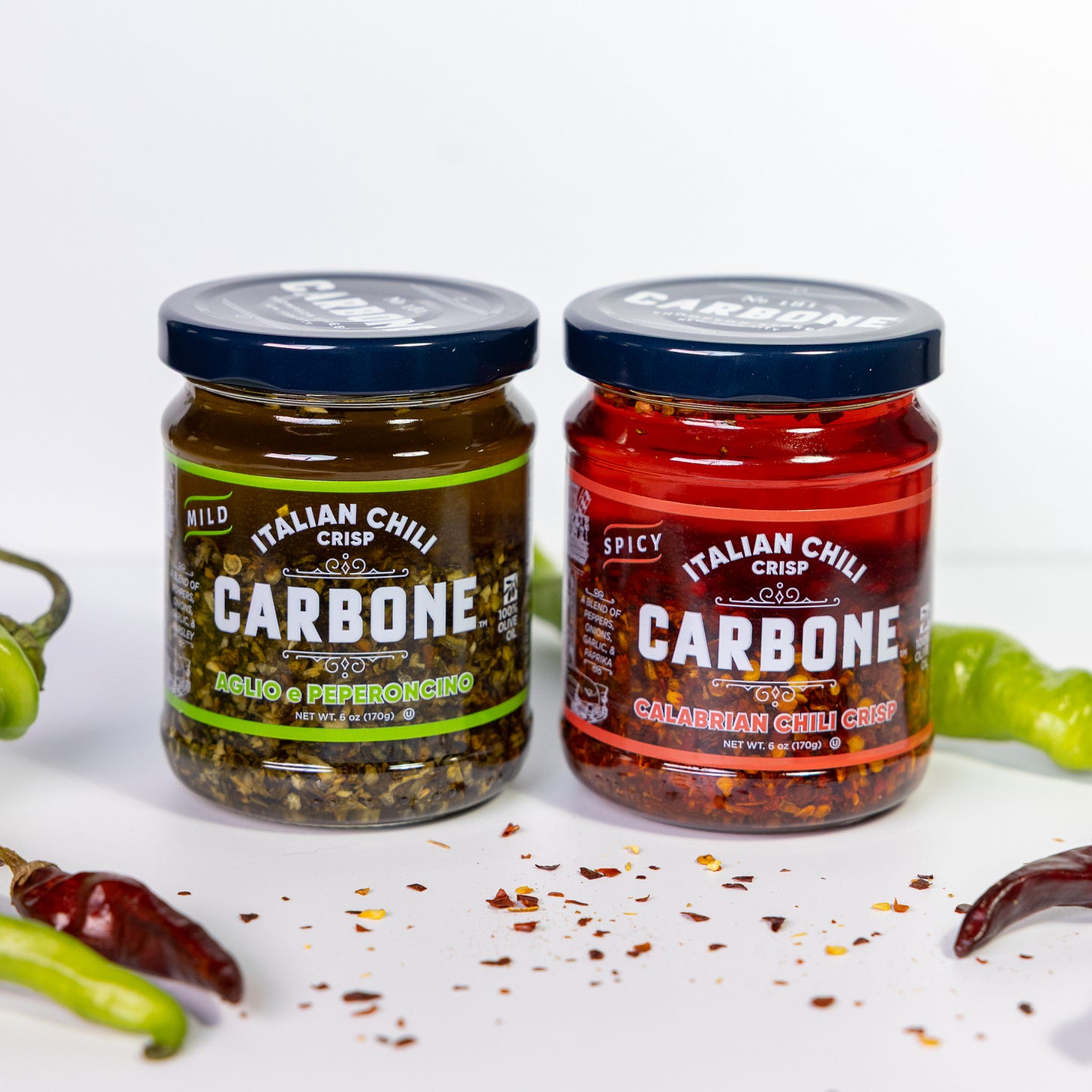
Chili crisp is already a crowded category, with Fly By Jing, LAOGANMA, Momofuku, S&B and Trader Joe’s all competing for your pantry space. Momofuku even owns the trademark for “chili crunch,” though it stopped enforcing it in 2024 after industry backlash.
Carbone is betting its Italian spin and restaurant name cache will help it stand out. A Whole Foods launch exclusivity keeps it at premium, but does cap the volume ceiling. The bigger question here is whether the Carbone name can sell its condiments as well as it sells pasta sauces.
I actually got to try this at a Carbone Fine Foods event early last year….it was so freaking good! Especially that green one. DAMN. I will be running to buy a jar or two when it hit shelves near me. - Nate
eCommerce
Every delivery service is launching an AI shopping tool:
This week, Instacart launched Cart Assistant, a white-label AI shopping tool regional grocers can embed on their own sites, alongside Clementine, its own marketplace assistant, which builds personalized, ready-to-buy carts from simple text prompts.
Food Bazaar, Heritage Grocers Group, and Woodman’s are already live; ads will be layered into both by year-end.
Meanwhile, Target-owned Shipt is doing something very similar: the delivery service launched Ask Shipt, an AI tool that generates shopping carts from meal photos or text prompts across 100+ retailers. Users can snap a dish photo or describe a spread, and ingredients get added to their carts automatically.
Kroger rolled out its own version this year, and now, delivery services are offering the same capability to basically any regional grocery chain that wants it. Expect nearly every grocer to have an “AI shopping assistant” within a year.
Definitely curious to see the stats on adoption here. The revenue promise isn’t about getting customers to add more to cart, necessarily; it’s more about the new ad units tucked into these platforms.
Retail
Whole Foods gets a raise. Amazon is investing more than $230 million in pay and benefits for 100,000+ Whole Foods employees, raising average pay to $21/hr ($29/hr in total comp) starting Sept. 28, with health plans from $5/week beginning January 2027.
Amazon has spent the better part of a decade unsure what to do with grocery—opening and subsequently shuttering Fresh and Go formats, never fully committing. But now that it’s dropping $230M into Whole Foods labor, it feels like Amazon is finally picking a lane: WFM is Amazon’s grocery identity now. But the question remains: will a ~75% jump in benefits actually rewrite Whole Foods’ post-Amazon reputation , or just buy goodwill headlines heading into the holidays?
Pay-to-play, but make it a felony. 😇 Southern Glazer’s, the largest U.S. wine and spirits distributor, will pay $12.5 million and enter a non-prosecution agreement with the DOJ after employees allegedly funneled cash, gift cards, golf trips, and luxury goods to California retailers—hidden behind false invoices—in exchange for better shelf placement between 2016 and 2024.
Every operator reading this knows shelf placement is, to some degree, bought (slotting fees, trade spend, “marketing support”). The distributor tier is the least visible and most powerful part of alcohol retail (thank the three-tier system), so this is a rare look at how the sausage actually gets made.
Grocery deserts get a lifeline. Illinois Gov. Pritzker announced more than $26M in grants through the Illinois Grocery Initiative—$20.8M for new stores in food deserts, $4.5M to reopen recently closed stores, and $750K for equipment upgrades—building on $19M already distributed since 2024.
While the national chains chase functional SKUs and reshuffle their wellness sets, ~$27M is going toward whether some Illinois towns have a grocery store at all. “Retail” isn’t only the Targets and Walmarts fighting over shelf space… a lot of the country is still fighting for access at all.
Funding news
Pouring cash into protein. Protein2o, the clear protein brand, announced a new growth investment, though it did not disclose the amount. The funding will support further brand building, retail expansion, hiring, and product development. The company also named Mark Rappaport CEO and added him to its board. Rappaport was previously global chief commercial officer at Congo Brands, the company behind Alani Nu, and held senior roles at Red Bull.
The brand might have a relatively generic name and pretty simple branding, but it clearly works: it surpassed $60 million in retail sales by late 2025 and is sold in more than 10,000 doors nationwide. Just because a brand doesn’t have flashy branding or marketing doesn’t mean it won’t perform well.
Brian Folmer, founder of FirstLook VC, a platform that puts emerging CPG brands in front of investors, saw Protein2o very early and told me most investors passed at the time, and the numbers definitely weren’t the issue. The company just didn’t fit the usual venture mold. The team was comprised of seasoned operators rather than a pair of young founders with a compelling origin story, and the branding wasn’t the polished, design-forward look investors have been trained to expect.
“They were not a standard VC-looking brand. Sometimes people put way too much emphasis on branding, like the actual appearance... To only pay attention to the brands that are in the VC buzzy circles is a complete mistake. You’re going to miss out on all these brands that are not in the VC bubble.” - Brian Folmer
Consumers mostly just want a product that works. And this focus and lack of flashiness can be a huge leg up for brands because it doesn’t alienate some consumers who might find extremely well-done branding a barrier to purchase.
The tampon gets a redesign. Viv, a Gen Z-founded period-care brand, just raised $2M to launch its patented Cottonlock™ tampon nationwide. The fiber-resistant design aims to prevent residue and protect the vaginal microbiome, and will roll out across all 526 Whole Foods locations.
A different kind of international delight. Petit Pot raised a seven-figure Series A co-led by Eclair Partners and Terri and John Penshorn to expand distribution of its French-inspired refrigerated desserts—pot de crème, rice pudding—already at Whole Foods, Costco, and Target nationwide.
Refrigerated dessert has been a sleepy, low-expectations category forever, the thing you grab on impulse while perusing for yogurt. Petit Pot’s whole bet is that Americans will pay up for a premium version, the same way they did for yogurt (hi, Chobani) and, lately, protein pudding cups.
While a seven-figure A is small, the brand’s retail footprint is already in place, and has potential to see some success from what we predict will be a new wave of “small, intentional indulgences”: products made with real ingredients and real sugar, but packaged in premium, portioned vessels. As appetites shrink (xoxo, GLP-1s), luxe, pre-portioned indulgences will likely see a surge over artificially sweet, ultraprocessed sweet snacks designed for volume eating.
“Pudding still has a special place in people’s memories, but the category has been stuck for years with low expectations, and uninspiring choices,” says Eric Lallart, CEO of Petit Pot. “American consumers are raising the bar for what they eat, and dessert should be no exception. Made with real ingredients and perfectly portioned, Petit Pot is a little treat worth slowing down for.”
Oral care first, everything else negotiable. Colgate-Palmolive is weighing the sale of Softsoap, Irish Spring, and Speed Stick in a deal that could top $1 billion, with Goldman Sachs hired to run the process. Its personal care unit generated ~$3.5B in 2025—17% of net sales.
This news comes off of last week’s announcement that S&P Dow Jones Indices confirmed that Colgate-Palmolive was removed from the S&P 100 index in favor of AI-adjacent tech companies (go figure).
This is the same portfolio-pruning move we keep seeing from the giants: shed the mature, slow-growth brands, concentrate on the core. Colgate’s core is oral care, which makes Softsoap, Irish Spring, and Speed Stick suddenly non-essential.
Just last week, we saw Nestlé dumping $1B of vitamins. These brands aren’t failing, they’re just not the core. And there’s a deep bench of PE firms and roll-ups happy to buy steady, unsexy cash cows. Speed Stick getting squeezed by DTC deodorant on one side and labeled “non-core” on the other is SUCH a classic tale of mid-tier CPG these days.
Kendall gets calm. Kendall Jenner is joining TRIP, the magnesium-based calming drink brand, as a global ambassador and equity partner. She will front the brand’s new global campaign and take a stake in the business as TRIP projects $200 million+ in revenue for 2026.
And miss Jenner here is far from the first celebrity to touch TRIP. The brand recently raised $40 million at a valuation north of $300 million in late 2025, with Joe Jonas, Alessandra Ambrosio, Paul Wesley, and Ashley Graham joining the round alongside Coefficient Capital. Millie Mackintosh has also been named as an investor, while Graham previously worked with TRIP on its Calm partnership. Earlier in 2025, Rosie Huntington-Whiteley’s Equity Studio took a multimillion-pound stake in the company. At this point, TRIP has assembled a full cast ready for a Netflix original!
Keeping the CSA box alive. Farm to People, a Brooklyn-based online farmers’ market, raised $5 million from New Fare Partners, Stonyfield founders, and a former Whole Foods exec—its first outside investment. The company serves 13,000+ monthly customers across 200+ NYC-area farms and will use the funds to open a 40,000-square-foot Bronx facility in 2027.
In case you missed it… 🎧
This week on the pod, we were joined by Adam Terry, CEO and co-founder of Cantrip and On the Brightside—and absolute WEALTH of knowledge on all things THC regulation and functional beverages.
Adam walks us through his journey in the cannabis beverage industry and pivot into a new kind of functional drink. He explains why the low-dose THC hypothesis didn’t pan out, the science behind the new functional ingredient he’s betting on, and the tricky retail landscape of functional beverages.
This is a great follow-up episode to our interview with Jake Bullock, CEO and co-founder of Cann—offering some updates and rare insights into the ever-changing THC regulatory environment!
If you haven’t yet, please subscribe, like, leave a comment, and share it! It helps us continue to bring you the most interesting news + nuance in consumer and retail every week.