



Hello hello!
Last week, we covered Mars Men’s wiiiild $27M raise. This week, we’re diving back into Create Wellness’s recent $20M raise. What both of these have in common?
They’re both Wayflyer customers who closed big funding rounds within days of each other. So… how did they get there?
Wayflyer-funded brands are writing the playbook on how to raise SMALL. The playbook makes sense: self-fund or raise a small seed, use debt financing to cover inventory and marketing through high-growth phases, then raise equity once you have the ARR to demand a valuation worth taking.
Wayflyer covered their working capital needs while they scaled aggressively… with relatively little equity sold. CPG darling Wild ran the same playbook, and was acquired by Unilever for £230 million.
If you're building a high-potential brand with a big exit in mind, this is a funding strategy worth thinking about early.
News from the week
Everyone’s talking about Grüns this week, for good reason—a $1.2B Unilever acquisition of a brand that’s been on shelves for under three years is a genuine outlier, and plenty of really smart folks have already broken down the how and why… so we’re not going to pile on.
We’re more stuck on a story from last week that—in our opinions—everyone moved past too quickly: another gummy supplement raised $20M. Create Wellness, the modern creatine brand.
It doesn’t compare to Grüns in headline dollars, but if you zoom out, it’s a really, really impressive story. Not that long ago, creatine was a sleeper supplement only bodybuilders were taking—and now everyone and their mother is looking for a creatine product to add to their stack. And Create Wellness was brilliantly early to that game.
A few cultural shifts had to converge to get us here:
The science went mainstream. Creatine has been one of the most-studied supplements in sports nutrition for decades, but it lived in fitness magazines and message boards. Then Andrew Huberman, Peter Attia, and the broader podcast-doctor class started talking about creatine for cognition, mood, and longevity—not just muscle. The research wasn’t new necessarily, but the audience was.
Women got brought into the conversation. For years, creatine was coded male, coded bulky, and (per Create co-CEO Dan McCormick) culturally tangled up with steroids—”Turns out that everyone in the MLB that was taking steroids was also taking creatine, and so in the hearts and minds of the American consumer, creatine was, therefore, a steroid.”
Then, seemingly all at once, female wellness creators dismantled the “lifting makes you bulky” myth (thank goodness), GLP-1 culture sparked an equal and opposite “strong > skinny” reaction (doubly thank goodness), and a new wave of research connected creatine to menopause symptoms, bone density, and brain health (shoutout modern clinical research for including women, for a change). The numbers caught up fast: women now make up 30% of creatine purchases at The Vitamin Shoppe, up from 18% in 2020.And consumers got skeptical of supplements generally—which actually helped creatine. 63% of supplement shoppers now say they “always” or “often” research ingredients, brand reviews, or scientific studies before buying. The #1 must-have, per a Thorne survey, is products backed by clinical research.
After years of Poppi-style functionwashing, ashwagandha drinks dosed at homeopathic levels, and influencer-led “wellness” cycles that didn’t deliver, consumers are demanding receipts. Creatine—boring, decades-old, hundreds of peer-reviewed studies—is exactly what that consumer wants.
Enter: Create. The story is genuinely wild in its timing. Dan McCormick, a former Away and Parade operator (read: DTC legend), had personally taken creatine for over a decade and was annoyed by the powder format—it’s gritty, it’s a hassle, it doesn’t travel. He started Create with his wife Sienna in December 2022, well before “creatine gummy” was a category anyone was searching for. Twenty-five gummy manufacturers told him the specs were impossible before he found one willing to take it on as an R&D project.
He also got the science partnerships right early. Create’s scientific advisory board includes two of the leading creatine researchers in the world, with one advisor particularly known for her work on creatine in women. That credibility shows up everywhere—NSF for Sport Certified, Creapure-sourced creatine, third-party testing…
…and this was, critically, all credibility that couldn’t be claimed by competitors as they sloppily entered the scene: a 2025 SuppCo report found 4 of the 6 bestselling creatine gummies on Amazon contained low or no actual creatine per serving. Create came out clean—their gummies contained slightly more than advertised.
The market arrived. Create scaled from $0 to $4.5M profitably in year one, Unilever Ventures led a $5M Series A in 2024, and late last year, Create rolled out nationally at Target, The Vitamin Shoppe, and Sprouts, adding to existing GNC, Wegmans, and Amazon distribution.
It’s been the #1 selling creatine gummy at Target since launch. The team scaled from 5 to 25, including former AG1 brand leadership and ex-Vital Proteins commercial muscle. And two weeks ago, the Series B—$20M led by Alliance Consumer Growth and Mike Repole’s Impact Capital, with Unilever Ventures following on—plus the launch of Creatine + Electrolytes, exclusive to Target.
Bloom has a creatine gummy now… and so does Lemme, Force Factor, Legion, Bear Balanced, and a growing list of European entrants. Clearly, the category is officially commoditizing. But Create has the early-mover position, the science-backed credibility, the omnichannel distribution, and the Unilever Ventures relationship. The global creatine supplements market was estimated at $1.37B in 2025 and is projected to hit $8.68B by 2033. Whoever owns the consumer’s first creatine purchase—and critically, secures their trust—is going to compound for a long time.
Which brings us back to Grüns. We’d bet money Grüns rolls out a dedicated creatine SKU within the year, slotting it neatly alongside Nütrops (cognitive support) and Jüced (energy) in the same playbook they’ve already run: take a once-niche, once-intimidating supplement category, scrub off the bro-y or clinical coding, deliver it in a format the wellness-curious consumer will actually take daily, and ride the cultural permission shift into a category-leading position.
They did it with greens (a category AG1 made aspirational). They’re doing it with nootropics and adaptogens. Creatine is the obvious next one.
The bigger pattern worth watching: the supplement aisle is being systematically rebuilt for a consumer who didn’t exist five years ago. She’s skeptical of marketing, seeking out clinical research for validation points, and willing to pay a premium for products that meet her where she is (likely, on-the-go).
Create saw her first in creatine. Grüns saw her first in greens. Whoever sees her next—in something nobody’s coded for her yet—is the next billion-dollar exit.
CPG & Consumer Goods
Speaking of creatine... Four Sigmatic, the #1 functional coffee brands according to SPINS data, launched a Creatine Coffee in collaboration with Sony Pictures for the launch of the final season of The Boys. The coffee combined Arabica coffee, lion’s mane, and 5g of creatine. It is available on Four Sigmatic’s website and Amazon for a limited time.
This is such a fun collaboration. Of course ~the boys~ want creatine in their coffee—who doesn’t? (see our deep dive 👆, lol). A note here: you’re not going to want to turn this into cold brew, or use an overnight drip situation—once creatine sits for hours in liquid, it can break down into creatinine (one of the reasons that basically every creatine ready-to-drink is functionwashing… fun fact 🤷♀️).
What’s interesting here is seeing Four Sigmatic lean into such a conventional, science-backed ingredient. Four Sigmatic’s whole shtick is pushing back against caffeine with lower-caffeine products and a boost of nootropics/adaptogens. Creatine has proven its place in both conventional, bro-y supplements and the bro-adjacent, woo-woo alternatives.
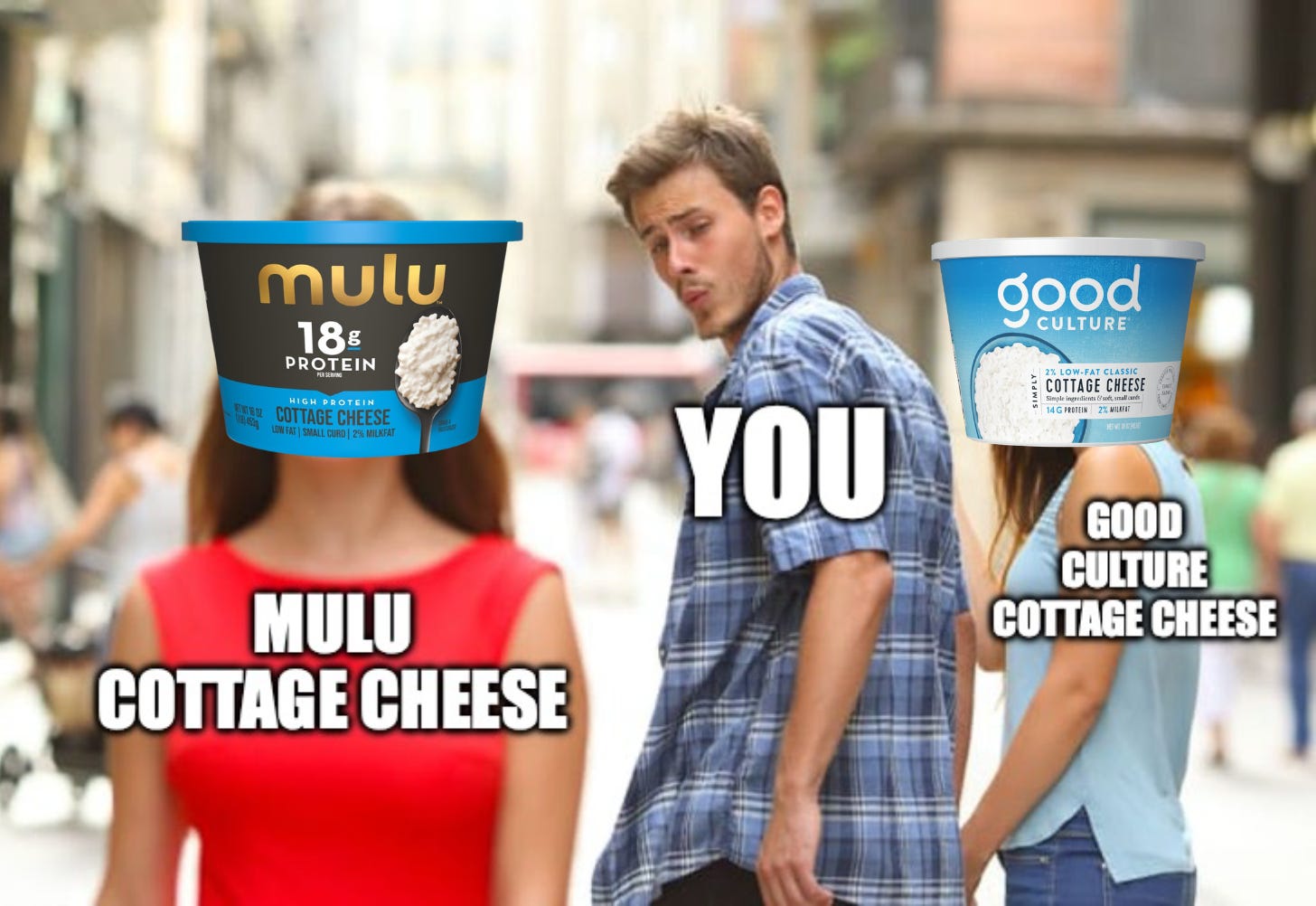
The next Good Culture? We might have the next big cottage cheese brand on our hands here, folks. Mulu is a new cottage cheese brand from Dairy Farmers of America that is launching at Walmart with 18g of complete protein per serving (most cottage cheese is closer to 14g per serving), a proprietary whey-and-casein formula, and a focus on taste, texture, and “performance-driven” nutrition.
The next generation of RTD coffee goes national. Espresso soda startup Esspo is launching at Whole Foods nationwide as it looks to bring its espresso soda into brick-and-mortar shelves. The brand is positioning the drink as a refreshing, moderately caffeinated alternative for people looking for a new afternoon pick-me-up.
Making mushy moves. MUSH, the ready-to-eat overnight oats brand, is expanding into most Starbucks locations and 7-eleven stores along with bringing its new protein products to more national locations like Target.
And the brand is well-positioned for success here. It’s operating in a consumer environment increasingly demanding high-protein, high-fiber, and convenient products made from real ingredients. This ticks all these boxes. Plus it’s a well known brand already having sold 200 million plus cups and are sold in 36,000+ stores nationwide.
We’ve loved watching Starbucks slowly but surely update its CPG set. Recently, Khloud Popcorn launched at Starbucks locations, and now MUSH is hopping on board. Clearly, the chain is prioritizing protein (like everyone else…).
Getting hot in the grill. Hot Ones™, the spicy brand born from First We Feast’s hit YouTube series, is launching four new BBQ sauces, including Original Hot BBQ and Hot Honey BBQ, at major retailers this spring and summer. Developed in partnership with HEATONIST, the line expands the brand beyond its iconic hot sauce into BBQ.
We’ve said it before, we’ll say it again: we are officially in the new age of condiments. The people want new sauces and dips, and brands are delivering. Excited to see how the Hot Ones brand promotes these new sauces!
A new tequila, in this economy?! Aaron Paul and Bryan Cranston are expanding Dos Hombres beyond Mezcal into tequila with a Blanco ($39) and Reposado ($49), debuting May 1 and July 1 respectively. An añejo is also planned for early 2027.
The launch comes at a turbulent time for the tequila category. According to IWSR’s preliminary 2025 data, global beverage alcohol volume declined 2% across 22 key markets, with spirits the worst-performing major category—down 4% in volume and 9% in value. The U.S. market specifically fell 5% in volume and 4% in value as inflation, political uncertainty, and cost-conscious consumers pulled back on discretionary spending.
Tequila has been hit especially hard. Diageo reported that U.S. tequila sales plunged 23% in H2 2025, with Don Julio sales down over 20%—prompting the company to downgrade its 2026 outlook. Meanwhile, Becle (Jose Cuervo’s parent) saw Q4 net profit fall 12.8% on a 14.1% revenue drop, with the flagship Jose Cuervo brand posting a 15.1% sales decline. Becle is calling 2026 a “transition year” and doesn’t expect U.S. growth to return until 2027.
So Dos Hombres is clearly betting on brand equity and a celebrity pull in a category where even the biggest players are struggling. Their relatively accessible price points ($39–$49) could be a smart play given the consumer shift away from ultra-premium bottles—but the headwinds are real, so we will see.
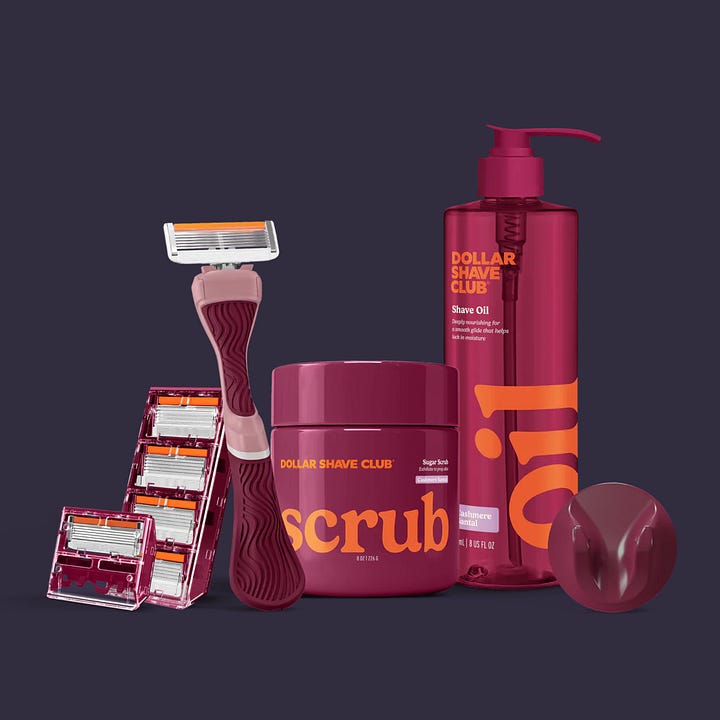
For the ladies. Dollar Shave Club (which is somehow still around) is making a move into the women’s grooming category, offering razors and shaving aids priced between $5 and $10 on their site and Amazon.
Dollar Shave Club is majority-owned by the private equity firm Nexus Capital Management, LP, which acquired a 65% stake in the company from Unilever in late 2023. Unilever previously acquired DSC for approximately $1 billion in 2016. And think about that timeline, a little late to launch a women’s category. Feels like a last hurrah for a once iconic brand that has seriously lost its luster.
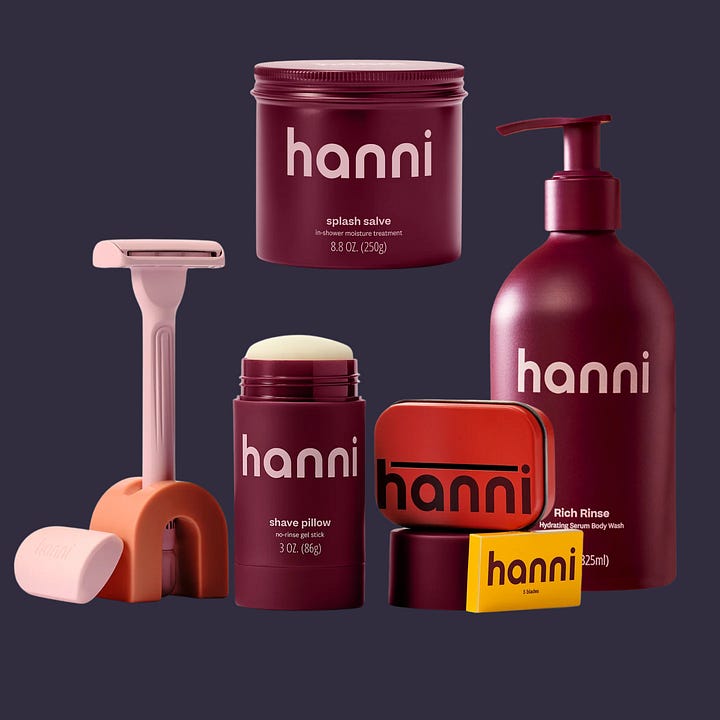
Oh boy, does this look like viral bodycare brand, Hanni 👀, from the product set itself, all the way down to the colors…
👀👀👀
The US sexual wellness market is booming. Sense, founded by Venezuelan entrepreneurs, is debuting its FDA-approved products at select Target locations. With the market projected to exceed $20 billion by 2030, Sense aims to redefine intimacy as an essential component of health.
The collagen ready-to-drink space is expanding. Nestle-owned Vital Proteins, known for its collagen powder supplements, is launching a collagen-infused sparkling water in two flavors.
Coming off last week’s news about Kylie’s k2o, a hydration-beauty stick-pack supplement, and the previous week’s news of Freaks of Nature launching UV-protecting electrolytes, this almost feels like deja vu. Brands are clearly betting on the hydration x “ingestible skincare” angle.


Retail


Hemp drinks future might hang in the balance, but retailers are still placing bets.
Edibles.com is opening its first flagship store just a year after launching in Atlanta’s Inman Park, marking a new chapter in hemp retail. The store aims to provide a more structured shopping experience for hemp-derived THC products, emphasizing education and, of course, compliance.
Edibles was originally launched in 2025 by Atlanta-based Edible Brands (yes, the fruit basket company). The timing is especially noteworthy—the hemp-derived THC beverage market is experiencing explosive growth in the US, with THC beverage sales exceeding $1 billion in 2024 and projected to grow to nearly $6 billion by 2035.
BUT, this growth is assuming all the looming regulatory changes don’t go through. The current administration is actively reassessing hemp-derived THC regulation, making this a pivotal moment for companies trying to establish compliant, and more importantly, scalable retail models.
Here’s what’s happening: An agriculture spending package passed last year as part of a government reopening deal removed products with more than 0.4 milligrams of THC from the federal definition of hemp—a change set to take effect this November that would effectively wipe out the entire hemp-derived THC beverage and edibles market as we know it. There are plenty of people lobbying for change, but we will see what will happen.
And in other THC distro news: after a successful 10‑store trial, Target is expanding hemp‑derived THC beverage sales in Minnesota by securing 72 one‑year licenses, making it one of the largest mainstream retailers betting on the category and potentially helping the space navigate looming regulatory hurdles.
Funding
Looks like tequila is coming back? Pronghorn, a spirits incubator founded in 2021 with a focus on funding and supporting Black-owned spirits brands, has invested in Humano Tequila, which offers four varieties sold across 11 states.
Betting on meat sticks. Bullish, the NYC consumer investment firm behind Peloton and Warby Parker, just invested in Singing Pastures—a female-founded meat stick brand using pasture-raised beef, bone broth, and collagen. The brand is already in 800+ stores and growing fast.
The meat stick market is nothing to laugh at. Chomps alone holds ~10% of the entire meat snack market and is valued at $1.5B doing around $600M last year alone. Meanwhile, meat snacks have emerged as the clear winner of America’s GLP-1 consumption shift, as high-protein, low-carb options continue to gain share over traditional snacks.
The kids snack aisle is getting a makeover. The recently launched kids’ snack brand cadootz! secured over $3M in seed funding led by Selva Ventures to expand its reach, aiming for a nationwide debut in June 2026. Known for its savory crackers in Cheddar, Sea Salt, and Ranch flavors, the brand saw its first launch sell out in under two hours!
We had the pleasure of having co-founder (and lifestyle influencer) rachel mansfield on our podcast to talk about building cadootz! Check it out here.
This week on The Curious Consumer, we sit down with Daniel Solomons, CEO of Update—the caffeine-free energy drink that caught Kim Kardashian’s eye organically before she became a full creative partner. We also cover every Kardashian-Jenner in CPG this week (yes, all of them), the Hershey reformulation saga, McCormick’s $45B acquisition of Unilever’s food business, and more. Check it out here →
If you haven’t yet, please subscribe, like, leave a comment, and share it! It helps us continue to bring you the most interesting news + nuance in consumer and retail every week.