



Hello hello!
There’s one big question every brand operator finds themselves asking around this season: Is a Black Friday customer worth it?
Our friends at Wayflyer crunched the numbers, and the answer is: a little less than you’d hope, but nowhere near as bad as the “bargain hunter” reputation suggests.
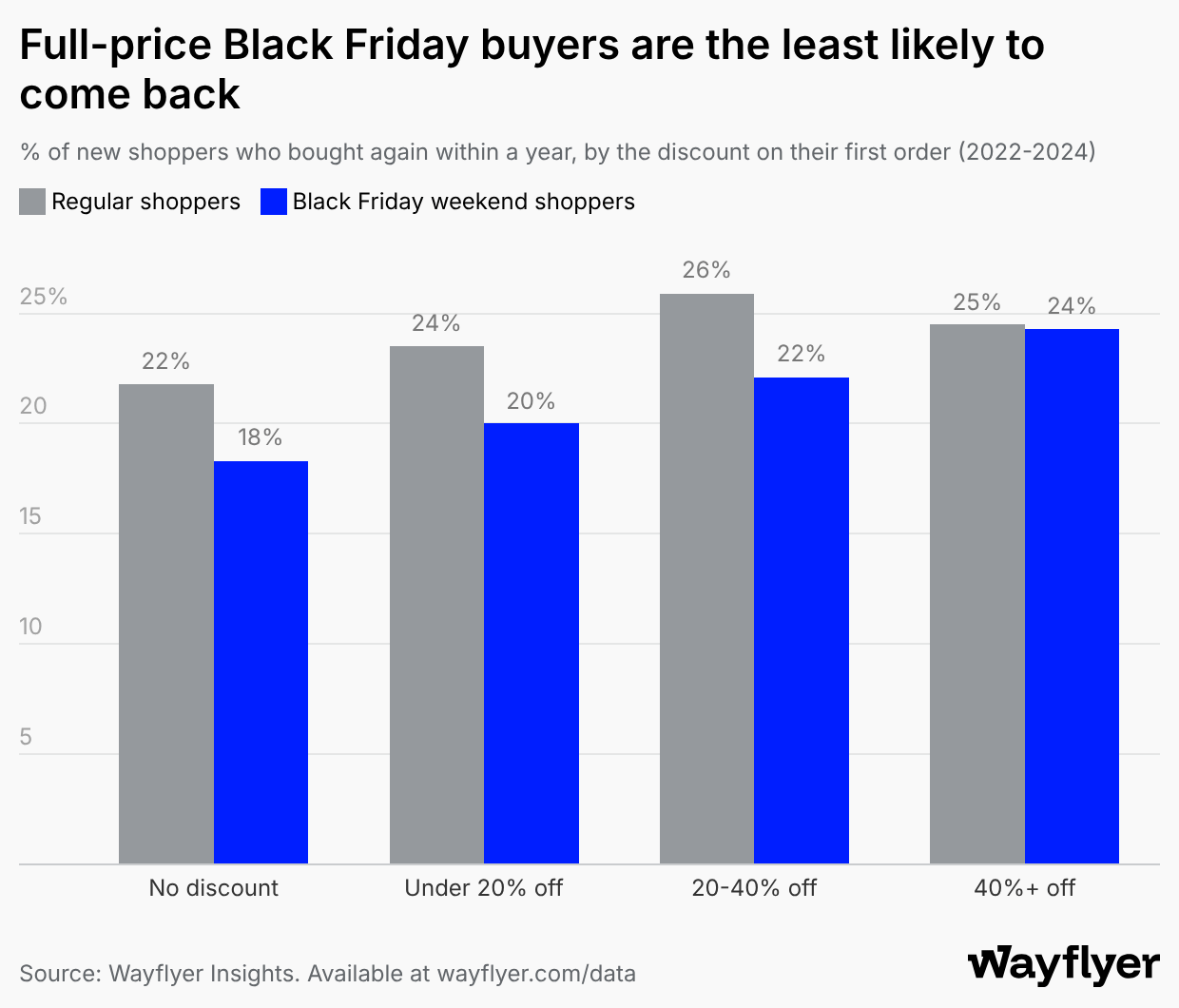
BFCM shoppers spend about the same as anyone else on their first order, but they’re roughly 13% less likely to come back. This impacts lifetime value, and twelve months later, a customer acquired during BFCM has LTV 5% below a customer that was acquired in January through October.
The big surprise is discounts: the deeper the Black Friday discount, the more likely the customer is to return. Shoppers who got 40% off came back 33% more often than those who paid full price!!
For 21% of SMBs, Black Friday is the biggest sales event of the year, but it requires a major stock up and marketing push now for sales that will come later.
If working capital is holding you back from your biggest Black Friday yet, apply with Wayflyer today (it just takes 10 minutes!!) and receive funding in as little as 24 hours.
News From the Week
It’s an awkward time to be a big CPG brand.
Data is telling strategics that they need to play in functional and better-for-you, and PepsiCo’s own Q3 results credited protein, fiber and simpler ingredients for what worked this quarter.
Historically, though, better-for-you + functional hasn’t really been BigCo’s thing.
Coca-Cola’s in-house swings have a short shelf life: it pulled Coca-Cola Energy from North America after just over a year, and drastically cut distribution of its Aha sparkling water as sales slid.
So far, the biggest wins for incumbents have come from buying in. PepsiCo bought Poppi (more on that below), and Hershey bought a clean-label popcorn brand to get into better-for-you snacking.
But private equity is now heavily competing for the same emerging brands, so strategics are scrambling to innovate in-house.
Without access to expensive data and insights, innovation at an emerging brand is largely rooted in intuition. Innovation for a larger CPG brand, on the other hand, is largely rooted in data—looking at the little guys and trying to square a pattern it can copy-paste onto its own products. The final result doesn’t feel natural or creative; it feels forced, almost viscerally cringe, and often misses the mark.
This week, both Coke and Pepsi showed us that awkwardness in action:
Coke announced it will add 6g of prebiotic fiber to Coke Zero, Sprite Zero and Fresca, piloting at the end of October in parts of New York, New Jersey and Pennsylvania. A whole new line of its beloved brands, now slapped with added fiber.
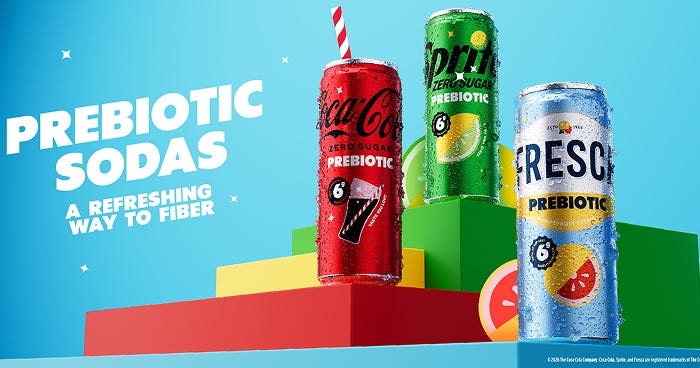
For context, this is Coke’s second major swing at the prebiotic soda category: Last year, Coke launched Simply Pop under its juice brand.
Strategics can get any data they want, and Coke’s is clearly telling them that prebiotic soda is having a moment, and fiber is the factor worth stealing. But what the data doesn’t tell them is why people buy—that je ne sais quoi cool factor. And, from what we’ve seen, Olipop and Poppi’s “cool factors” were never really about fiber:
Poppi is the clearest case study, because its fiber claim has already been tested in public. In 2024, the brand was hit with class actions arguing that its 2 grams of fiber per can was too little to do anything for your gut. Poppi denied wrongdoing and settled for $8.9 million.
If gut health were the reason people bought Poppi, that should have hurt… and it didn’t. As the suits were being filed, Poppi’s U.S. dollar sales were up 171.5% to more than $273 million, per NielsenIQ. A year later, PepsiCo paid $1.95 billion for the brand with that claim still under legal challenge.
Poppi knew it, too: co-founder Allison Ellsworth said publicly that most people drink Poppi for the flavor, and the brand moved away from gut health toward a lifestyle positioning.
Fiber wasn’t the core reason people were buying Poppi. It was a health halo, a secondary justification for buying the product they already wanted for its taste, its branding, and what it says about them. But that one visible, replicable halo is the part Coke is copying.
Meanwhile, PepsiCo is taking something good… and forcing its strategic lens on top of it. When faced with the same threat of the modern soda category, PepsiCo took the opposite route of Coke: it bought the whole Poppi brand, context included.
But now, growth calls (it always does for Big-Boy Brands), and PepsiCo is similarly falling into this forced innovation cycle:
Last week, PepsiCo unveiled Poppi Lift (energy) and Chill (relaxation), pushing Poppi beyond its gut-health origins into new consumption occasions.
While the idea of an actually-functional Poppi isn’t a bad one—and in fact, could really take off—it does feel like an awkward, forced departure.
It reads, again, as a strategic brand haphazardly applying data (this time, from the rapidly growing energy and relaxation drink categories) to an existing brand. It’s asking a brand that was loved for being fun to start justifying itself with function.
Put side by side, Coke and Pepsi ended up in the same awkward spot from opposite directions: Coke copied the most visible trait of a brand it couldn’t buy, and PepsiCo bought the brand… but is now bolting new traits onto it. In both cases, the data showed what’s selling, and the brands mistook it for why.
Big CPG will always have more data than the little guys. What it keeps struggling to buy—or hold onto once it starts tinkering—is the gut feeling that made anyone care in the first place. Until the incumbents figures that out, expect a wholeeee lot more awkward. 🥴
CPG & Consumer Goods
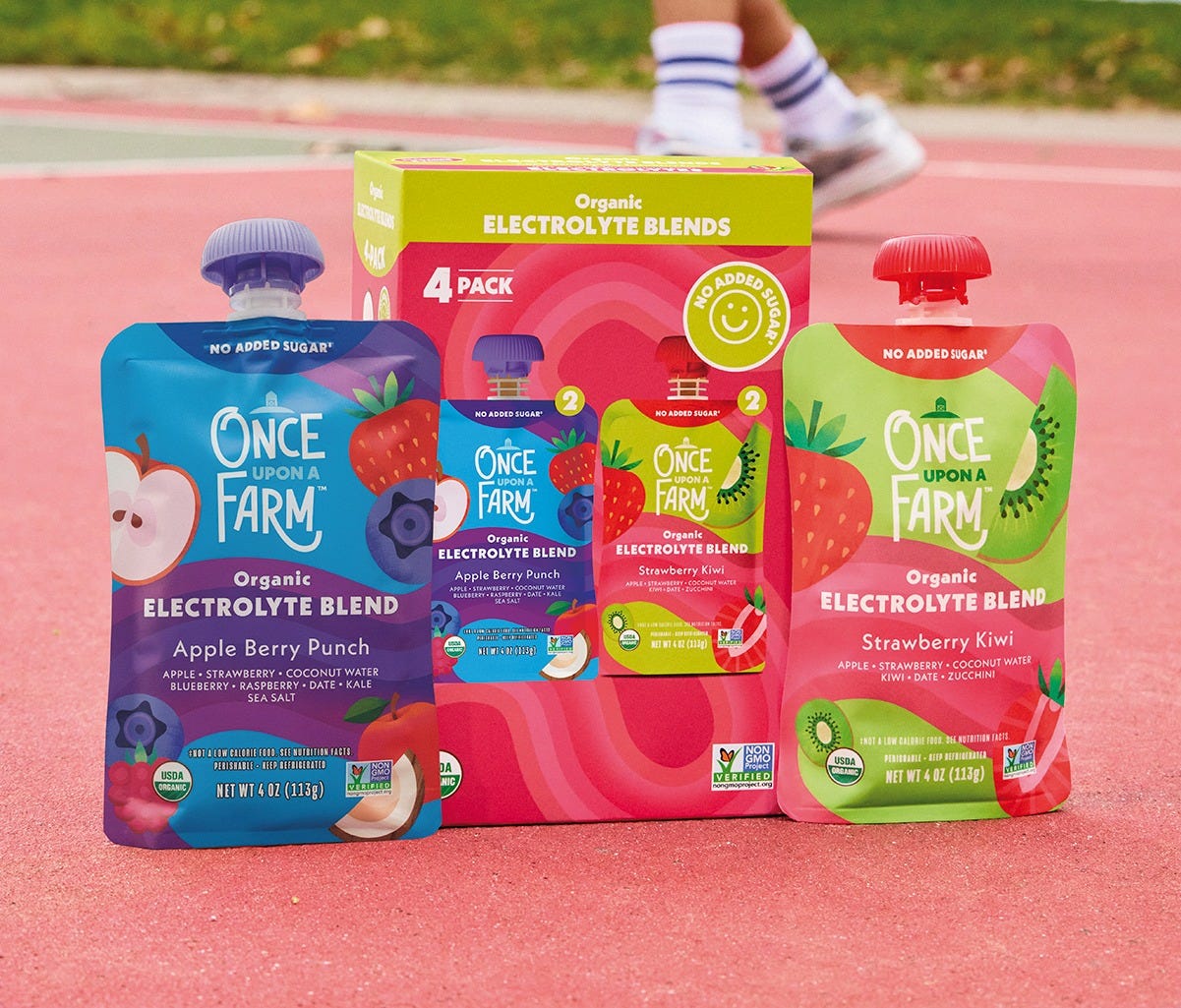
A cure for the back-to-school hangover. Once Upon a Farm, the organic kids’ snack and meal brand, launched Electrolyte Blends, These are fruit-and-veggie hydration pouches for school-age kids made with coconut water and sea salt for “active kids”. The pouches are available at select retailers nationwide, while the brand’s broader lineup spans 25,000+ retail doors.
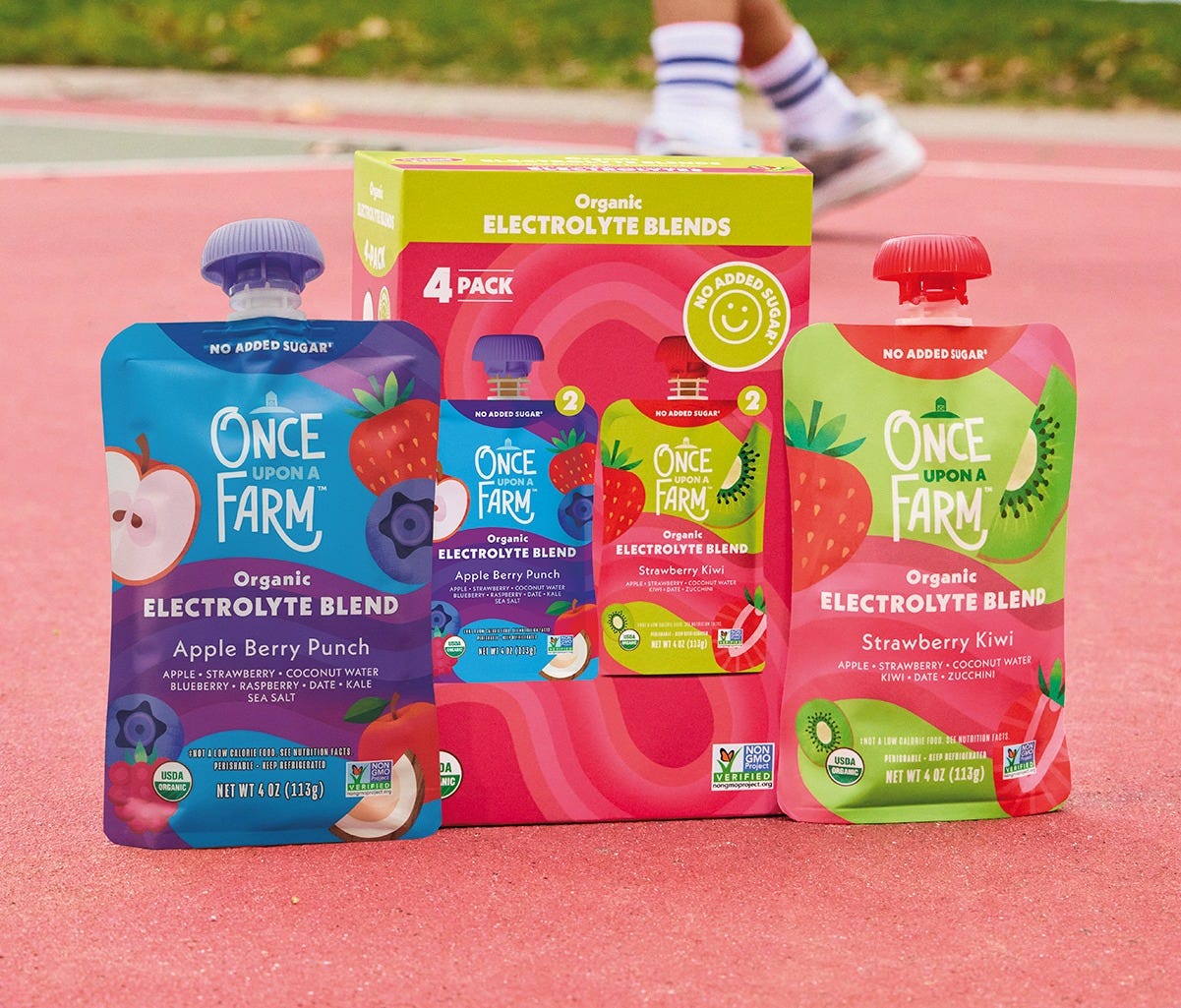
Electrolytes are the latest wellness darling, so it’s no surprise that hydration has reached the blossoming kids aisle. Last month, Nestlé USA entered the pediatric rehydration space with Gerberlyte (a more medically-skewed product), and claimed that the pediatric electrolyte market is expected to reach $451 million by 2031. Though Once Upon a Farm is actively avoiding any language around medical rehydration or sustained energy for this product, it’s slotted into the same sphere.
Nearly 50% of U.S. parents buying products for ages 6–12 look for electrolytes, according to SPINS’ 2024 survey. Cure already makes kids’ drink mixes; Once Upon a Farm is bringing that pitch to pouches.
One thing is clear: kid’s products are no longer an afterthought. We’ve spoken about this before, but the same parents who upgraded their own pantries and medicine cabinets want better options for their kids, too. The same effort going into adult formulation, packaging, and design is finally going into kids’ products, with ingredients suited to their age and formulations they actually enjoy:
Hiya Health built its whole brand around better supplements for kids, from zero-sugar multivitamins to probiotics and fiber.
Baby care brand Frida moves into personal care for ages 6–11, with everything from body wash to deodorant and electric flossers.
Shay Mitchell’s (highly controversial) Rini is bringing K-beauty to kids with various gentle formulas and playful face masks.
There are even multiple brands trying to bring the Modern Soda category to kids’: NoBiggie, Roxberry, and Wave Kids.
These brands aren’t just selling to the parents anymore. Modern kids have opinions!! In PwC’s 2026 survey of U.S. kids ages 7–14, 61% said social media makes them want to buy things, and 81% said they have at least some influence over skincare and beauty purchases. They’re online seeing the same brands we are, and they want the cool stuff and not a watered-down kids’ version. The ingredients need to pass the parent test, but the packaging, flavors, and experience need to be something a kid actually asks for. Mom might have the credit card, but she’s not always picking what goes in the cart 👀
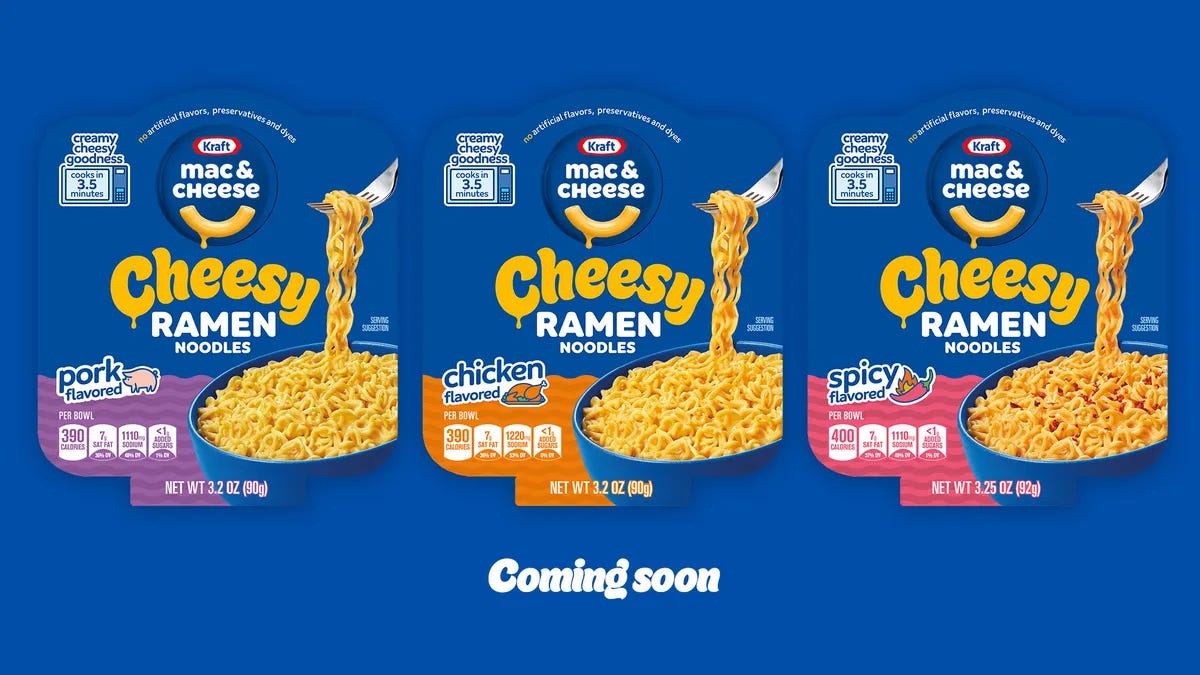
Can ramen save Kraft? Kraft Mac & Cheese is launching Cheesy Ramen in April 2027, its first new category in two decades. The $2.99 microwavable bowls come in chicken, spicy, and pork flavors. Apparently, defending the blue box now means getting into someone else’s noodle business 👀
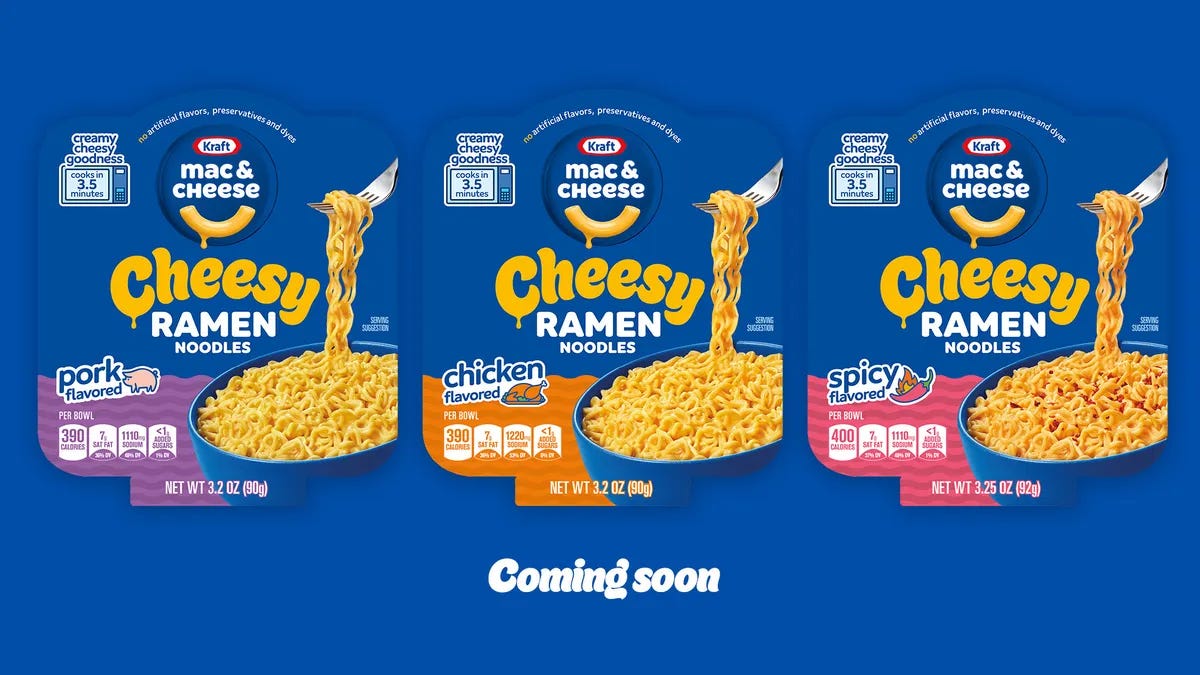
Kraft Heinz is trying to regain its footing. After pausing its planned split earlier this year, CEO Steve Cahillane said the company is investing $700 million in marketing, sales, and R&D. Kraft Mac & Cheese’s marketing spend alone is up 35% year over year. The brand’s first “innovations” included protein-heavy PowerMac and a “gourmet” Restaurant Edition. Now, it’s expanding into other noodle categories. Kraft wants to give people more reasons to reach for its iconic blue box by meeting demand for trends such as more protein, distinctive flavors, and options beyond the same mac they’ve eaten since childhood.
Kraft isn’t competing with just another store-brand mac anymore. Goodles has been winning shoppers with protein, fiber, and fun flavors. Meanwhile, Korean noodle maker Otoki already launched a Cheesy Ramen lineup in January, with flavors like Cheddar & Mascarpone and Spicy Chili & Cheddar in cups and packets. A-Sha has cheesy noodles with chef Andrew Zimmern, too, including Vermont Cheddar. Everyone is meeting in the same cheesy noodle aisle. This Kraft ramen move looks like both a defense strategy of its comfort-food territory and an attempt to grab some of theirs.
These launches, though they’re rooted in cultural flavors, aren’t trying to recreate traditional dishes. Otoki is making Korean noodles with cheddar and mascarpone, specifically for North American shoppers, while Kraft is putting its familiar cheese into ramen—neither is trying to sell you an authentic bowl from a ramen shop (we recommend Crafty Ramen for that). At the same time, this isn’t necessarily “dumbing things down” for an American palate, either. It’s more of this mash-up, built around what the consumers are already buying and eating.
Global flavors and formats are already all over US grocery, and now even Kraft wants in. They’re no longer confined to the “ethnic” aisle or left to smaller brands and imports. Ramen is familiar enough that Kraft sees it as a place to put its cheese, and that says a lot about how Americans eat now.
Pepsi’s bargain era is over. PepsiCo reported Q3 revenue of $25.27 billion, up 5.6% year over year, beating expectations—but cut its core EPS (earnings per share) growth outlook to 2.5%–3% (from 5%–7%) and reiterated plans to raise prices 15% to offset rising input costs.
Quick refresher: earlier this year Pepsi went the other direction, cutting prices to win back volume, and it cost the company 280 basis points of North America core operating margin. 😅 So this is a reversal, and an expensive lesson in what a price cut costs… even when you’re the biggest player in the aisle.
Meanwhile, what actually worked this quarter looks more like an insurgent brand’s vibe: protein, fiber, simpler ingredients, and portion control (think Doritos Protein, Lay’s Baked with Olive Oil, the dye-free NKD line, and lower-sugar Gatorade). Pepsi is raising prices on the core while borrowing the better-for-you playbook to make the new prices easier to swallow.
So, what does this mean for smaller CPG brands pricing into a Pepsi-led inflation environment? The upside is a bigger price umbrella: when Lay’s goes up 15%, the gap between it and a $6.99 bag of better-for-you chips shrinks, and a brand that holds price (or raises less) suddenly looks like the reasonable option on shelf.
HOT DOG! Gleezy, the premium hot dog brand making double-smoked beef brisket dogs 😋, is rolling into 684 Walmart stores across 15 states with its dogs and Carolina Dog Sauce. The expansion follows a $2 million raise earlier this year.
Even the humble hot dog is getting a premium upgrade! There’s never not a category in need of a little touch up, and Gleezy is doing that for the wonderful world of hot dogs.
Distribution is the new DTC. Some of the biggest DTC brands of the 2010s are finding a new home in retail, and seeking ever more distribution to solidify their status as retail brands:
AG1, the DTC darling and all-in-one greens powder turned broader supplement brand, announced expansion into Walmart, Kroger, Harris Teeter, and Wegmans, bringing its US retail footprint to more than 8,000 doors—up 75% from earlier this year. AG1 Energy+ launches in November, with an RTD line to follow in 2027.
Daily Harvest is expanding its frozen meals at Kroger, Wakefern, Target, Fresh Market, and Meijer—its biggest retail push since Chobani bought the brand in May 2025.
Daily Harvest has spent the past few years figuring out its lineup and where shoppers want to buy it. After refreshing its smoothies and oat bowls, ditching the DTC subscription requirement, and building out its freezer-aisle presence, the brand seems to finally be finding its footing. Now, it has Chobani’s retailer relationships behind it to help get it to the next level. Getting on shelves is one thing, but becoming a freezer staple is another beast.
Beauty looooves fragrance. 2026 has been the year of beauty brands entering fragrance, with nearly every beauty brand—from drug store to premium—entering the space. Earlier this year, we saw Summer Fridays launch its first fine fragrance, as well as Mikayla Nogueira’s POV Beauty launch fragrance in collaboration with Snif. As we shared in a previous newsletter, beauty brands launching fragrance (think: Glossier) is a massive signal of lifestyle ambition—that a brand wants to live in your full beauty routine, not just one step of it. As the Glossier era fades out, there will need to be a new player that can be the all-in-one beauty brand, bleeding into lifestyle. This week, these brands are throwing their hats into the ring:
Merit is launching New Wave L’extrait De Parfum, its second fragrance, on Oct. 22 at $92—created with master perfumer Dominique Ropion. The brand’s first fragrance, Retrospect, is now its #5 SKU, with customers averaging four repurchases over two years.
e.l.f. Brands launched e.l.f. POP, a new fragrance and body care line debuting with a Norway-inspired holiday drop—three SKUs priced $12–$13 on TikTok Shop, its website, and Amazon. A full destination lineup follows in January 2027. The e.l.f. POP name is an ode to the limited edition scent Jelly Pop.
Earlier this year, e.l.f. dabbled in fragrance with another limited-edition scent collab with H&M. That was a more premium collab—an eau de parfum as opposed to the new fragrance mist.
e.l.f. also introduced its haircare line earlier this year, which we covered here.
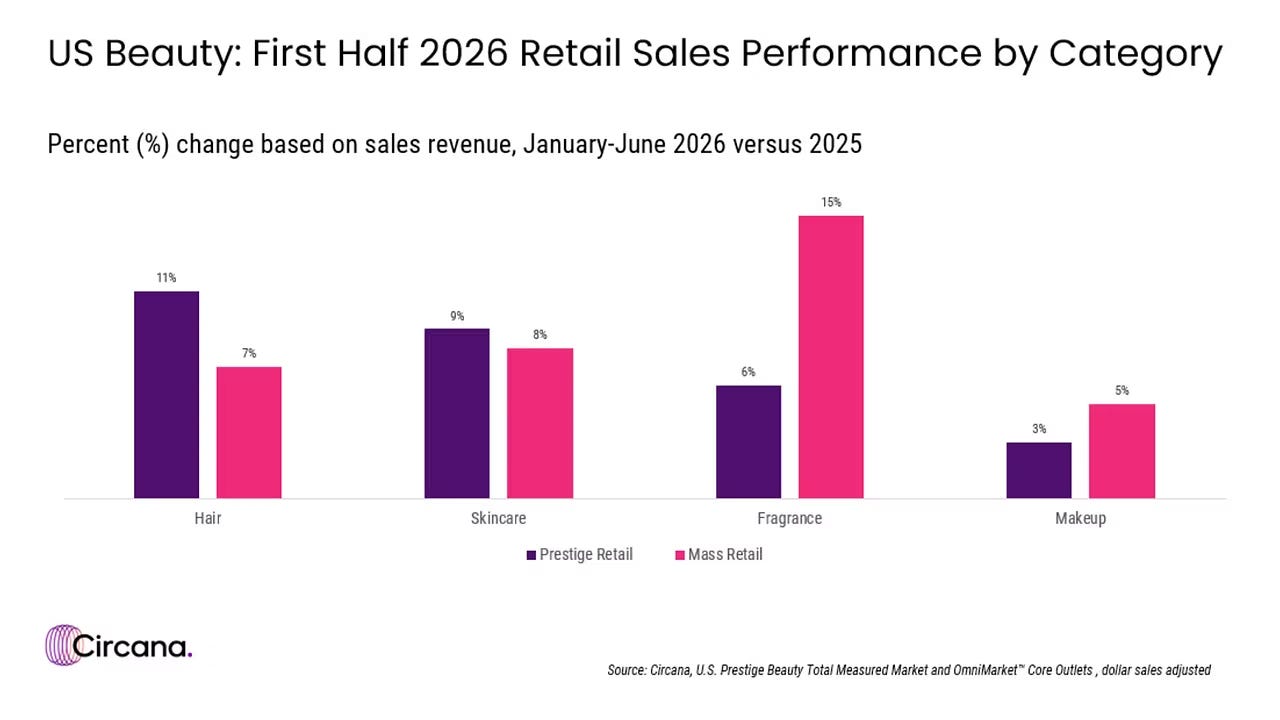
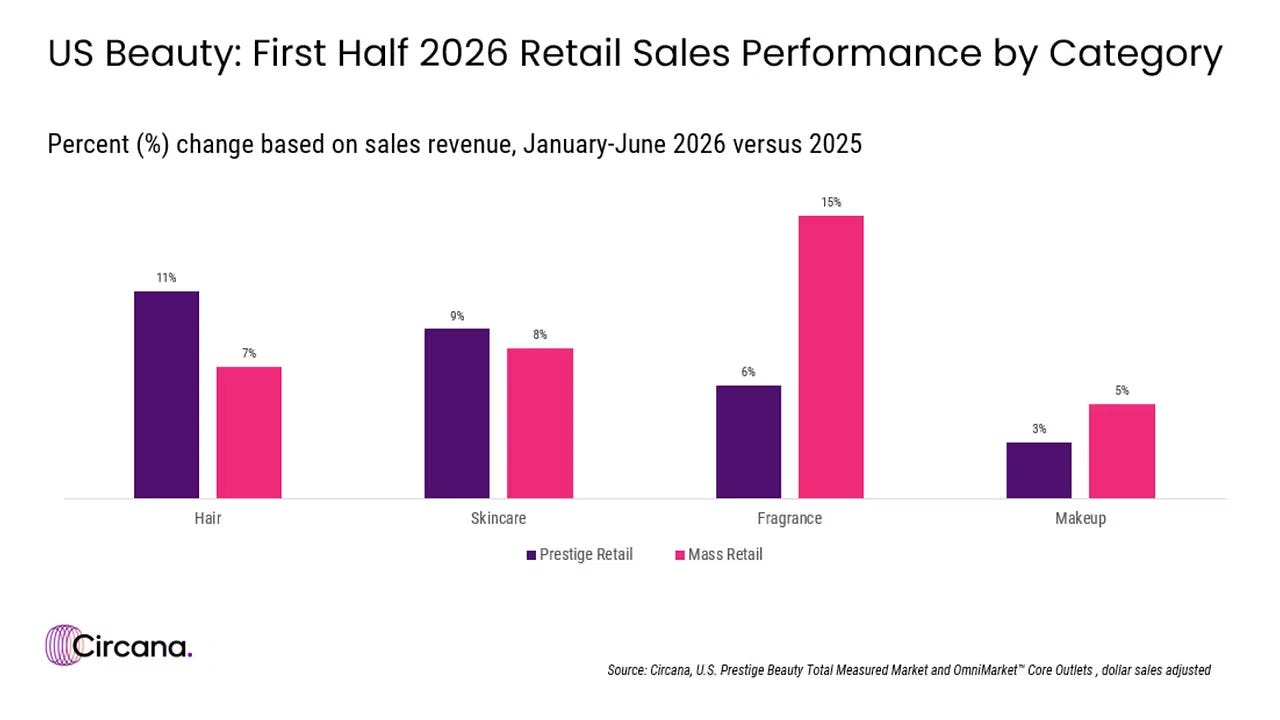
Per Circana, fragrance is really where the money is—in both prestige and mass retail. In the first half of 2026, consumers traded up into higher-concentration formats, with eau de parfum (EDP) and perfume posting double-digit growth. Meanwhile, fragrance was the fastest-growing beauty category in mass retail, with sales increasing +15% and units rising +7%.
When the strategy is selling… nothing. Tower 28 opened its first pop-up with Sephora in Venice, Calif., offering shade matching for the Swipe Serum Foundation, SOS Rescue Spray refills, and limited-edition merch—no products sold on-site. Founder Amy Liu framed it as a community test, not a revenue play.
Is this the Four Loko for Gen Z? Monster is (re)launching Monster Protein Energy, a 30g-protein RTD built on an ultra-filtered milk base, with just 2g of sugar and 6g of fiber, in Chocolate and Vanilla, slated for early next year.
If you’re a hardcore Monster fan, you may remember when the brand attempted a very similar product with the same name in 2018 (surrounding the Arnold Expo. At the time, the product was higher sugar, slightly lower protein, and came in a screw top bottle. Now, the product is relaunching into a very different consumer environment—one that is actively seeking protein outside of athletic environments, and is familiar with the concept of a canned high-protein beverage (thanks to brands like Nurri and Slate). Because there is now precedent for protein in a can, Monster was able to maintain its classic energy format while introducing the protein functionality.
Do we think this is going to take off? In all likelihood… no. The major hurdle here is that consumers already have an understanding of the experience of drinking a Monster—and a creamy, indulgent milk beverage simply doesn’t jive with that experience.
An important note: on the front of each can, it says “GLP-1 Aligned,” which is frankly bizarre copy (”aligned?” Is this a board meeting?!), but also is very telling. Clearly, Monster is betting that this innovation will attract the GLP-1 consumer, which seems to be an increasingly popular target for protein products. Maybe this was added for the NACS audience of buyers and retailers, but we wouldn’t be surprised if this ends up on shelf too.
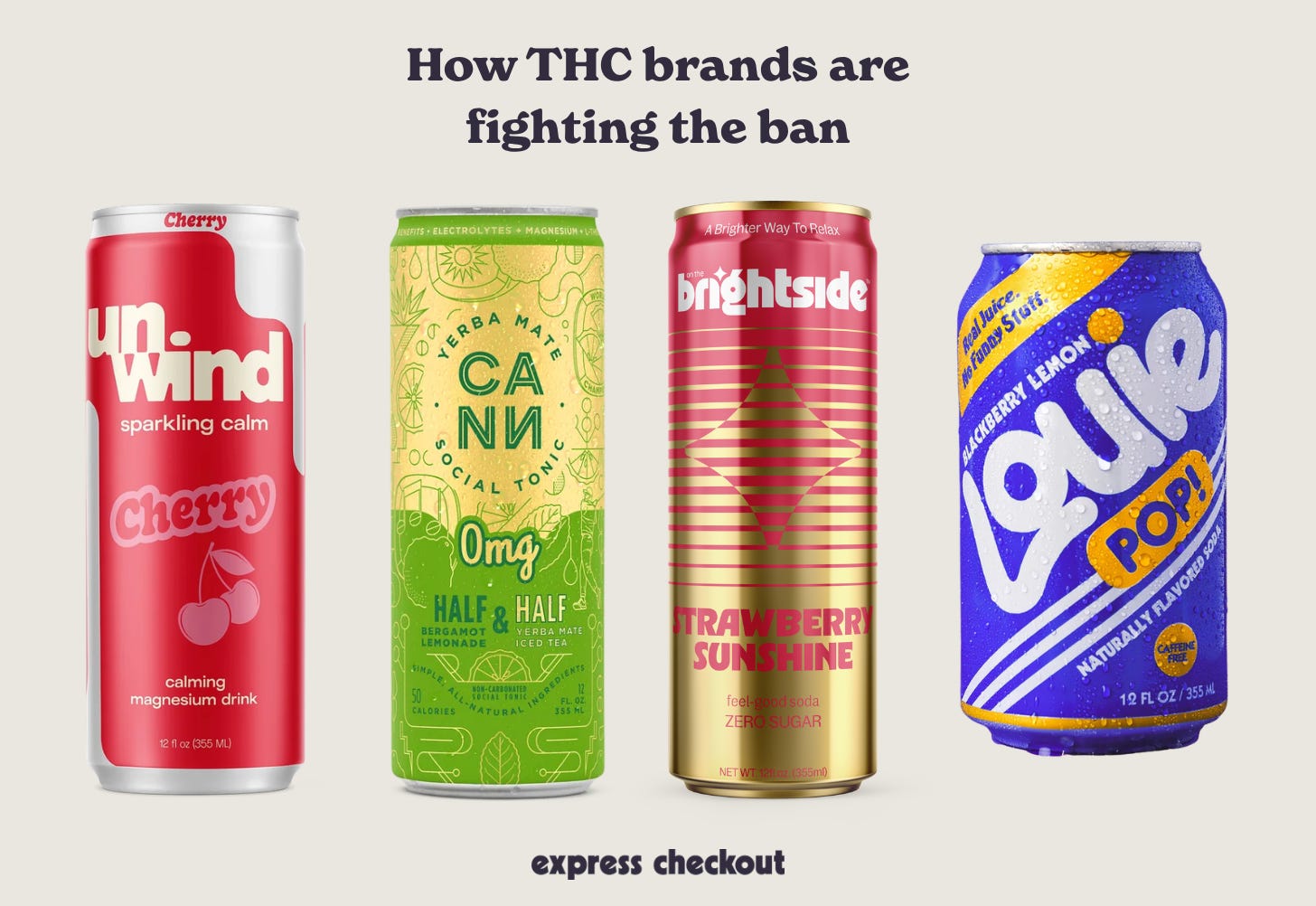
Another 🍃 bev brand ditches the “funny stuff.” Louie Louie, the THC-infused drink, launched a separate modern soda brand, Louie POP!, promising “natural sodas without the funny stuff.” The four-flavor lineup skips the functional pitch entirely, there’s no fiber or prebiotics or protein, just soda sweetened with sugar and monkfruit.
This is the fourth THC beverage maker we’ve seen build a THC-free offering recently all thanks to a looming ban. A change to the federal definition of hemp is set to take effect December 11, 2026, excluding finished hemp-derived cannabinoid products with more than 0.4mg of combined THC and similarly acting cannabinoids per container. That’s well below the 2–10mg in many popular drinks. Congress is considering alternatives, but right now it looks like this is going through.
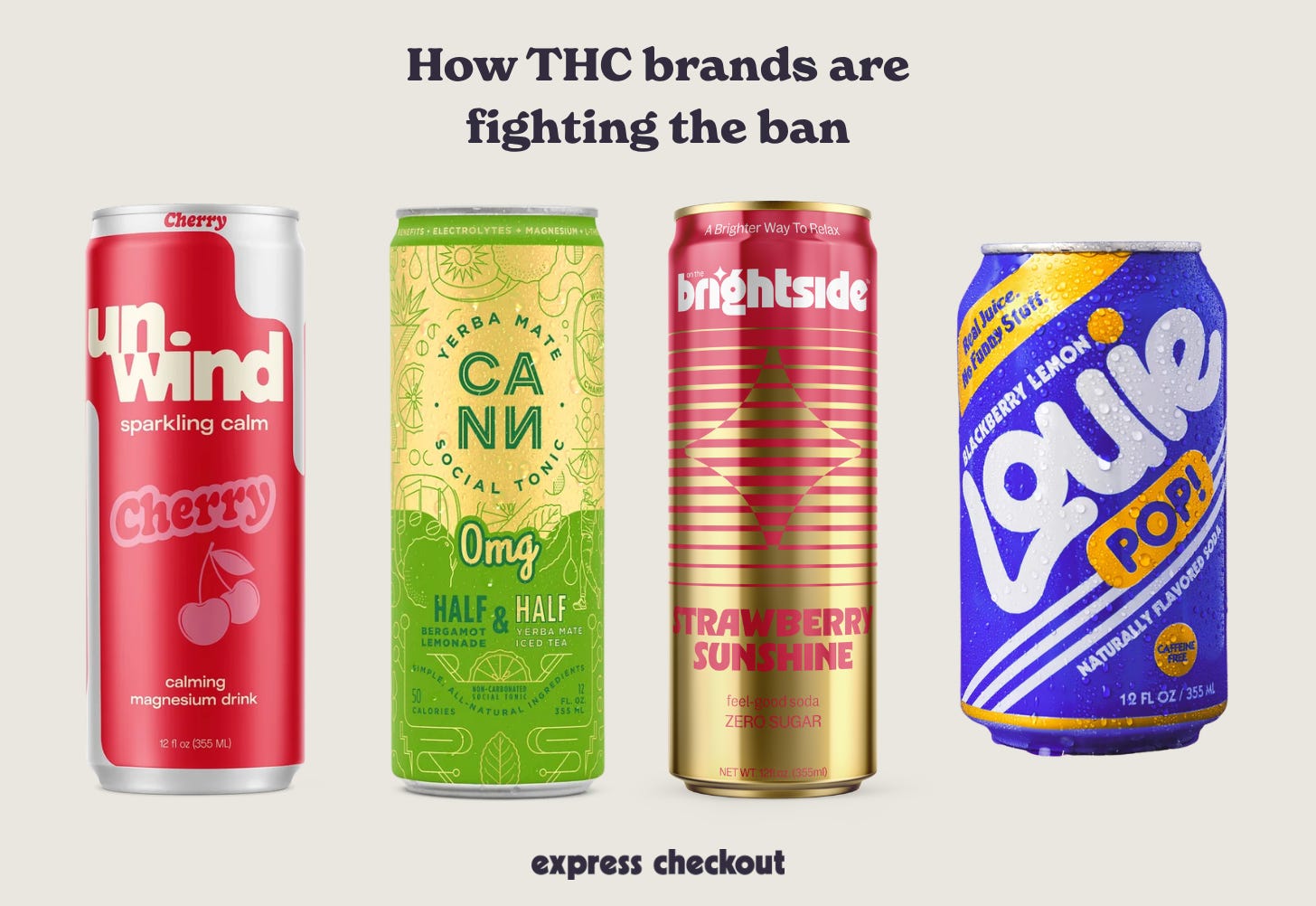
Louie Louie does stand out among what the other hemp-based beverage makers are doing. The rest are still leaning hard into function, trying to help people unwind without the weed: Nowadays’ founders launched Unwind earlier this month, swapping THC for magnesium and L-theanine in a sparkling drink debuting in roughly 1,000 Walmart stores, with TikTok Shop to follow mid-October. Cantrip’s makers took a similar approach with On the Brightside, a “feel-good soda” built around Zembrin, a kanna extract (check out our podcast episode with founder Adam Terry!). Cann is making that shift under its existing brand launching its 0MG line in July, pairing their flavors with magnesium, L-theanine, electrolytes, and passion flower.
eCommerce
Anotha one bites the (AI-powered discovery) dust. TikTok launched its agentic AI shopping experience, featuring Shopping Assistant (a conversational AI agent) and Buy Direct (one-click purchases from directly inside the FYP), letting consumers discover and buy products without leaving the app.
As Retail Dive explained, the move raises a major question for brands: who owns the customer relationship when customers never actually have to enter your brand’s ecosystem? When shoppers don’t have to go to your website or socials, don’t have to provide any first-party data to the brand, the company no longer owns the customer relationship… TikTok does.
Retail
A more equitable grocery store. New York City is moving ahead with five city-owned grocery stores—one in each borough—as part of its effort to address food insecurity. The NYC Economic Development Corp. has brought together four firms to shape how those stores look, sound and work: Gander, Librarie, Noble Signs and Seven Roots.
A lot of the coverage focuses in on the firms’ buzzy-brand credentials—which they rightfully have a lot of. Gander has a long list of clients like Graza, Magic Spoon, Banza, Stiller’s Soda, and Gotham Greens.
To us, the “bougie” framing misses the whole point. A city-run grocery store is an ambitious, exciting project on its own. And if the city can make these stores feel as good to shop in as the fancy markets around town—while keeping prices in reach for more people—that’s a win for everyone.
Affordable groceries shouldn’t mean a worse shopping experience. Target’s Good & Gather and Walmart’s bettergoods show that private-label can be more than a cheaper substitute and can give people products and a shopping experience they actually want at better prices. City-run grocery stores deserve that same care. People should be able to shop somewhere welcoming and thoughtfully designed, and buy what they want without paying premium-market prices.
The drones keep coming. Wing and Walmart are expanding drone delivery to Denver and Seattle by 2027, pushing their partnership toward 270+ Walmart locations and 40 million customers. The two new metros join Dallas-Fort Worth, Atlanta, Houston, and Orlando.
Funding, Mergers, and Acquisitions
RTD bevs keep winning. Constellation Brands acquired SpikedAde, a zero-sugar, vodka-based RTD founded in 2025 by serial CPG entrepreneur Jason Cohen (founder of SkinnyPop and Core Hydration), for $75 million—with up to $278 million in performance payouts over five years.
As much as everyone loves to cite stats about alcohol dwindling, it isn’t dead yet. In particular, RTD cocktails are booming as the rest of the category seems to be struggling. Spirits-based RTDs grew 30% in dollar sales in Q1 2026 and now make up 28% of off-premise spirits volume; core spirits fell 4.4% in volume and wine 8.3% over the year to March. The catch is that the growth is getting narrower: malt-based RTDs are still declining, and more than 750 spirits-based cocktail brands are now fighting over the same shelf.
Love this analysis from Drew Fallon on LinkedIn:
“SpikedAde went from first can to 9 figure exit in 15 months. Up to $353M all within 15 months of its NYC debut last summer. My key takeaway here, which I’ve said a bit recently, is that strategics are increasingly ‘risk on’ as they’re more willing to make bets on relatively ‘unproven’ brands that haven’t been around very long. This is the opposite of the patterns we saw the few years prior and signals to me that strategics are feeling some squeeze and pressure to do M&A.”
Capitalizing on Greek yogurt’s second wave. Clio Snacks, the refrigerated Greek yogurt bar, has been acquired (for an undisclosed amount) by Stride Consumer Partners, a growth-equity firm with $1.3B AUM. The brand has more than quadrupled revenue since 2021 and is now sold in ~60,000 stores, on track to produce 150M+ bars this year.
This isn’t one of those scale-fast-sell-fast brands; Clio has been around for 11 years! Instead, this is one of those examples of a brand that found its footing with the trend cycles. As protein—and therefore Greek yogurt—grew more popular, the idea of a Greek yogurt bar became more approachable and sought-after.
More cash going into function. Supermush raised a $3 million Series A led by Ndude Labs. The functional mushroom snack brand joins a crowded-but-growing adaptogen space as investors continue betting on functional food.
The bean renaissance is HERE. Bare Beans, a Native woman-owned Idaho startup, raised $2.79M in seed from Raven Indigenous Capital Partners to fund a DTC launch of vacuum-sealed, preservative-free, ready-to-eat kettle-cooked beans, with retail expansion to follow.
As someone whose wifi network is quite literally named “beansforpresident,” I (Jenna) have strong feelings about the bean movement we’ve been witnessing. Beans are the perfect food for the modern wellness environment: they’re a whole food (AKA non-UPF), and naturally high in protein and fiber.
The biggest blocker for beans’ takeoff is that, if you’re looking for the good quality stuff (as opposed to canned beans which are cooked in their tins with preservatives), they typically require preparation. Bare Beans solves for that.
More broadly, this is a really interesting brand and founding story. The founders are Indigenous women; Indigenous founders receive roughly 0.05% of US VC, and women received just 0.6% of VC funding in the US this year.
Family buys back the brand. MadeGood’s founding Fotovat family has repurchased Prelude Growth Partners’ minority stake, returning Riverside Natural Foods to full family ownership after 4 years—during which net sales grew 2.5x and the brand expanded to 40,000 retail doors globally. Terms were not disclosed.
In case you missed it… 🎧
Last week, we sat down with the wildly impressive Tristan Walker, who built and sold Walker & Company (the parent company behind Bevel) to Procter & Gamble and recently joined Collaborative Fund to help launch Collab Holdings—a private equity arm built for consumer brands that don’t fit the traditional VC/PE playbook.
He walked us through building Bevel, and why he now believes most founders shouldn’t take VC money in the first place. We also dug into what makes a CPG brand “durable,” why Gen Z is increasingly skeptical of private equity, and whether AI can ever replicate intuition. 👀
Catch the full episode below 👇
If you haven’t yet, please subscribe, like, leave a comment, and share it! It helps us continue to bring you the most interesting news + nuance in consumer and retail every week.