



Hello hello!
The DTC-to-retail crossover is the defining growth move in CPG right now. We constantly share stories of the buzziest DTC brands finally finding themselves on shelves—but turns out, there’s a lot more to the story than we realized.
immi—the totally viral, high-protein, low-carb instant ramen that sold out on launch and built a cult following—is now in Whole Foods, Wegmans, Sprouts, and The Fresh Market. And when the POs started coming in, the spreadsheet that had carried them through their legendary DTC era started getting clunkier… and soon near-impossible to manage.
We spoke with Silas Ang, Director of Operations at immi, about what it took to get the back end under control—and how Jampack AI got them there: 40 hours saved per week, 5–9% back on freight, and rate shopping from days to seconds.
Read it here, thanks to our friends at Jampack AI.
Food for thought.
We’re doing something a little different this week. Instead of diving into one news story, I’m giving you a few things to chew on (metaphorically, I’m sorry).
Please enjoy this series of recent CPG-related happenings in my (Jenna’s) life. They won’t inform you of any news, but they’ll offer a moment to slow down and consider the downstream impacts of the industry we play in. Each headline we cover inevitably moseys its way down to real lives; these stories offer a glimpse into that trajectory.
(If you are really only here for the news, scroll down—we’ve got you covered!)
Growing up on modern soda. This weekend, I found myself getting a haircut next to a 9-year-old girl, accompanied by her mother. To pass the time, the girl rifled through modes of entertainment: first TikTok (until she hit a limit), then Instagram (another limit), only to be followed by an actual, physical chapter book. Her mom patted her back when she begrudgingly picked up the book, admiring her daughter’s reflection in the salon mirror.
”Think we can get these curls to last through tomorrow?” She asked. The stylist offered hairspray. “She has a big double-digit birthday party tomorrow.”
I couldn’t help but insert myself: ”What does that entail these days?”
”A big sleepover, with lots of treats,” the mother shared. Of course, I had to inquire about said “treats” involved. “Nerds Gummy Clusters and soda,” she sighed, drawing out “soda” with an eye roll.
”It’s not normal soda, Mom,” the birthday girl finally chimed in, peeking up from her book. “It’s Poppi.”
”Yes, Poppi,” her mother repeated, “we’ve had to ration them on this stuff. Only one can per girl.”
The daughter whipped around in her chair. ”Only one? Can we please have more?” This was met with a knowing glare. “But Mo-om, they aren’t even bad for you!” Her mother doubled down, further dipping her chin and raising her eyebrows. I watched the girl continue to flip through her book in defeat, locks of her long, shiny hair weaving in and out of a round brush and falling in perfect rings on her shoulders.
I have a feeling she had a great 10th birthday party. Her curls stayed intact, secret-revealing ensued, and her friends each sipped on a Poppi throughout the night—nursing the low-sugar soda like a too-potent cocktail, feeling very adult with their carbonated bevs in hand and newly minted double-digit status.
She might even grow up to remember her 10th birthday party, looking back fondly on the day she picked Nerds gummy out of her molars, stayed up giggling until 4 AM (ah, the days before Sleep Scores), and surreptitiously consumed more than one Poppi. She’ll laugh, recalling the great lengths she went to break her Poppi ration—now unable to recall the taste, but beaming at the feeling of merely holding that brightly colored can.
How to know you’ve finally made it: The other day, I saw a crushed can of Bloom Sparkling Energy smushed into the sidewalk. The illustration and copy were distorted by car tires, but I could still make out that it was the Raspberry Lemonade kind (solid choice, but not as good as the Crisp Apple, I thought). It was glimmering in the sunlight, this metal trash, its emblematic lavender sheen now just as much a part of the landscape as a weed. What a feat, I thought, for your brand to grow so large, it becomes as ubiquitous as trash.
On injecting yourself with mysterious drugs. On a recent beach trip, a friend-of-a-friend was very excited to tell the group about his recent discovery: peptides.
He used something called BPC-157 to recover from a muscle tear, and swore it made a difference. He told us about his source, a certain “eternal peptides dot com,” which was vetted exclusively (but, he assured us, thoroughly) via Reddit threads.
“Now I’m trying a GLP-3 again,” he shared, puffing his chest.
“What does the ‘three’ mean?”
”Uh, just that it’s not one?” he shrugged. “I lost like 10 pounds the first time I did it. I only stopped because it made my heart beat weirdly fast, and I got crazy night sweats. But it’s probably fine this time.” Probably.
”So you’re injecting yourself with this stuff?” someone asked. He nodded, mimicking the motion—pinching a slab of belly fat with one hand, stabbing a syringe with the other. “Weren’t you not such a fan of the COVID vaccine?”
He went on to explain his thought process: it wasn’t the vaccine itself, necessarily, but more the rollout—the development was all too rushed, he said.
”And peptides… aren’t? There aren’t even studies on them yet.”
”Fair, but at least no one is telling me I need them. I want to make my own decisions about my body, do my own research, not have the government mandate what I do.”
The logic, at least, was sound.
If any of these stories stirred something in you or brought up a CPG-related happening from your own life, please reply to this email! I would love to continue to collect and share these vignettes, reminding us how this industry trickles down to real moments + lives. Now, onto the news! - Jenna
CPG & Consumer Goods
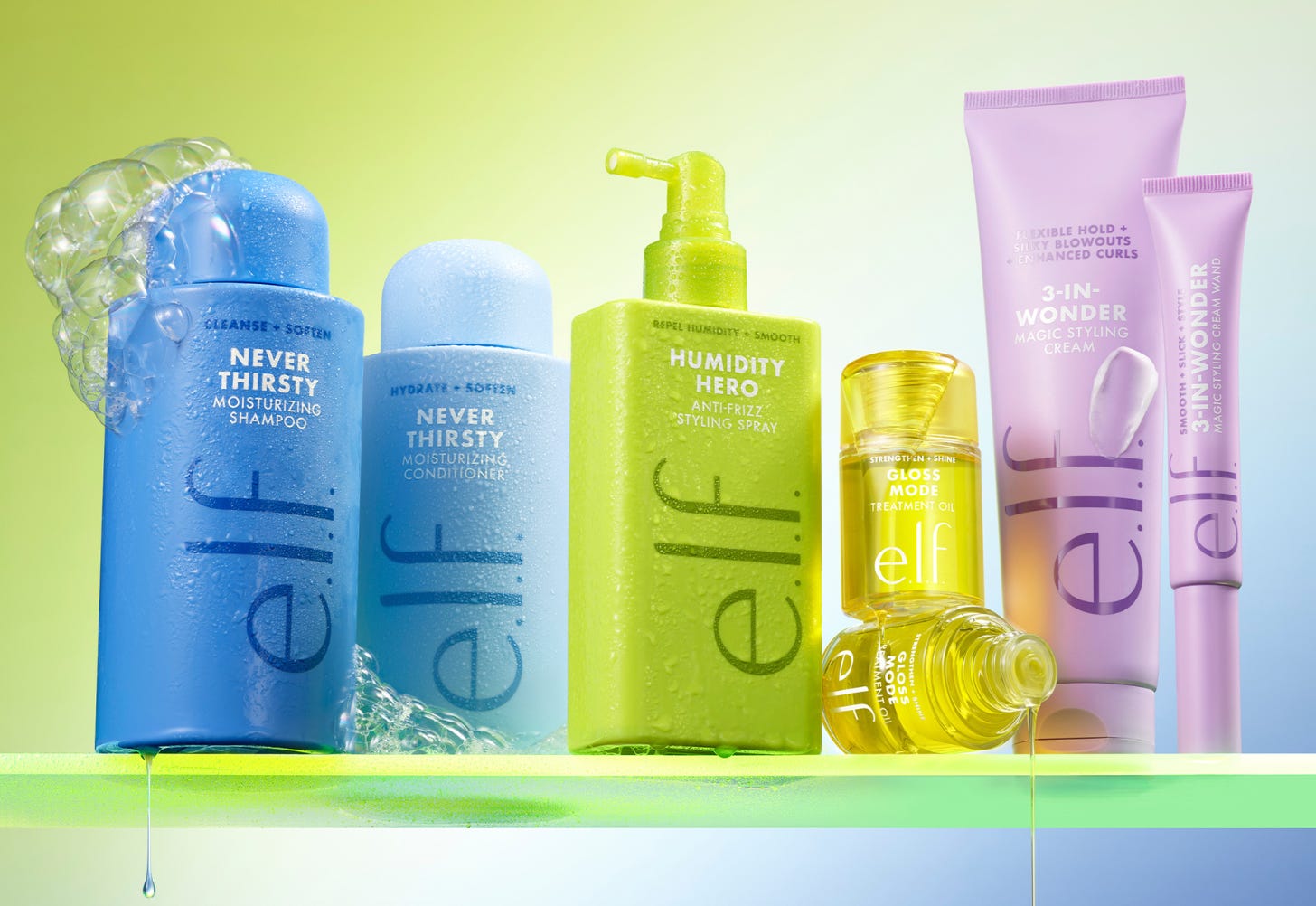
e.l.f. launches haircare. e.l.f, the affordable beauty brand (literally stands for “eyes lips face”) officially has entered its haircare era. The new haircare line promises “instant transformation with prestige-quality formulas at an accessible price point,” and includes six pieces, from a glossy treatment oil to a humidity-repelling styling spray and everyday wash essentials (shampoos + conditioners).
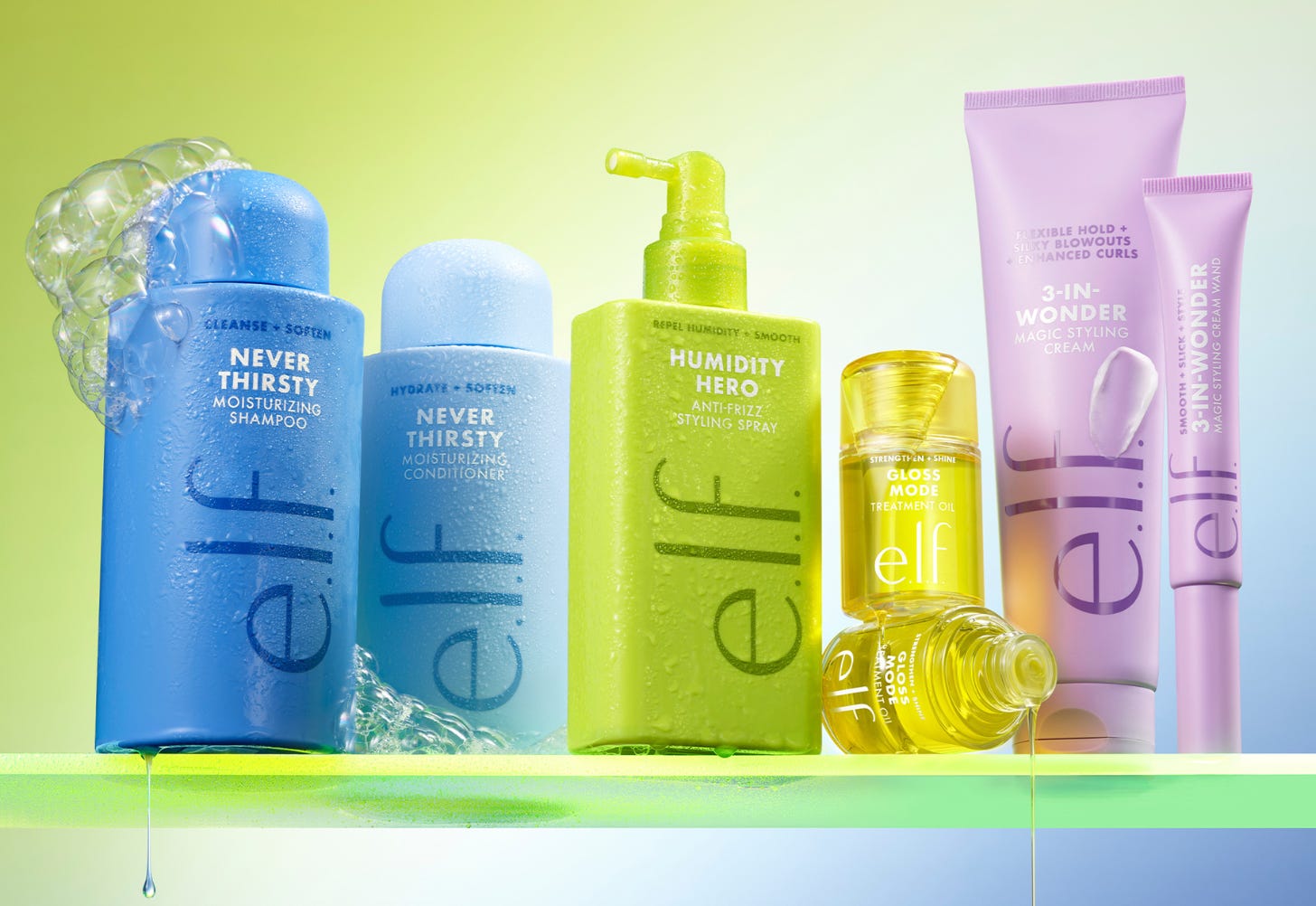
Haircare, like fragrance, seems to be the next frontier for beauty brands. We’ve seen a ton of M&A action around the category recently (ex. Not Your Mother’s and OLAPLEX acquired by Henkel) and continue to see VC money get poured into the category (just last week: California Naturals raised a Series B, Filament raised a seed round). Launches over the last year include Cardi B’s Grow-Good Beauty, Kitsch launching into liquid hair products, Kerativ (derm-developed scalp care), and more.
In the press pitch (shared with us via email), the brand emphasized its key ingredient in multiple SKUs: creatine. Upon further research, I learned that creatine is actually a common ingredient in topical products, known to help prevent breakage and retain moisture. This is the first time I’ve seen it proudly emphasized, though—likely because it is finally a recognizable ingredient to the average consumer.
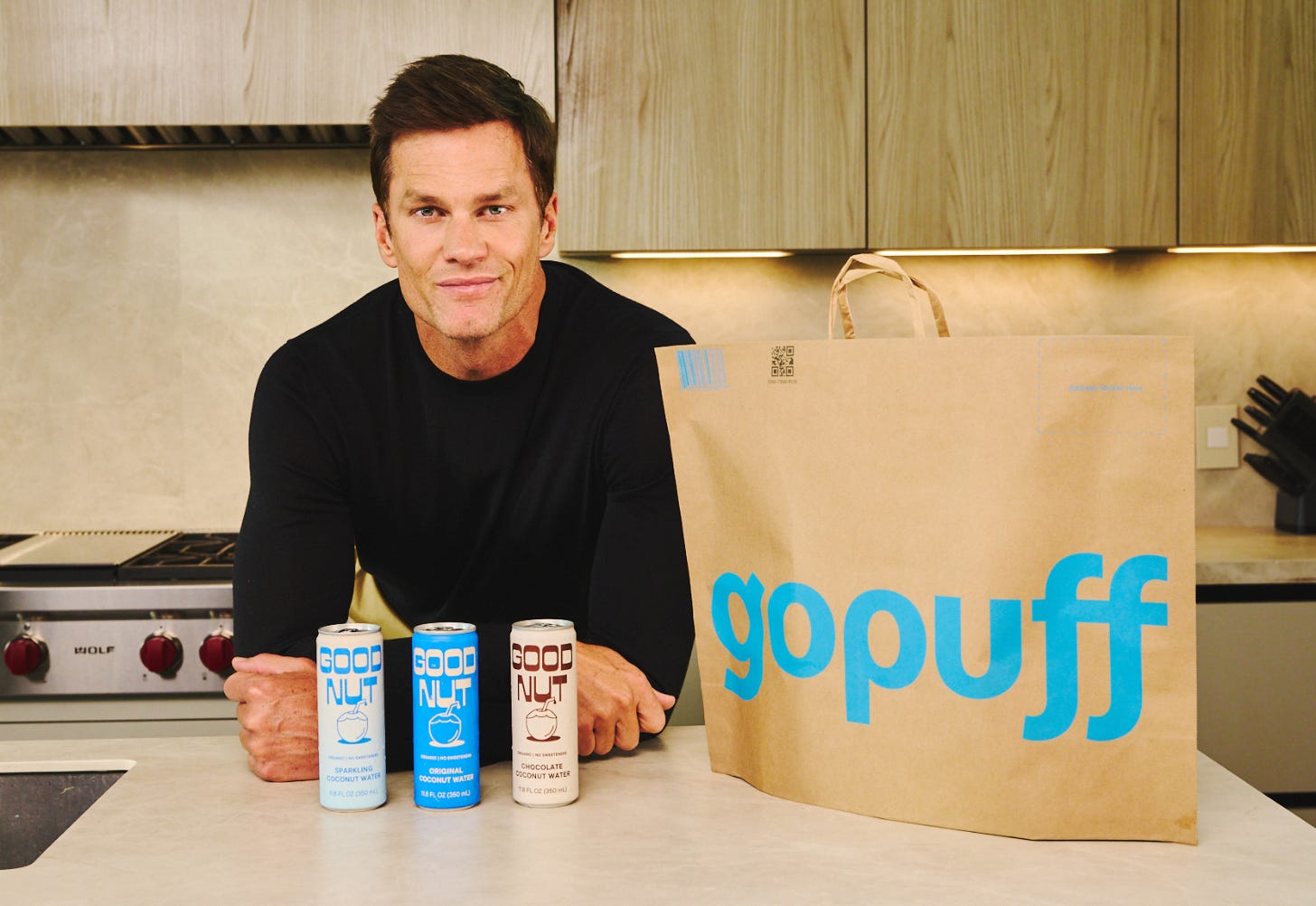
Brady goes nuts for hydration. Tom Brady and Gopuff launched Good Nut (incredible name, if you ask us), a line of organic coconut water available exclusively on Gopuff. The lineup includes the first certified organic chocolate coconut water alongside a still and sparkling can. Consumers are vying for hydration, on GoPuff alone coconut water sales are up 115% YoY! So pair this with the GOAT and you have yourself a winning formula.
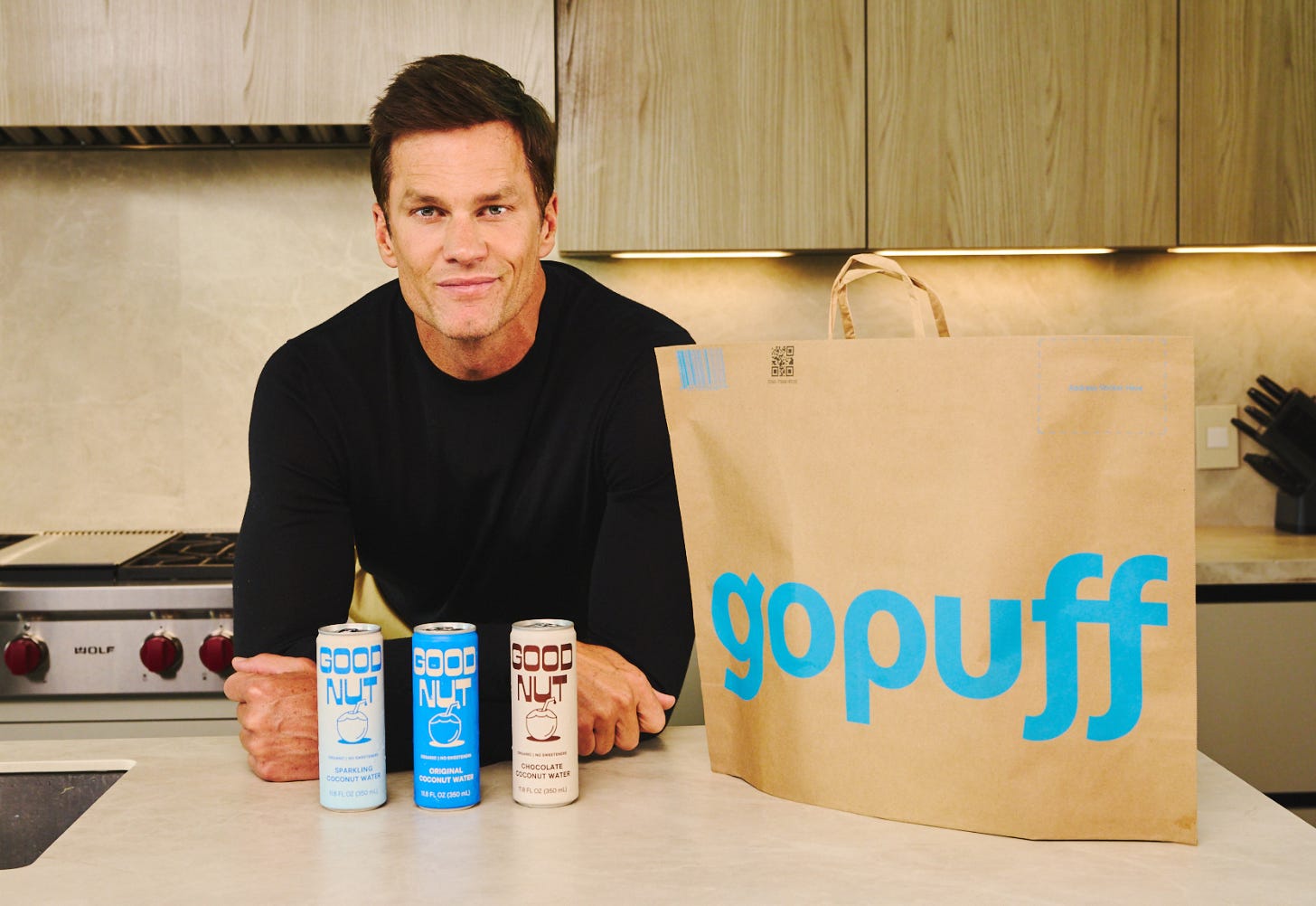
Almost a year ago to the day, Tom Brady and Gopuff launched their first product together, GOAT Gummies—a line of better-for-you candy that covers all the bases. They’re organic, vegan, gluten-free, contain no artificial dyes or sweeteners, and use real fruit juice. All they’re missing is protein!
It’s no surprise that they decided to go the beverage route, and it’s even less surprising that they went with coconut water. The category is on a tear—just look at Vita Coco, where coconut water net sales grew 42% in Q1 2026 and coconut water led all major U.S. beverage segments with 31.3% dollar growth, outpacing energy drinks, sports drinks, bottled water, and soda. Part of the appeal is that it’s a natural product, made with “real ingredients,” a callout that appeals to a growing number of consumers. But it also happens to actually work, with electrolytes that make it genuinely effective at hydrating. And the hydration market broadly is booming. Consumers are reaching for functional, hydrating beverages like never before—electrolyte mixes, RTDs, even banana waters.
Target’s biggest food bet of 2026 is a kids cracker. Cadootz!—the organic kids cracker brand started by creator and investor Rachel Mansfield—just landed nationwide in Target (its first retail partner) only six months after launching online and selling out fast. The brand has raised over $3M led by Selva Ventures (who were early investors in Grüns).
The Cadootz timeline is fast. Most emerging brands earn nationwide Target after years of grinding—see: Little Spoon, which spent seven years and built up to $150M in revenue before its 23-SKU Target rollout last Fall (the largest F&B rollout in Target’s history). First Day, a kids-focused supplement brand, launched in 2019 and didn’t hit Target shelves until December.
The DTC-to-nationwide jump in <6 months is certainly a testament to the product itself, but also seems to be pulling on the creator-led playbook, fueled by Rachel’s 1.5M+ follower base (which de-risks the velocity question of most emerging brands).
This is also a testament to the new “clean lunchbox” wave, which has been taking off in the past few years. But where the aisle was once split (clean baby + toddler brands like Serentiy Kids and Cerebelly vs. school-age snack brands like Annie’s that didn’t really cut it for some BFY-focused parents), Cadootz is closing that gap. The real competitive set is arguably less about kids brands and more about adult clean-label crackers (Simple Mills, Mary’s Gone Crackers) that these parents already buy and share with their kids anyway.
It’s creatine’s world, we’re just living in it 💪
AG1 announced AG1 Pro, a creatine-infused version of its Next Gen powder, also including calcium-HMB (for muscle building) and zinc carnosine (”advanced gut barrier function”). The launch follows AG1’s expansion into Ulta Beauty, Target, and Costco, as the brand crosses $600M in annual revenue.
At this point, it really feels like AG1 is doing anything it can to stay relevant as more and more buzzy supplement brands start to steal its limelight. In the last year alone, the brand launched a sleep supplement (AGZ), multiple flavors (AG1 Next Gen), and now it’s getting into creatine. Frankly, it feels a little late to the creatine game—which is one of the most researched and scientifically validated nutritional supplements in the world.
What we find especially interesting here is the “Pro” positioning. AG1 as a brand always had an air of superiority—the supplement to end all other supplement stacks, the all-in-one formula used by the most elite athletes and wellness-minded consumers alike. Now, it seems like the brand is repositioning its hero SKU, AG1 Next Gen, for the everyday consumer, while AG1 Pro is an upsell for the real fitness gurus.
Meanwhile, Create Wellness teamed up with Kendall Toole (ex-Peloton, NKO founder) for a national, multi-platform campaign to spotlight creatine’s benefits. While this is not a new creatine product launch, it’s another sign creatine is being repositioned from a hardcore bodybuilding supplement into a mainstream wellness ingredient—marketed around benefits like cognition, recovery, energy, and everyday performance. This is a markedly different approach than pinning the word “Pro” to a creatine product.
We dove into creatine’s rise and Create’s $20M funding round in our recent issue Creatine’s big break back in April.
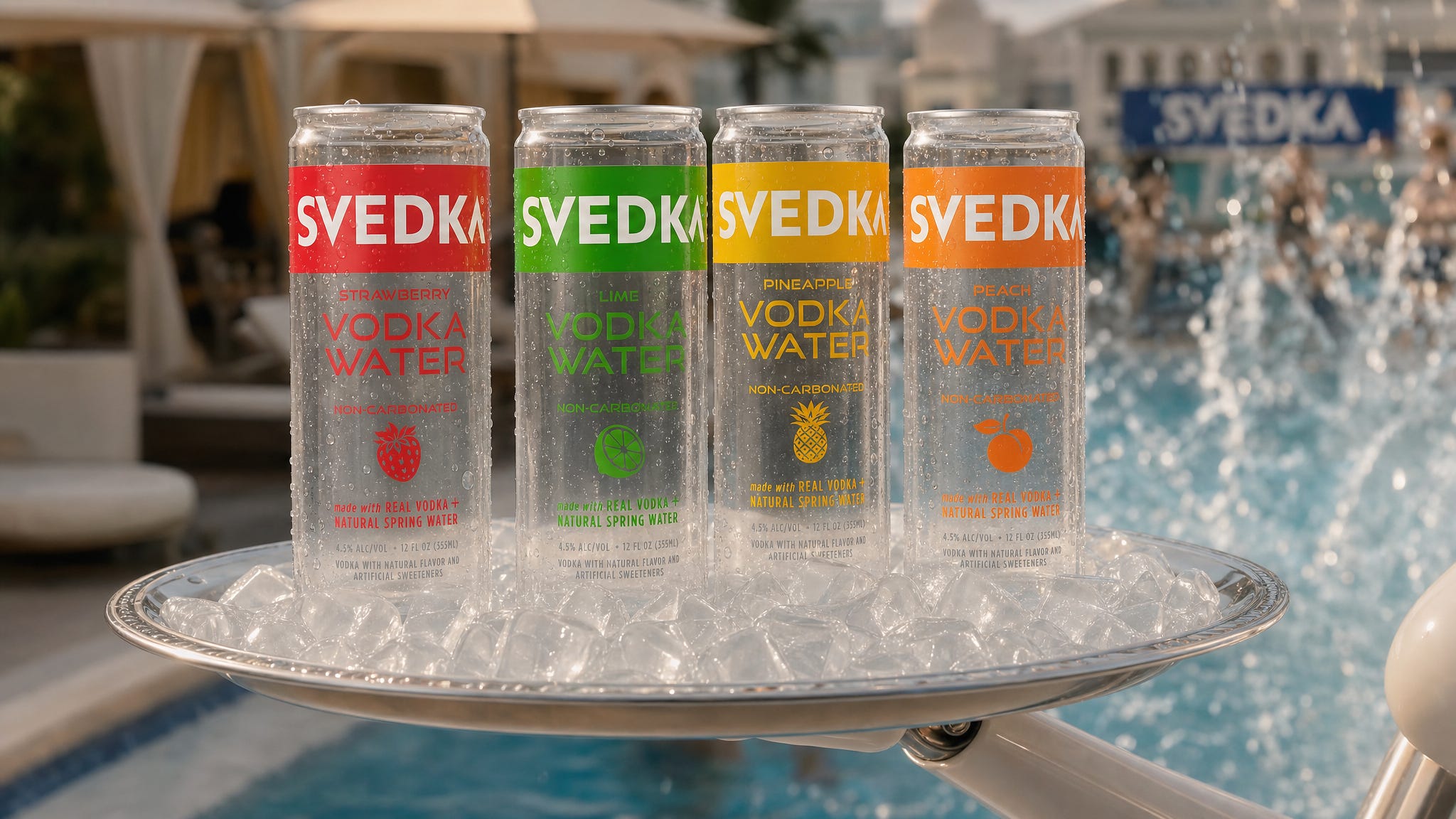
The next wave of RTDs is….non-carbonated? Sazerac launched Svedka Vodka Water, claiming the title of “world’s first transparent canned vodka water.” A mouthful. The non-carbonated RTD comes in four flavors—strawberry, peach, pineapple, and lime—with 90 calories per 12oz can.
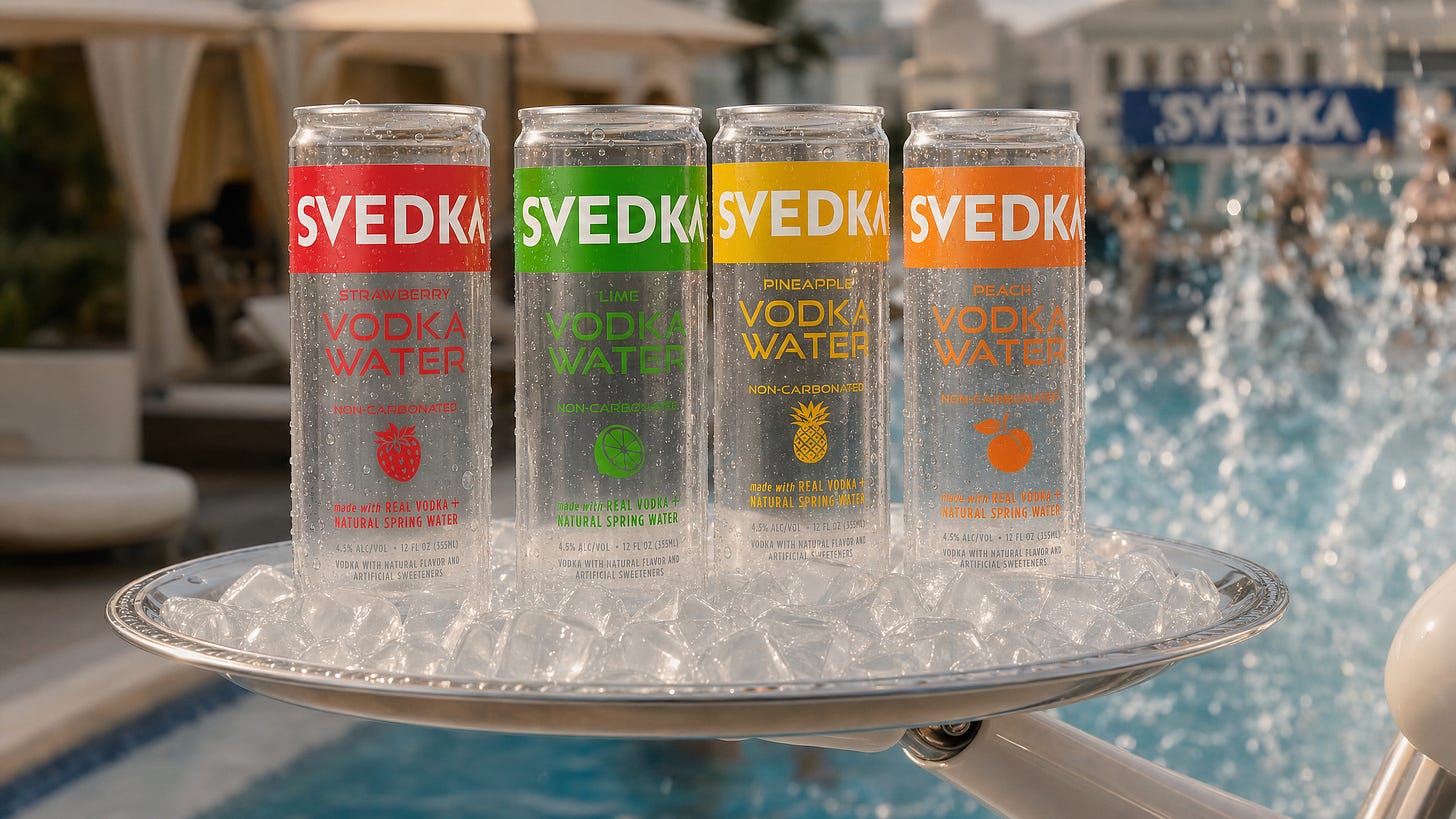
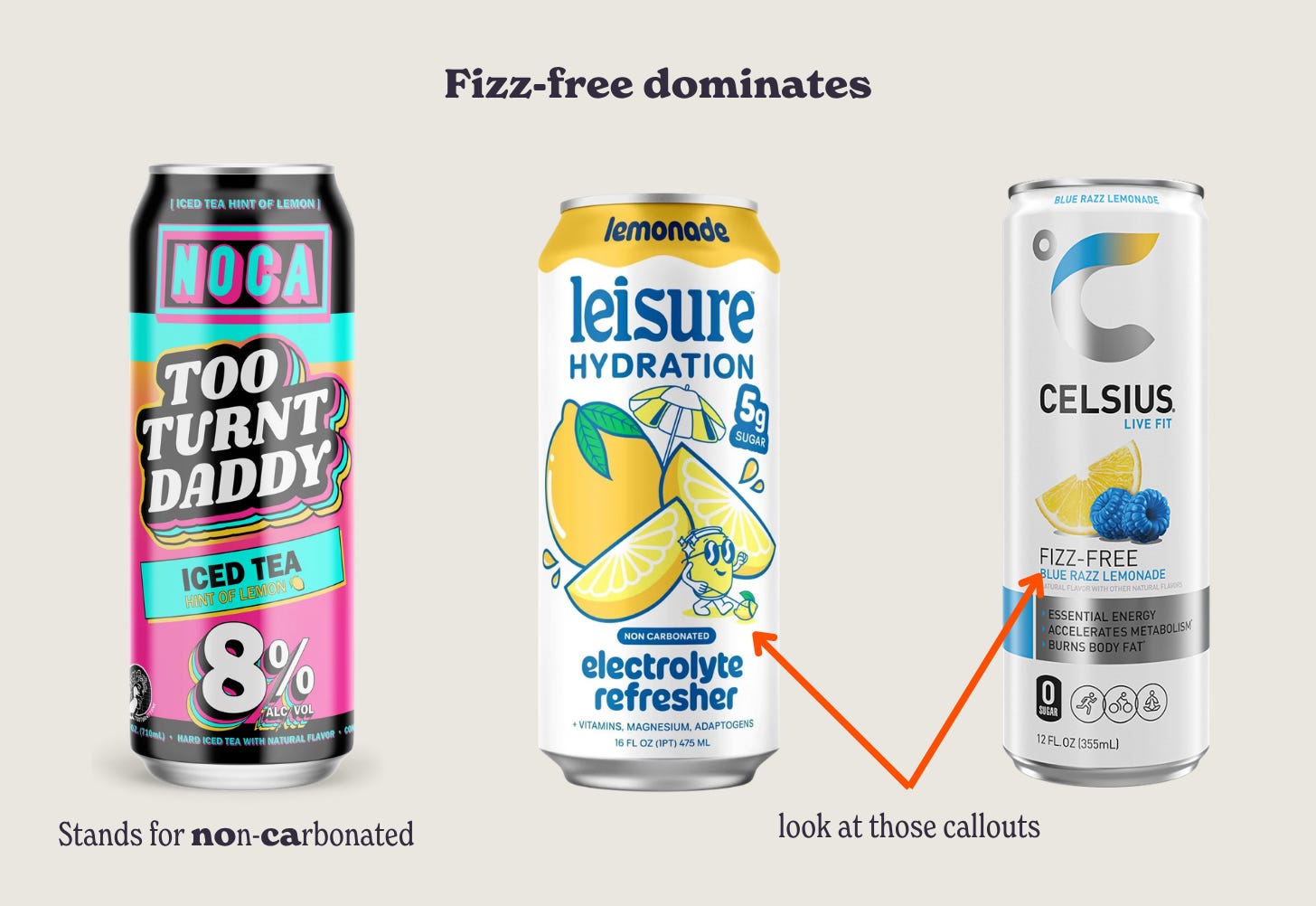
Consumer preferences are shifting away from carbonation, and brands on both sides of the bev-alc/non-alc line are cashing in:
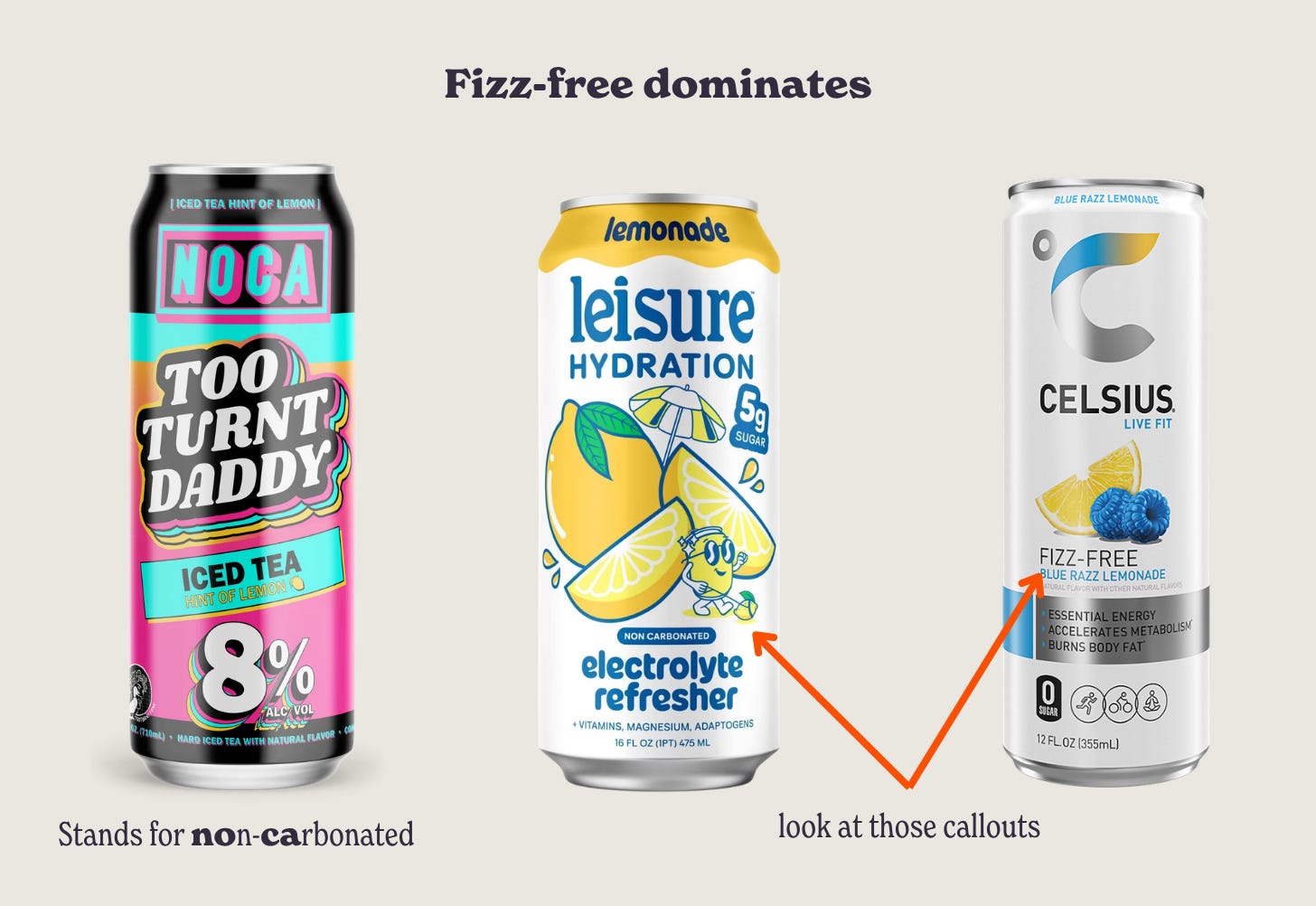
Surfside has become one of the fastest-growing alcohol brands right now, hitting 11.1 million cases in 2025.
NOCA is an iced tea-and-vodka RTD that built its name around the absence of bubbles—it literally stands for “no carbonation.”
Celsius, the energy drink known for its fizz, just expanded its fizz-free line.
Leisure Hydration, a non-carbonated enhanced water, closed an oversubscribed Series A on the back of 1,300% revenue growth over two years and the #1 dollar velocity in its category, and is now expanding nationally.
And look at Beatbox, a flat non-carbonated party punch that sold to Anheuser-Busch for nearly half a billion dollars.
Protein pretzels go domestic. CRISP POWER opened a $15M production facility in Stafford, Texas, shifting from an Israeli import model after triple-digit year-over-year growth. The brand now sits in 3,000+ doors with Costco, H-E-B, Wegmans, and Hy-Vee.
The founder, Gilad Zilberberg, owns the Israeli bakery (Meir Bagel) that’s been producing these since he acquired it in 2000—so this isn’t a brand that outsourced manufacturing and is now reshoring. It’s more about replicating his own factory, but stateside.
This is a sleeper brand: after building a following through DTC, Amazon, and TikTok shop, the brand has launched into traditional retail, hitting 3,000 doors (Costco, Vitamin Shop, Meijer, and more).
In legal CPG news….
Another infant Nara Organics recalled its organic, European-manufactured whole milk powdered infant formula—sold at Target and DTC—after three babies in across the country were hospitalized with botulism in April and May.
This follows another recall late last year involving similar botulism concerns from ByHeart. That recall was linked to 48 cases of infant botulism across 17 states
Texas AG Ken Paxton has announced an investigation into Celsius Holdings and its Alani Nu brand for marketing energy drinks with 200mg+ of caffeine to teens, after a 17-year-old’s death was allegedly linked to the product.
eCommerce
Everything is Amazon. Pinterest signed a $4 billion deal with AWS—the largest in its history—to power AI visual search and discovery infrastructure through 2031, accelerating its push to become a more personalized, shoppable platform.
$4B through 2031 works out to roughly $700–$800M/year (depending on exactly how it’s spread across the 5–6 year term), which is ~16–19% of Pinterest’s 2025 annual revenue ($4.2 billion). This is the new economics of consumer platforms in the AI era: either build it yourself (like Meta) or write a check the size of a small acquisition every year to rent it.
Pinterest has been a high-intent, low-conversion platform for years. If this plays out the way Pinterest intends, brand teams might have to consider it as another social commerce destination.
Retail
The drone takeover continues. Walmart and Wing announced seven new metro markets for drone delivery—New Orleans, Philadelphia, Phoenix, San Diego, the Bay Area, Salt Lake City, and Memphis—targeting a 2027 launch as part of a 270-plus-store national expansion plan.
We dove into retailers’ larger drone strategy here!
Walmart+ goes global. Walmart launched Walmart+ in Canada at $89/year—its first international expansion—offering same-day delivery on orders over $35 and free shipping with no minimum. Walmart+ members in the US spend four times more than non-members.
Funding
L Catterton bets on the derm-founded wave. REMEDY, Dr. Muneeb Shah’s skincare brand, raised an oversubscribed $20 million Series A led by L Catterton (already backs Merit, TULA, Kopari—also derm-founded brands), with Norwest and Sonoma Brands Capital participating. Launched March 2024, now in Target nationwide—and it’s this mass distribution that Shah claims connected him to L Catterton in the first place.
Shah is an interesting anomaly, boasting 21M+ followers across TikTok, Instagram, and YouTube—a built-in audience few emerging skincare brands can match. The derm credential matters, but here, it might be the derm-as-creator model that’s really different.
REMEDY has been profitable since year one, and is on track to hit $50M in sales just this year (at only two-years-old).
The brand part of a fast-growing masstige (mass + prestige) sub-category, including brands like Byoma, Good Molecules, and Naturium (acquired by e.l.f.).
We’re all betting on meat sticks these days. Second Nature Brands (owners of Brownie Brittle, Sahale Snacks, and more) acquired Tillamook Country Smoker, a $175M+ clean-label meat snack brand known for zero-sugar jerky and beef sticks, from Insignia Capital Group—its first move into the protein snacks category, which it values at over $5 billion.
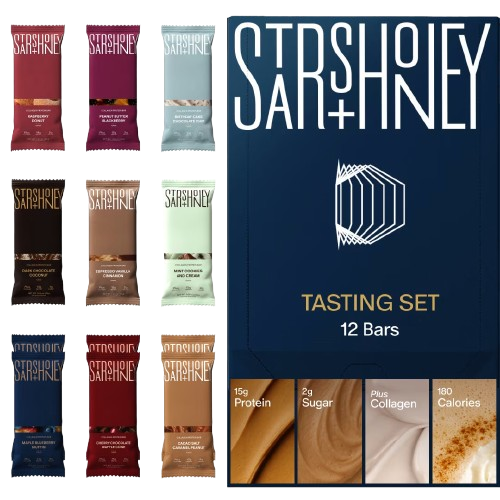
Beauty + braun. Stars + Honey, a collagen protein bar brand, raised a $24M minority growth equity round from VMG Partners to fuel national retail expansion and a new 60,000 sq. ft. facility. The brand hit 300% growth last year exclusively on Amazon and DTC, and is targeting ~$50M in 2026.
Stars + Honey bars deliver 15g of protein in 18 chef-inspired flavors, like Espresso Vanilla Cinnamon and Cherry Chocolate Waffle Cone. They’re formulated with Type I and Type III grass-fed bovine collagen peptides, intended to “support skin elasticity, hair health, and joint comfort to optimize health.” But flavor variety and innovation is clearly a key focus for the brand, which emphasizes its culinary appeal with sensory imagery.
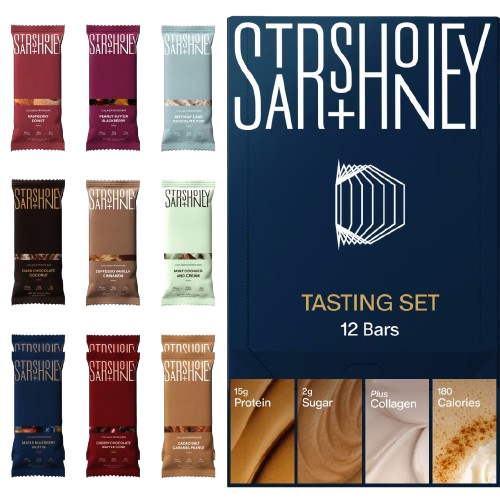
If you’re thinking “18 flavors sounds like a lot,” fair. That was all made possible by in-house-led flavor development and vertical integration of the brand’s supply chain, giving Stars + Honey end-to-end control of production and innovation.
Microgreens, macro moves. AeroFarms, the leading U.S. microgreens supplier, has been acquired by an affiliate of Palm Ventures, an Austin-based family office. The deal—completed April 2026, terms undisclosed—brings new CEO Gustavo Burger (ex-Kraft Heinz, AB InBev) and a push to expand beyond its current ~2,000 retail locations.
Instant coffee, but make it gourmet. Diamond Brew raised an oversubscribed seven-figure pre-seed for its “brewless,” flash-frozen espresso pods (a craft-made version of instant espresso), with backing from G/7 Venture Studio, CPG operators, and NFL players including DeAndre Hopkins and Sean Clifford.
This is a brand that attributes a lot of its growth to an emerging platform: live shopping. In 2025, Founder & CEO Douglas Yu spent over 2,000 hours on TikTok Live. There, he gathered insights on his customers’ shopping behaviors that informed his whole strategy with the brand.
If you haven’t yet, please subscribe, like, leave a comment, and share it! It helps us continue to bring you the most interesting news + nuance in consumer and retail every week.