



Hello hello!
Your next best-performing ad may just already be in a creator’s camera roll.
These days, Meta CAC keeps climbing... while shipping and product costs chip away at every order, and your ad team still needs fresh creative every single week. 🙃
The brands getting ahead are pulling more out of just one relationship: the creator who posts about your product because they genuinely like it.
SARAL is built to run that whole program, from finding the right creators and seeding product to tracking which posts actually sell. The ones that perform become Meta partnership ads straight from the creator’s handle, and with newly launched Shoppable Feeds, those same videos land on your homepage, tagged and ready to buy.
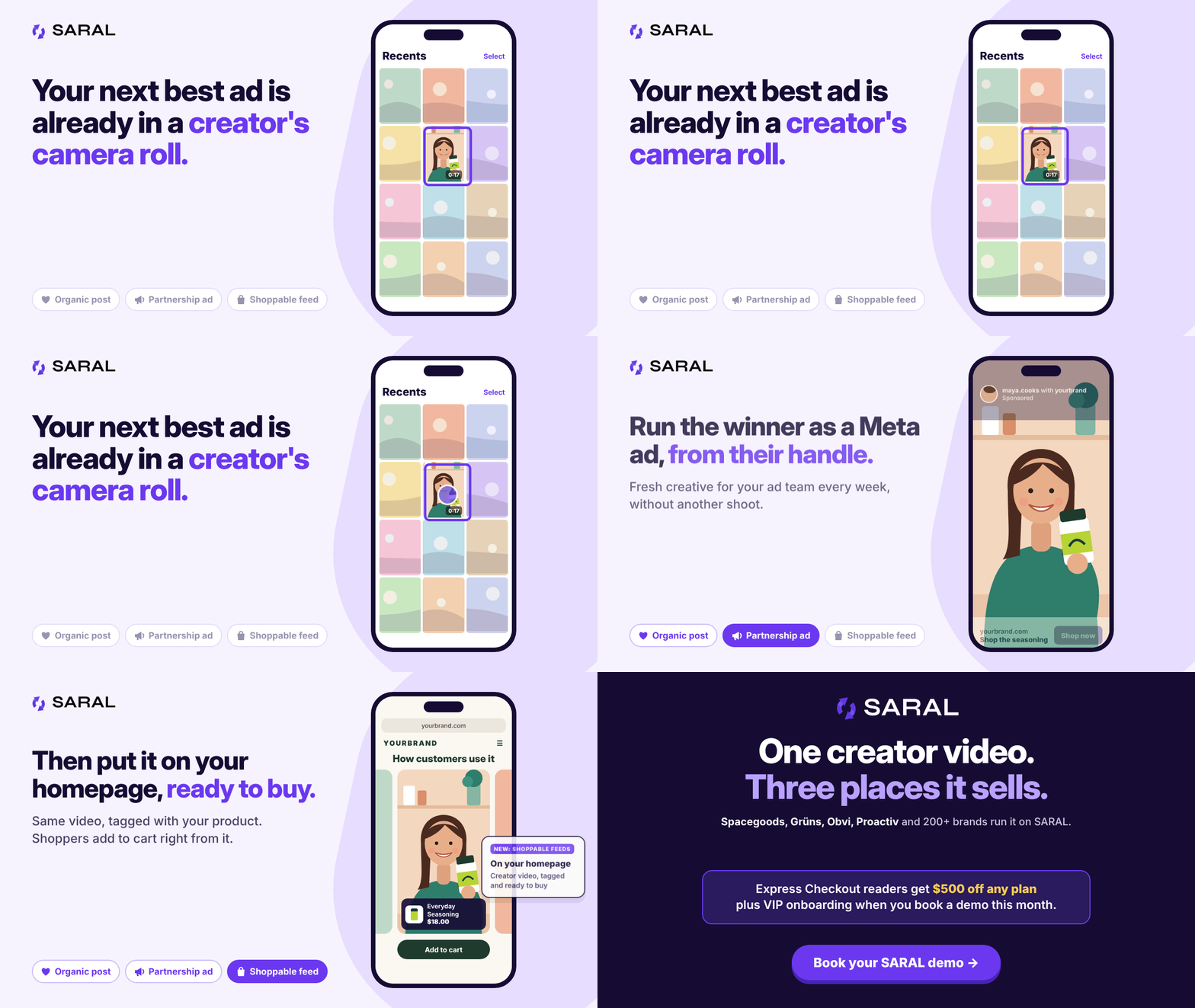
Spacegoods, Grüns, Obvi, Proactiv and 200+ other brands are using SARAL to build a sustainable + profitable growth channel with influencers.
EC readers who book a demo this month get $500 off any plan, plus VIP onboarding, migration support and ongoing strategy sessions!!
Book your personalized SARAL and get $500 OFF!
What we’ve been thinking about…
Hey @gummy supplements… there’s another format coming for your gig.
Goli Nutrition, the wellness brand largely known for turning non-vitamin supplements into gummies (like apple cider vinegar or ashwagandha), launched a line of supplements in a new format: jelly stick packs.
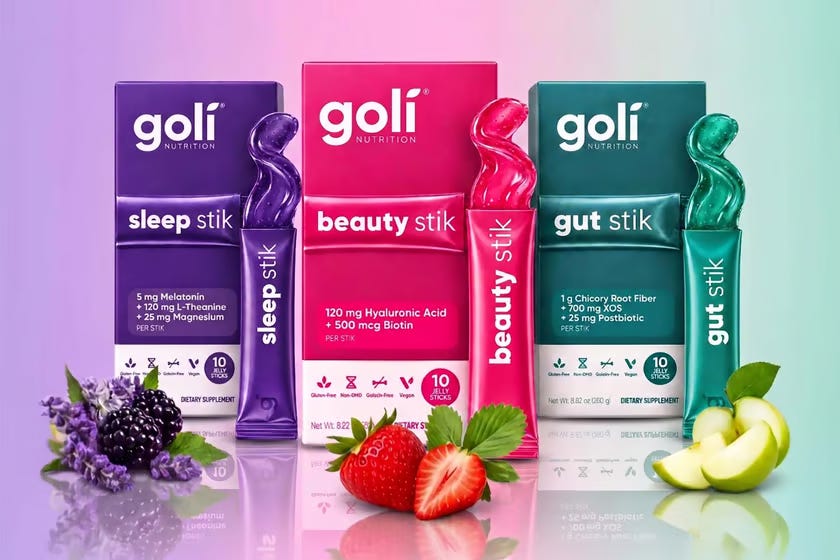
Jelly sticks (or, in Goli’s case, “stiks”) are packaged like a single-serve powder stick, but squeeze out as a soft, fruity jelly. Goli’s line includes Beauty Stik (hyaluronic acid, biotin), Gut Stik (fiber, prebiotics, postbiotics), and Sleep Stik (melatonin, l-theanine, magnesium).
When Goli changes formats, pay attention. The last time Goli brought new functionality to a format, it was the very start of a supplement boom.
In 2019, it launched what it called the world’s first ACV gummy, which set the stage for non-vitamin supplements everywhere to go gummy. By 2021, Goli was doing an estimated $438 million in sales.
We’ve talked ad nauseam about the “gummy-ification” of wellness, but the boom is hard to overstate. Last year, gummies were the top-selling supplement format in the US, at 24.6% of all sales, ahead of powders (18.7%) and every kind of pill.
So if Goli is launching jelly sticks, more US supplement brands will (likely) follow. And this time, the conditions are already in place.
The timing is perfect. Jelly sticks sit right where two trends meet: the “beautrition” trend Whole Foods Market called out in its 2027 Trend Report, and the K-beauty boom. In Korea, where Goli is manufacturing its stiks, the format is basically a staple. Social video reviews, plus (controversial) celebrity moments like Kylie Jenner featuring Korean brand Foodology, turned Korean “cutting jellies” (fiber jellies, also dubbed “Korean Ozempic” online) and collagen sticks into global trends over 2025 and 2026.
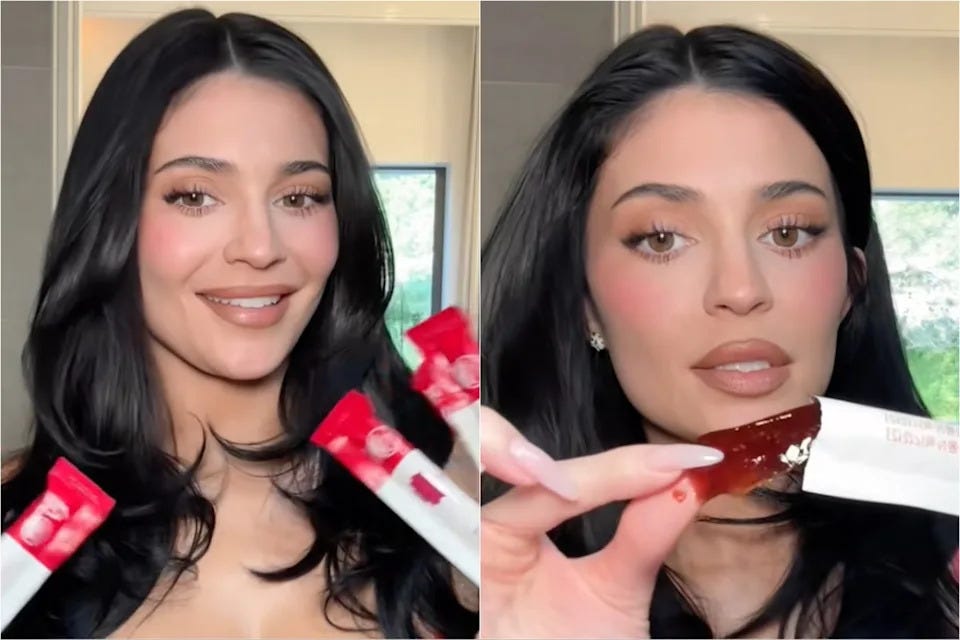
Now, US brands are starting to bring them stateside:
Starting with fiber jellies. In June, Ponlu launched The Jelly Stick, a pomegranate-flavored mix of konjac, chia, and prebiotic fiber pitched for gut health and fullness. It looks a loooot like Korea’s viral Coleology Cutting Jelly. Last month, Physician’s Choice launched Fiber Jelly on TikTok Shop, then in Walmart stores nationwide.
The probiotic brand is best known for capsules, enzymes, and a fiber powder, with an almost private-label vibe, so the bright, fun jelly is a sharp turn. Its marketing even pitches the jelly as the fix for “messy powders, pills taken multiple times a day and sugar-loaded gummies”… all of which Physician’s Choice sells.
And closely followed by beauty jellies. In August, Mimitime, a new brand from Cocokind founder Priscilla Tsai and beauty creator Ava Lee (Glow With Ava), launched collagen-infused konjac jelly exclusively in Target’s beauty aisle. Target has already committed to more than doubling its footprint in January 2027.
The manufacturers are ready. This spring, contract manufacturer Cosmax NBT started offering jelly stick packs to US brands, so any brand can launch one without building the capability itself, which is how formats scale.
The format is finally fit for efficacy. The manufacturer’s pitch is that gummies, for all their popularity, come with performance problems, and the sheer volume of a jelly stick fixes them:
A standard gummy weighs about 3 grams, while a jelly stick serving is 25 to 30, roughly eight to ten times the room. Brands can use that space to cut sugar and to add ingredients that never really fit in a gummy, while maintaining the playfulness, taste, and joyful experience of gummies.
Goli caught gummies right before the boom. This time, with jelly sticks, it has company: two trends pulling in the same direction, manufacturers ready to make it, and a format that can actually deliver on its promises.
Gummy supplements, consider yourselves on notice. 👀
CPG & Consumer Goods

Does every founder have to be an influencer? In Stock, Shopify’s Substack newsletter, answers that question in its a recent piece, featuring founders from brands like Sourmilk, Biena Snacks, Fly By Jing, Pistakio, and Honey Dept. Subscribe for a regular peek behind the news and into the real stories from the front lines of entrepreneurship.*
The perfect drink for a F1 driver. Lewis Hamilton’s non-alcoholic agave brand Almave launched ready-to-drink Margaritas and Palomas exclusively at Target, hitting around 1,100 stores.
The broader NA space is still finding its footing after all these years, but it’s surprisingly growing. US retail sales of alcohol alternatives rose 14.6% to $1.08B in the 52 weeks through June 27, according to NIQ. Zero-ABV beer still dominates though, accounting for 80.8% of sales and growing 12.2%; NA wine made up 11.7% and grew 17.8%. NA spirits, including ready-to-drinks, were just 7.5% of the market—but grew 40.7%. And within that smaller segment, RTDs made up 75% of sales and grew 61.5%.
It’s easy to see why Mr. Hamilton and team want in on RTDs. Almave’s bottled Blanco has been on Target shelves for almost a year, but a bottle of NA spirits asks a lot shoppers to commit to. A canned beverage makes trial so much simpler for a consumer, and gives the brand more room to flex beyond the home, from bars, to restaurants, and to events. With RTDs driving so much of the growth in NA spirits, this is a smart way to bring Almave to more people and more occasions. But the real test will be to see how it tastes 👀
Another one for the “hard sports drink” aisle. Big Sipz, the convenience-store party drink brand from Patco Brands, announced Lyte Ade, its first vodka-based drink. It’s a non-carbonated mix of vodka and coconut water at 5% ABV with 100 calories and zero sugar, and it comes in a 500ml resealable Tetra Pak in Fruit Punch, Watermelon, and Orange Crush. It hits shelves in select states in mid-February.
If this sounds familiar, it’s because we wrote about the hard sports drink boom just last month, when White Claw’s parent launched RefreshAde and Constellation paid $75 million for SpikedAde. Now there’s a “Lyte Ade” sitting next to Super Lyte and SpikedAde (subtle!).
Protein coffee is coming for your breakfast:
Oats Overnight, the brand behind the shake-and-go protein oats, launched sub-brand oon Iced Protein Coffee exclusively at about 1,310 Target stores. Each packet has 10g of protein and 100mg of caffeine.
Jordan’s Skinny Mixes, the sugar-free syrup brand, just introduced Protein Barista Mix, a dairy protein creamer in French Vanilla, Caramel Macchiato, and Sweet Cream. A full serving has 20g of protein and less than 1g of sugar and sweetened with Stevia. It’s interesting to see a syrup brand delve into dairy (a whole other complicated supply chain) for the sake of launching a protein creamer SKU—turning this brand into a platform brand for at-home coffee rather than a syrup brand.
And just a few weeks ago, Clean Simple Eats launched Protein Coffee + Collagen, a coffee protein powder that smushes all of the coffee trends in one product: collagen, protein, l-theanine, and low-caffeine (only ~45mg caffeine per serving).
The protein coffee—or “profee”—trend isn’t anything new. But it seems like this has moved from a ready-to-drink, impulse-buy trend (Super Coffee; Premier Protein) to a cafe option (Starbucks; Dunkin). Now, brands are serving the protein trend to at-home coffee consumers, and Javvy Coffee is a great example of the potential of this category: While Javvy originally launched with liquid coffee concentrates, it was the brand’s pivot to protein coffee and creamers (DTC launch in 2023; retail launch in 2025) that skyrocketed it to a potential $1 billion sale (reportedly explored earlier this year).
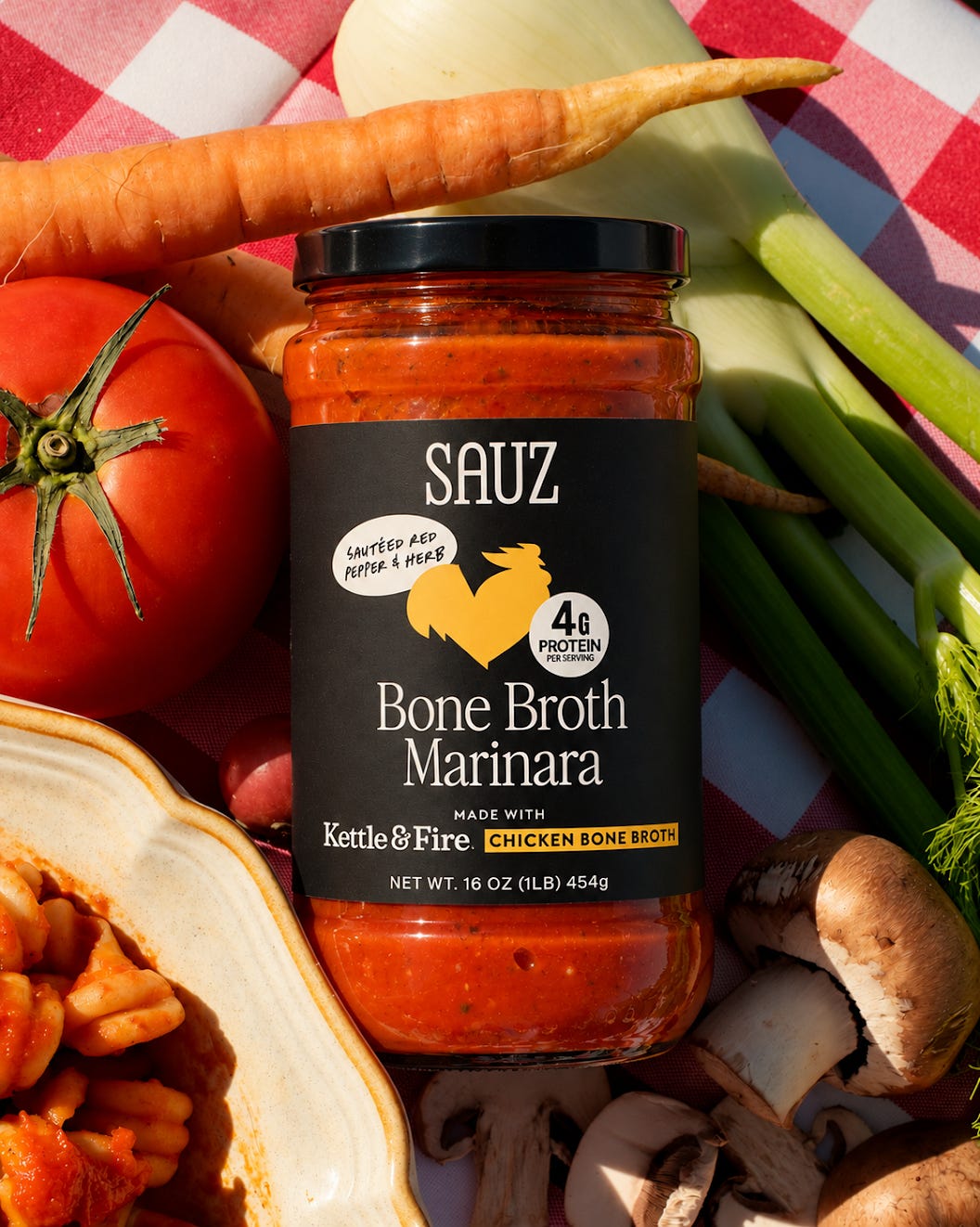
SAUZ goes for protein. SAUZ, the colorful pasta sauce brand with refreshingly modern flavors, collaborated with bone broth maker Kettle & Fire on two Bone Broth Marinara sauces: chicken bone broth with sautéed red pepper, and beef bone broth with caramelized onion. Each 16oz jar has 16g of protein (equating to 4g protein per serving), and will be available online and at Kroger.
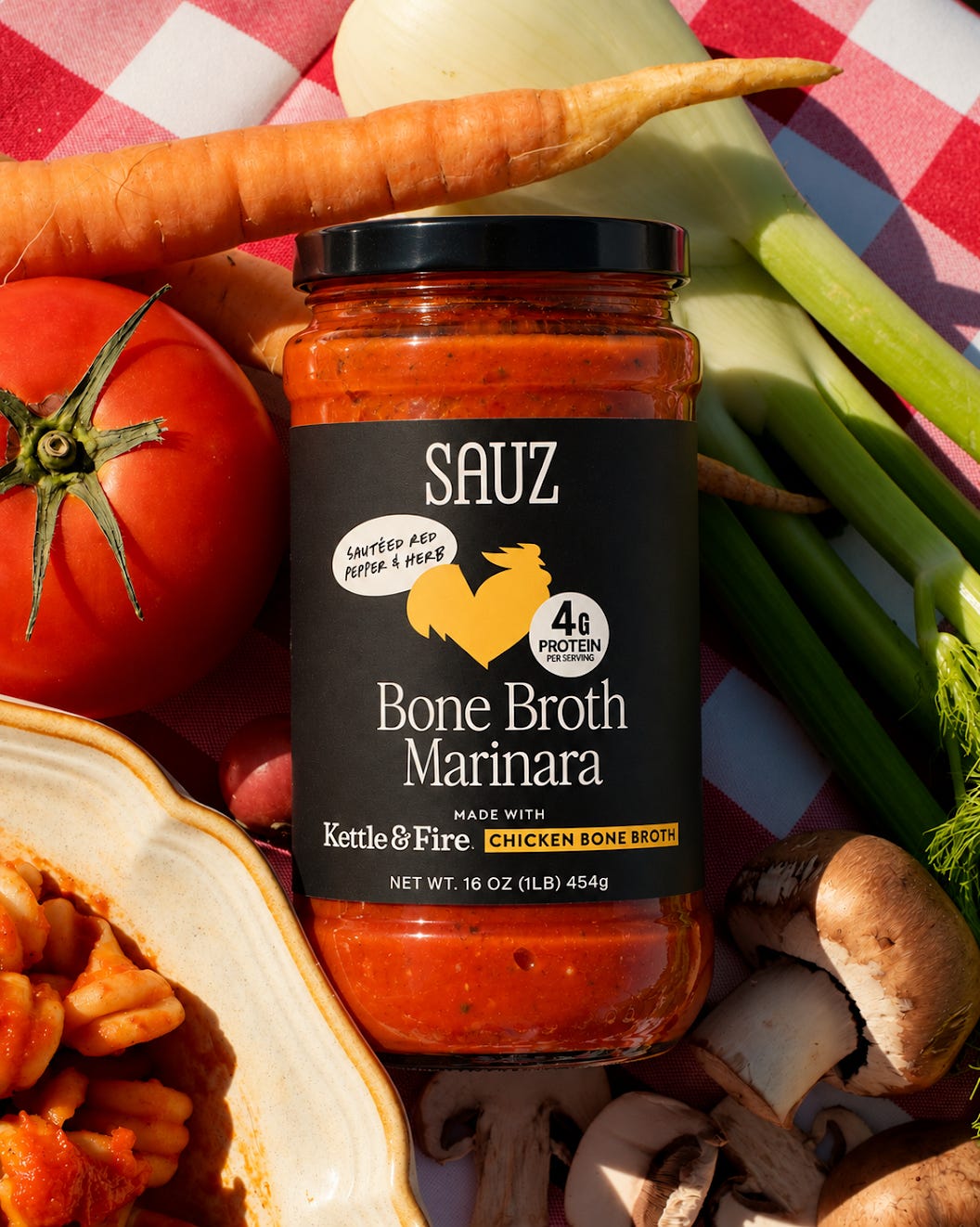
Protein pasta sauce isn’t new. people have proteinmaxxed every product. Sturdy Sauce has been doing this since at least 2024 with a whopping 80g of protein per jar, but that comes from added whey, which is exactly what SAUZ says it wanted to avoid. 4g per serving won’t win over the protein-maxxers, but SAUZ is trading grams for a cleaner label.
But SAUZ isn’t first to bone broth, either—Noodo (a brand built entirely around bone broth tomato sauce) rolled into 1,000 Target stores just last month. What’s interesting is that Noodo actually doesn’t promote the protein perk of added bone broth, only the richness in flavors it offers.
While bone broth itself may not be the shelf standout here, the branded collaboration is a pointed choice. SAUZ could’ve added bone broth as an ingredient, but instead, it partnered with a beloved bone broth brand that already has its own brand loyalists. If this collab product pulls incremental sales, we’d guess it’s actually more about the Kettle & Fire brand recognition than the few grams of added protein per serving. (That’s also likely why SAUZ ditched its typical bright colors for this matte black label, more reminiscent of K&F’s branding.)
Chicken is the new protein powder. Buffy Protein just rolled out its high-protein chicken dips to 488 Sprouts Farmers Market stores across 25 states. The dips are made with real chicken and cottage cheese, come in Buffalo and Lemon Pepper, and land at ~10 grams of protein and ~80 calories per serving in an 8 oz tub.
Call it a case of being whey’d out. Protein is popping up in just about everything, and brands are finding ways to get it from animal-based ingredients people already know, which beats adding another dozen scoops of powder.
As we shared here, WILDE is a prime example of this, and the clearest sign that shoppers actually want this. The brand sells chips and crackers made from chicken breasts and grew to more than $100M in retail sales and is now sold in over 30,000+ doors nationwide. The brand also just raised $40M last month to keep growing and expanding.
Protein dip seems to be a burgeoning category, too. The buzzy-brand sides of the internet (as well as specialty grocer shoppers in the Northeast) with the buzzy brand Cotto, a whipped cottage cheese dip brand, launched in March in French Onion, Buffalo, and Garden Ranch.
Coconut water is having a moment (again). Coaqua, a fast-growing canned coconut water brand, is now in more than 3,000 Walmart stores with nine SKUs, plus 500+ grab-and-go coolers at the front of select stores. It’s the brand’s biggest retail expansion to date.
Coaqua was originally founded in New Zealand in 2013 and brought to the US by its current owners, who bought the brand at the end of 2024, rebranded it, and launched new varieties. It sources coconut water from young green coconuts grown on family farms in Vietnam’s Mekong Delta. Coaqua told Express Checkout its dollar velocity grew 140% year over year and that it was the #1 coconut water in Northeast grocery earlier this year. It also says it made more revenue this July than in all of 2022. The brand is sold at retailers including Sprouts, Wegmans, H-E-B, and Circle K, as well as on Amazon.
Coconut water is a shockingly burgeoning space right now, and you can see it in the category leader’s numbers. Vita Coco just reported Q3 net sales of $244 million, up 34%, with its namesake coconut water up 15%. It also raised its full-year sales outlook to $810–$820 million. Co-founder Michael Kirban called coconut water “one of the fastest growing beverage categories” in its major markets, and credited more US households buying it and drinking more of it. For a drink a lot of people wrote off as a 2010s fad, that’s quite the second act.
Vita Coco still dominates, sure, but there are A LOT of other players chasing that growth. Once Upon a Coconut has been everywhere this year, launching at Costco across the Southeast and Texas, and partnering with L.A. Libations ahead of an Albertsons rollout. It also signed basketball star Sophie Cunningham. And ZICO is making a comeback, too. Its founder sold the brand to Coca-Cola in 2013 at the height of the first coconut water craze, then bought it back in 2021, and this year it got its Pure version into Target and added a Pineapple Mango flavor
Your hair deserves its own perfume. The celebrity hairstylist is back with Otherwise, a hair fragrance brand that just launched at all 611 Target Beauty Studios across the country. The alcohol-free line features 14 scents at $25 each, made with a micellar water base and designed to be worn alone or layered.
Ess’s argument is that the shelf is full of hair and body mists, but nothing made solely for hair. Most of those mists are alcohol-based, and she wanted something more nourishing for the category she knows intimately. She has a point. Even Kitsch, a full-on haircare brand, sells its mists as “Hair & Body” and even tells you to spritz them on your pillowcase too. Ess says there’s plenty of data on hair and body mists and almost none on fragrance just for hair, but we’d trust her gut on this one.
Kristin Ess Hair (the brand) launched as a Target exclusive in 2017 with incubator Maesa, and in 2023 she sued Maesa to get the rights to her own name back (they reached an undisclosed agreement). Otherwise is the first brand from Starseed Beauty Brands, her new holding company, where the plan is more hair-adjacent launches that stay small and stay hers.
Speaking of hair and body mists… clean fragrance brand Skylar brought back its hair and body mists two years after discontinuing them. The three scents—Banana Candy, Black Sugar, and Night Boss—are $30 each on Skylar’s site and Sephora.com.
The relaunch comes from Love Island USA star Leah Kateb, who joined as “refounder” and chief creative officer in July 2025. Skylar says their revenue nearly doubled to $7.1M in the first half of 2026.
Stoli’s second act. Stoli Group announced its return to the US after completing its Chapter 11 restructuring and settling with creditors of its US arm. It’s coming back with a bigger lineup that adds Moskovskaya vodka, two tequilas, and two Irish whiskeys, and it’s exploring a non-alcoholic Stoli Ginger Beer.
eCommerce
Is TikTok Shop the new Amazon Prime? TikTok Shop is piloting a paid membership tier called TikTok Shop Plus, which rolled out to 1 million people on Saturday. Members get free shipping and exclusive discounts (among other perks), and after a 30-day free trial it costs $9.99 a month.
It’s a pretty clear comparison: Amazon Prime runs $14.99 a month, so TikTok is coming in about a third cheaper. And the membership is one more piece of a full Amazon-style stack. TikTok Shop launched a stand-alone shopping app in some markets (no word yet on a U.S. date), and this fall it added UPS’ Happy Returns, so shoppers can drop returns at 10,000 Return Bars with no box or label.
Brands: stop sleeping on TikTok Shop!!! TikTok Shop made up nearly 20% of social commerce by the end of 2025, and sales are expected to pass $20B this year and $30B in 2028.
Right now, most of TikTok Shop sells is an impulse buy you stumble on while scrolling. Paying $9.99 a month gives people a reason to open the app to shop, and that’s the habit Amazon built Prime around. For brands, the thing to watch is who pays for that free shipping as the program grows. If it follows Amazon’s path, sellers will end up covering more of the cost of keeping members happy.
Funding, Mergers, and Acquisitions
Salmon chips find a home. Core Home, the company behind a range of housewares, beauty, pet, and toy products, bought Tochi Snacks for an undisclosed amount. Tochi makes salmon chips and coconut oil popcorn in flavors like ube, milk tea, and black sesame. The deal is part of Core Home’s push into food and beverage, where it already owns bubble tea brand BUBLUV.
The smoothie bowl aisle consolidates. Sambazon, the açaí brand, bought Pitaya Foods, which sells frozen dragon fruit, smoothie bowls, and smoothie pops at Whole Foods, Costco, and Target. Sambazon says the deal lifts its retail reach by 20% and puts it in almost 70% of US grocery stores.
In 2024, Sambazon bought SunOpta’s frozen açaí and smoothie bowl business, a deal pitched as doubling production for ready-to-eat bowls. First it bought the factory capacity, and now it’s bought a brand with more fruit and more formats.
What Sambazon is buying is formats. Pitaya adds fruit flavors and product formats to the company’s range, in luding ready-to-eat smoothie bowls, smoothie pops, and bite-sized pieces of dragon fruit and avocado. Sambazon has been expanding formats on its own, too: pre-topped bowls last year and scoopable açaí this year. Together, the two companies can stock most of the frozen smoothie set.
Mars attacks (its capex budget). Mars, the company behind M&M’S, Cheez-It, Pedigree, and Royal Canin, plans to invest about $1.4B in its U.S. manufacturing and operations in 2027, the most it has ever spent in a single year, per the company. That’s on top of more than $9B since 2017, and Mars says 94% of the products it sells in the U.S. are made here.
Mars is putting much of the money behind its fastest-growing brands… and one star of that show is better-for-you brand Trü Frü, which Mars acquired in 2023. Mars spent $60M on two dedicated Trü Frü lines inside its Salt Lake City factory (the $240M site it opened last year for Nature’s Bakery), which can now make 17 million frozen Trü Frü products a year.
Sweet proteins find a bigger home. Amyris, the biomanufacturing company that came out of bankruptcy in 2024 as a B2B ingredient business, is acquiring Oobli, which makes sugar replacements from sweet proteins (through precision fermentation). The acquisition amount was not disclosed.
Sugar reduction is one of the biggest asks in food right now, and Amyris has been missing a sweetener since it stopped making Reb M (the stevia compound) for Ingredion. We spoke about Oobli’s most recent (brilliant) innovation on the podcast (at minute 7:09)!
A big week for protein powder:
Montreal-based Good Protein, which makes plant-based protein shake powders, raised around $90M led by Semcap Food & Nutrition, with Del Monte also participating. It’s sold in about 4,500 Canadian stores, including Costco and Walmart, and plans to use the money to expand beyond Canada.
Semcap previously backed Purely Elizabeth (headed to Ferrero for $850M) and Good Culture (sold to L Catterton for $500M+).
What’s different about this brand (from the 1829384 other protein powders) is that it’s touted as an all-in-one plant-based situation, featuring over 20 vitamins, minerals and micronutrients per serving from a blend of 19 fruits, vegetables and mushrooms, plus probiotics and digestive enzymes. It comes in in 15 (!!) flavors and clear protein sachets.
Scoops, the Colorado brand making plant-based protein powder from peanut protein isolate, raised $2M in a seed round led by James Weil. Its powder packs 27g of protein per serving, and the brand is now sold in more than 1,600 Target stores.
Founder Elizabeth Lane (a Huel and Magic Spoon alum) has a pretty uncommon story when it comes to launching this brand. She apparently walked into Target with some branding and a single sample, hoping to land a 250-store test, and walked out with 1,100 doors. Since then, monthly sales reportedly have gone from $25,000 at launch to $400,000 this September.
I (Jenna) wrote about Scoops earlier this year when covering the whey protein shortage! This brand is a fascinating solution to the whey protein problem: a first-to-market ingredient (peanut isolate) made from an existing (and robust) agricultural supply chain. This is a perfectly-timed brand, with favorable macros and zero reliance on a dwindling supply, plus consumer familiarity of peanuts as a beloved flavor + nutrient-dense food.
If you haven’t yet, please subscribe, like, leave a comment, and share! It helps us continue to bring you the most interesting news + nuance in consumer and retail every week.